





 Portuguese
  English
  Spanish
  7 min of reading
  0 comments


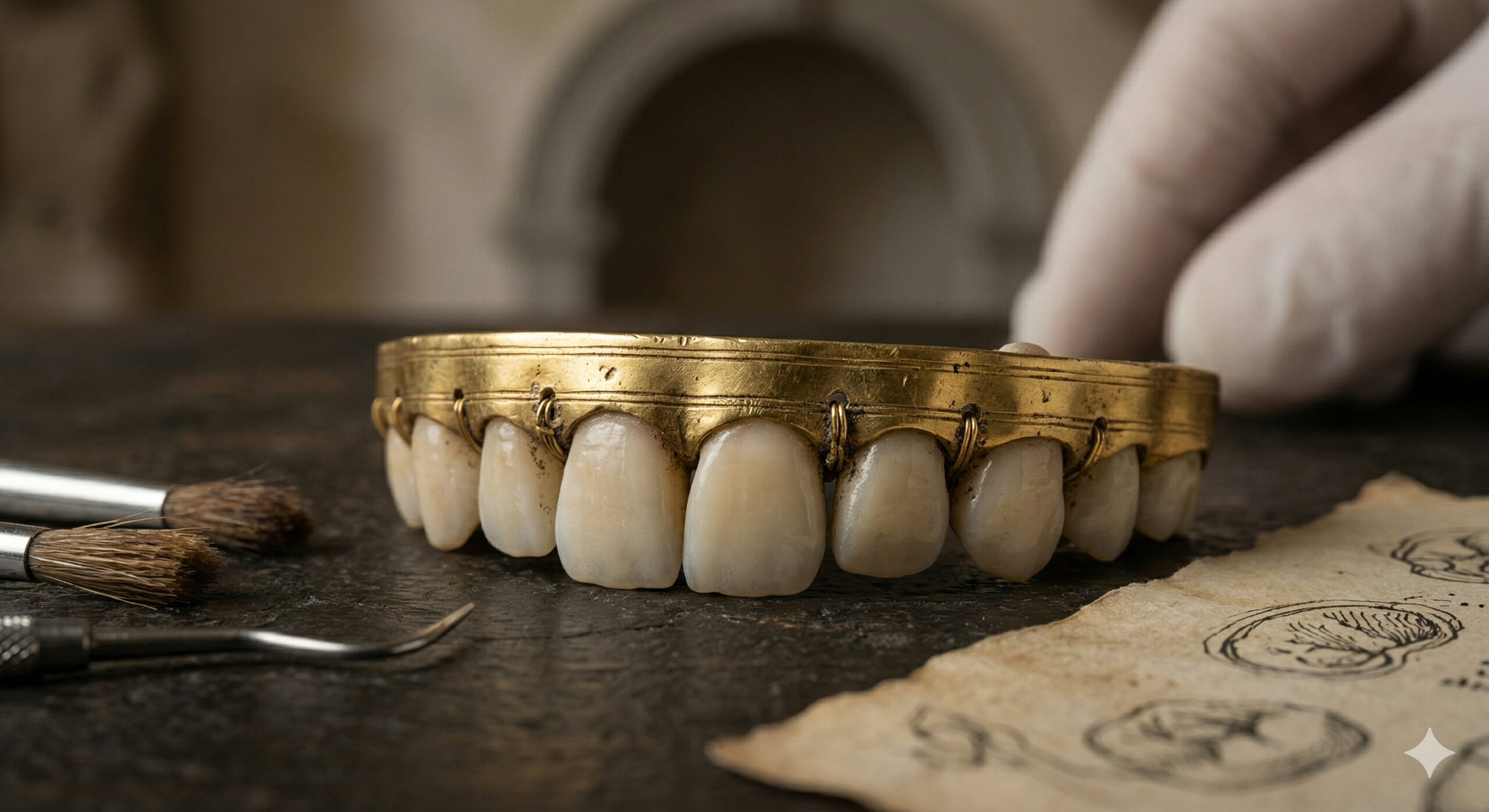
Study reveals dental prosthesis from Tuscany with human teeth fixed in gold between the 16th and 17th centuries, indicating advanced dentistry in the Modern Age.
In Tuscany, more precisely in Lucca, a gold dental prosthesis discovered by archaeologists revealed an unexpected technical level in dental practice during the Modern Age. The finding was described in a study published in the journal Clinical Implant Dentistry and Related Research and indexed in PubMed, which analyzed a structure made up of five human mandibular teeth attached to a gold plate shaped to replace the anterior portion of the dental arch.
The device, found during excavations at the Monastery of San Francesco in Lucca, demonstrates that techniques of oral rehabilitation were already employed with considerable precision long before the consolidation of modern dentistry in the 19th century. According to the study, the piece underwent macroscopic and microtomographic examinations, which even identified small gold pins used to secure the teeth to the internal structure of the prosthesis.
The discovery indicates that complex dental replacement procedures had been in use for over 400 years. Although precise archaeological dating was not possible, the authors point out that some elements suggest manufacturing in the early 17th century, reinforcing the existence, at that time, of practical knowledge of fixation, adaptation, and material selection in sophisticated dental interventions.
-
After 200 years, blue and yellow macaws return to Rio with the release of 4 birds in Tijuca Park.

-
The glaciers of the Himalayas are melting faster than any previous forecasts indicated, and scientists warn that changes in the monsoons could leave millions of people without drinking water, irrigation, and energy in India, Nepal, and Bangladesh.

-
Every day, before the sun rises, tractors go out to clear a road that the desert tries to swallow throughout the night, because in the United Arab Emirates there is a highway that cuts through the largest continuous sand sea on the planet, passing alongside dunes 300 meters high and melting the soles of any shoe that touches the asphalt in the summer.

-
In León, potholes become craters and burst tires and suspensions, but the city hall blames the drivers, saying that the road was marked and that at 30 km/h it was possible to swerve, and they only cover at most half of the repair costs.

Structure of the prosthesis combined real human teeth and molded gold band
The analyzed prosthesis was composed of five human mandibular teeth, possibly from donors, connected by a gold band that served as a structural base.
The gold was chosen not only for its value but for its physical properties: corrosion resistance, malleability, and relative biocompatibility.

The metal band was shaped to follow the curvature of the dental arch, allowing for a more stable fit in the user’s mouth.
This type of construction reveals technical mastery over materials and sufficient anatomical understanding to partially reproduce chewing function. Additionally, the presence of multiple connected teeth suggests an attempt to restore not only aesthetics but also functionality.
Fixation technique indicates practical knowledge of stability and oral adaptation
The study points out that the prosthesis was not simply loosely fitted. There was a fixation system, likely involving metal wires or ties to the remaining teeth.
This method allowed the piece to remain relatively stable during use, avoiding constant displacements. Although rudimentary compared to current standards, the system demonstrates a clear understanding of the need for efficient fixation.
The presence of a functional anchoring mechanism indicates that the prosthesis was designed for real use, not just as an aesthetic adornment. This detail is crucial to differentiate the artifact from mere decorative or symbolic pieces.
Use of human teeth reveals historical practice of biological reuse
The use of natural human teeth in the prosthesis indicates a practice that would become relatively common in later periods, especially in 18th and 19th century Europe. These teeth could be obtained in various ways, including extractions or even informal trade.
In Modern Age Tuscany, this type of practice suggests that there was already a market or network for obtaining biological materials for medical purposes.
The reuse of human teeth reinforces the idea that dentistry was already operating with practical and adaptive solutions in the face of a lack of synthetic materials. The approach demonstrates technical creativity in the face of technological limitations.
Historical context shows gradual advancement of dentistry before the scientific era
During the 16th and 17th centuries, dentistry was still not a formalized discipline as an independent science. Many procedures were performed by barber-surgeons or specialized craftsmen.
Even so, evidence like the Tuscan prosthesis indicates that there was a body of empirical knowledge in development. Dental treatments included extractions, drainage of abscesses, and, in more advanced cases, attempts at dental replacement.

The existence of a functional prosthesis during this period suggests that more sophisticated practices were already being tested and applied in clinical practice. This broadens the understanding of the technical level of medicine in the Modern Age.
Choice of gold reveals knowledge of materials and durability
The use of gold in the prosthesis was not merely an aesthetic or social status issue. The material has ideal properties for use in the human body, such as resistance to oxidation and ease of molding. These characteristics allowed for the creation of structures adapted to the patient’s anatomy without immediate risk of degradation.
Additionally, gold does not easily react with bodily fluids, making it safer for prolonged use.
The choice of material indicates that there was practical knowledge about which substances were most suitable for internal applications in the human body. This type of decision reinforces the technical nature of the piece.
Dental prosthesis suggests concern with chewing function and aesthetics
The partial reconstruction of the dental arch with multiple teeth indicates that there was concern not only with appearance but also with the ability to chew food.
The loss of teeth directly compromises nutrition, especially in historical periods with stricter diets. The prosthesis could improve chewing efficiency, contributing to the overall health of the individual.
This demonstrates that oral rehabilitation was already seen as a functional necessity, not just aesthetic. This aspect brings the ancient practice closer to the principles of contemporary dentistry.
Finding reinforces that oral rehabilitation was already more advanced than previously thought
For a long time, it was believed that effective dental prostheses only began to emerge consistently from the 18th century. However, discoveries like the one in Tuscany indicate that structured attempts had already been occurring centuries earlier.
The complexity of the piece, both in terms of materials and execution, suggests an underestimated technical level. The prosthesis challenges the idea that pre-modern dentistry was limited to simple and rudimentary procedures. This type of evidence contributes to reevaluating the history of medicine.
The analysis of the prosthesis was made possible thanks to modern techniques, including microscopic examinations and comparative studies with other historical pieces.
These tools allow for the identification of details that would have previously gone unnoticed, such as signs of use, wear, and manufacturing techniques. Thus, it is possible to reconstruct not only the object but also its context of use.
The application of modern technology to archaeology has revealed levels of technical sophistication in historical periods that were previously considered limited. The process continues to expand knowledge about the evolution of medicine.
Comparison with other historical prostheses shows continuity of development
The Tuscan prosthesis can be compared to other historical examples, such as older Etruscan dental prostheses and later European devices.
These comparisons indicate a continuity in the development of oral rehabilitation techniques over the centuries. Although methods have evolved, the basic principle of replacing lost teeth remains the same.
The discovery reinforces that dentistry is the result of a continuous process of experimentation and improvement throughout history. This connects ancient practices to current technologies.
Dental rehabilitation in the Modern Age reveals adaptation in the face of technological limitations
Without access to synthetic materials, modern anesthesia, or sterilization techniques, professionals of the time had to adapt solutions with the resources available. The prosthesis made of human teeth and gold represents one of these solutions. Despite the limitations, the result demonstrates reasonable functionality and durability.
The ability to develop effective solutions with limited resources highlights a level of innovation that is often underestimated. This type of adaptation is one of the driving forces behind technological advancement throughout history.
The dental prosthesis found in Tuscany shows that the search for solutions to tooth loss is much older than previously thought. It evidences that there was already a concern for quality of life, functionality, and adaptation of the human body.
This type of finding broadens the understanding of how medicine evolved not only through major discoveries but also through practical solutions developed over time. The history of dentistry, in this context, reveals itself to be more complex and continuous.
To what extent did ancient medicine already master solutions that we consider modern?
The analysis of prostheses like this raises a relevant question: how many other advanced techniques may have existed in the past and have not yet been fully understood? The limitation of historical records may hide a significant part of this knowledge.
Archaeology and medicine continue to reveal that many solutions considered modern have roots much older than previously thought.
In light of this, an inevitable debate arises: how far does the real level of technological sophistication that existed before the consolidation of modern science go?








Seja o primeiro a reagir!