





 Portuguese
  English
  Spanish
  5 min of reading
  0 comments


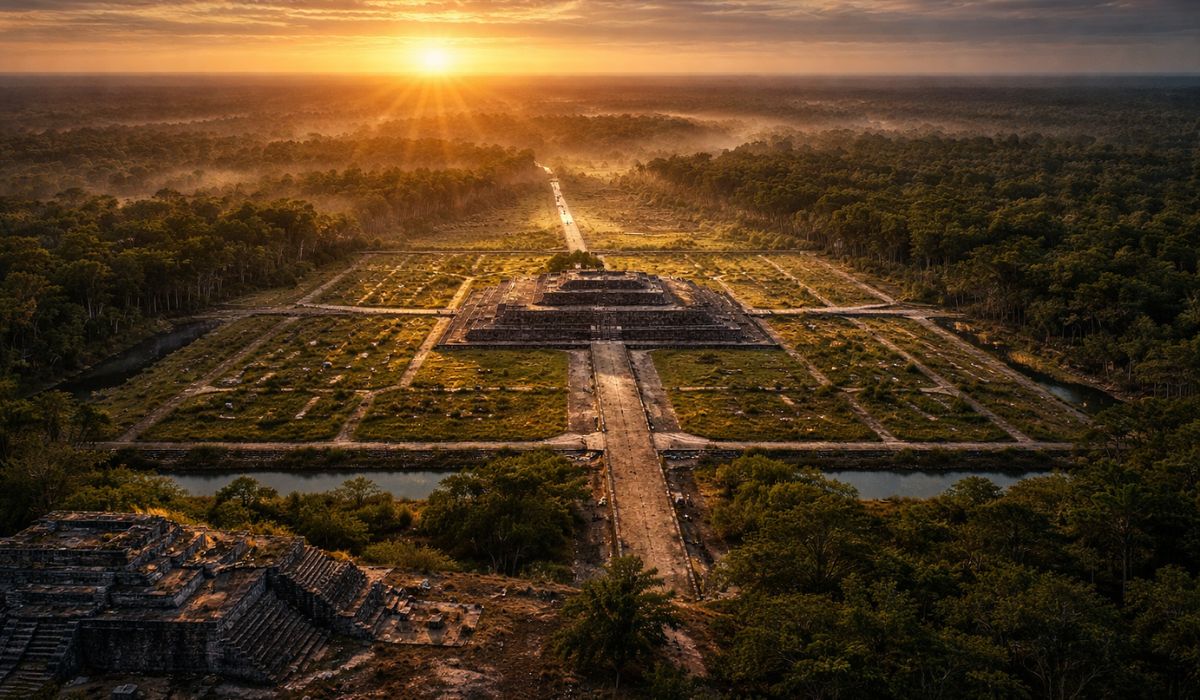
A monumental site in Mexico rekindled discussions about astronomy, social organization, and landscape engineering among the ancient Mayas, with an interpretation that connects architecture, symbolism, and rare-scale mapping technology in Mesoamerican archaeology.
Aguada Fénix, in southeastern Mexico, has returned to the center of archaeological debate after a study argued that the site was not just a monumental construction of the Maya tradition, but a large cosmogram created to represent the order of the universe.
According to the authors, the complex, dated between 1050 B.C. and 700 B.C., was planned with axes, channels, elevated passages, and structures arranged in a cross, on a scale comparable to or even larger than that of later Mesoamerican cities.
The work was published in the journal Science Advances and is led by archaeologist Takeshi Inomata from the University of Arizona.
-
Japan wants to build a solar ring of 10,900 kilometers on the Moon to continuously send energy to Earth.

-
Weighing almost 1 ton, with temperatures of up to 3,000°C, the ability to launch 10,000 fragments within a radius of 1 km, capable of penetrating concrete and melting steel, Turkey’s terrifying bomb emerges as one of the most destructive non-nuclear weapons ever presented.

-
After a submarine disappeared beneath the “Doomsday Glacier,” scientists announce a new monstrous machine capable of operating at 3,000 meters depth to return to the heart of the ice and investigate a threat that could raise sea levels worldwide.

-
NASA has set a date for the beginning of the end of Earth, and it won’t be an asteroid or an explosion: the planet will slowly lose its oxygen over the course of 1 billion years because the Sun is getting hotter every day.


According to the research, Aguada Fénix contains the oldest and largest known monumental architecture in the Maya area.
The central hypothesis of the article is that the entire landscape of the site was organized to express a worldview based on the north-south and east-west axes, associated with the organization of space, the movement of the Sun, and the passage of time.
Aguada Fénix and the hypothesis of the Maya cosmogram
Aguada Fénix was already known for its monumental size, but the new research expands the interpretation of the site’s function.
Based on excavations and surveys using LiDAR, a technique that uses laser pulses launched from aircraft to map the terrain beneath vegetation, researchers identified a system of channels, walkways, corridors, and a dam that intersect to form large-scale geometric patterns.
According to the study, the complex measures about 9 by 7.5 kilometers, a dimension that the authors compare to that of much later Mesoamerican urban centers, such as Tikal and Teotihuacan.
At the center of the complex is a grouping of small platforms and buildings known to archaeologists as group E.
This type of architectural arrangement appears in several Mesoamerican sites and is often associated with the observation of the sunrise on specific dates, according to the archaeological literature cited in the coverage of the study.
It was in this central area that the team found buried deposits with possible ritual function, including green stone ornaments, ceramic vessels, and pigments.
Among the objects described in the material released by the University of Arizona and reproduced by reports on the research are pieces that may represent a crocodile, a bird, and possibly a woman giving birth.
Maya astronomy, solar axes, and space organization
The interpretation of Aguada Fénix as a cosmogram relies mainly on the spatial orientation of the site.
In an interview with Live Science, Inomata stated that the ancient occupants “probably thought that the universe was ordered according to the north-south and east-west axes.”
Regarding the east-west axis, he added that it “was linked to the movement of the Sun and probably also to the passage of time.”
The University of Arizona also reported that the central line of the monument aligns with the sunrise on October 17 and February 24, dates separated by an interval of 130 days, half of a 260-day cycle associated with the Mesoamerican ritual calendar.
For the authors, this arrangement reinforces the interpretation that space and time were conceived as integrated.
In another statement reproduced by Live Science, Inomata stated that the builders aligned Aguada Fénix to a specific direction of the sunrise linked to this 260-day cycle, which was central to Maya and Aztec tradition.
The interpretation presented in the article, however, is treated by the researchers themselves and by specialized coverage as an archaeological hypothesis supported by spatial and contextual evidence, and not as a settled point in academic debate.
Collective construction and ancient Maya society
Another point highlighted in the study is the absence of clear signs of social hierarchy at the site.
According to the researchers, no evidence of the rigid organization observed in later Maya cities, such as Tikal and Copán, was found.
The team also estimates that more than a thousand people would have been needed to build Aguada Fénix.
This data is used by the authors to support the hypothesis of a significant collective effort.
In the article, the researchers suggest that the cultural and ceremonial weight of the project may have been enough to mobilize the population without the need for direct coercion.
They wrote that large construction events and collective rituals “may also have involved feasting, exchange of goods between different groups, and opportunities to meet partners,” which would have created additional incentives to gather people.
Moreover, the authors mention the possibility of the involvement of figures with specialized knowledge in astronomical observation and calendrical calculations in the design of the project.
Debate among experts about the Maya site in Mexico
The reactions gathered by Live Science show that the interpretation proposed in the study is not consensual.
Michael Smith, a professor of archaeology at Arizona State University, stated that the site is “fascinating and important,” but assessed that the authors have not yet sufficiently demonstrated that it was, in fact, a cosmogram.
According to Smith, it would be necessary to define more clearly what should be considered a cosmogram and establish a more precise method for identifying it.
Other experts consulted by the report received the results more favorably.
David Stuart, a professor at the University of Texas at Austin, said he sees the discovery as important and praised the analysis conducted by the team.
Arlen Chase, from the University of Houston, assessed that the deposits found in group E reinforce the interpretation presented by the authors.
James Aimers, from the State University of New York at Geneseo, stated that the classification depends on the definition adopted, but highlighted as a central point of the article the proposal that the monumentality of the site resulted from collective construction, and not from the direction of powerful rulers.
LiDAR, archaeology, and new readings on Aguada Fénix
As Aguada Fénix predates the emergence of Maya writing, there are no textual records produced by its builders that allow for a precise explanation of the complex’s meaning.
This limitation means that part of the conclusions depends on the combination of excavation, analysis of objects, study of the landscape layout, and comparison with later traditions.
At the same time, the case shows how technologies like LiDAR have expanded the capacity for archaeological investigation in Mesoamerica in recent years.
It was this type of mapping that allowed for the identification of the scale of the site and showed that its channels, corridors, and platforms were not isolated elements, but parts of a larger composition.
Instead of revealing just an ancient construction, the technique allowed researchers to reconstruct the spatial organization of a ritual center that, according to the study’s interpretation, articulated astronomy, landscape engineering, and symbolism.







Seja o primeiro a reagir!