





 Portuguese
  English
  Spanish
  4 min of reading
  0 comments


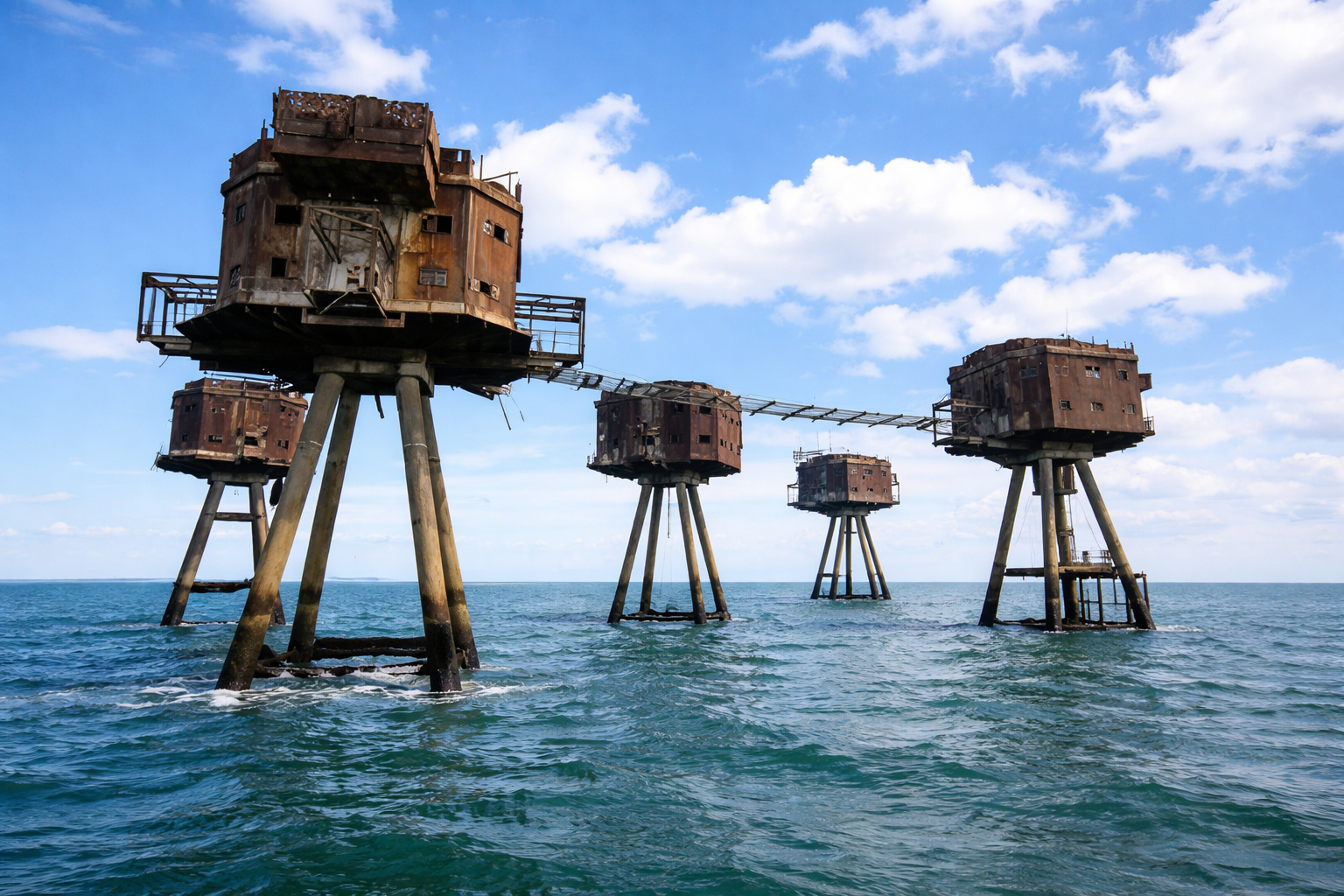
Built by the British Navy during World War II, these coastal fortresses emerge isolated in the sea like futuristic concrete and steel structures that still intrigue today with their Star Wars-like appearance and function.
Erected by the British Navy during World War II, the Maunsell Fortresses are concrete and steel structures positioned offshore, kilometers from the English coast. Created to protect strategic maritime routes, they attract attention not only for their military function but also for their appearance: tall towers, supported by pillars, that seem to have come straight out of a universe like Star Wars.
These fortresses were installed mainly in the estuaries of the Thames and Mersey rivers, essential points for supplying cities like London and Liverpool. Today, many still remain visible on the horizon, like strange and almost unreal silhouettes.
What are these fortresses in the sea
The Maunsell Fortresses were developed starting in 1942, commissioned by the British War Office and the Admiralty. The project was designed by engineer Guy Maunsell, who sought an efficient solution to protect the coast against German attacks.
-
For years, no one could cross a neighborhood in Tokyo because of the tracks, but an impressive solution changed mobility and completely transformed the local routine.

-
With 15 floors, an unusual building in Curitiba uses concrete, pilasters, and exposed roofs to create the effect of stacked houses.

-
Archaeologists opened a secret chamber that had been sealed by sand for 40,000 years inside a cave in Gibraltar and found what may be the last place where Neanderthals lived before disappearing from Europe forever.
-
The water that may have gone to the Moon with NASA during the Apollo 11 mission and been consumed by the astronauts springs in a Brazilian city at an altitude of 945 meters, famous for its thermal springs, above-average quality of life, and a natural radioactivity so unusual that it attracted Marie Curie.


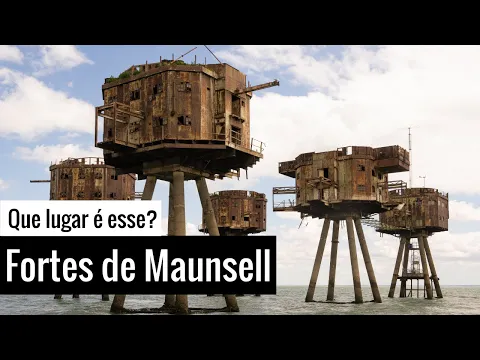

The Royal Navy operated the so-called “naval forts,” strategically positioned to intercept threats such as mines dropped by planes and bombings. The first began operating between 1942 and 1943, at a critical moment in the war.
These fortresses functioned as an advanced line of coastal defense, increasing the security of maritime routes at a time when control of the sea was vital.
How these structures were built
What makes these fortresses even more impressive is the engineering behind them. Built with reinforced concrete and steel, they were designed to withstand the extreme conditions of the sea.
Each naval fort had four concrete pillars about 49 meters high. On top of them, a steel platform housed armaments, radar systems, accommodations, and basic infrastructure for the military.
The versions used by the Army had, therefore, multiple connected platforms, also supported by robust concrete bases. These structures were capable of withstanding heavy artillery and facing constant winds and waves.
Everything was designed to be self-sufficient, allowing teams to remain on-site for long periods, even in total isolation.
How they functioned in practice
In practice, these fortresses were true military bases in the middle of the sea. Soldiers lived in them, continuously monitoring the air and maritime space.
Equipped with anti-aircraft guns and radars, they could detect and respond to enemy attacks before they reached the coast. This was essential to protect ships and prevent damage to cities.
Additionally, they played an important role in preventing maritime mines, one of the greatest dangers to vessels during the conflict.
Why they look like they came out of Star Wars
The appearance of these fortresses is what sparks the most curiosity today. Thin towers, elevated on pillars, isolated in the sea, create an image that completely deviates from the ordinary.
Many people compare these structures to giant robots or futuristic platforms. The combination of concrete, steel, and geometric shapes reinforces this feeling of something coming from another world.
Over time, wear and abandonment have intensified this aspect even further. Some resemble ruins of a future imagined in the past.
After the war, some of these fortresses found unexpected reuse, including pirate radios and even the famous micronation of Sealand.
The challenges of maintaining fortresses at sea
Despite the innovation, living and operating in these structures was not simple. The conditions were extreme: constant wind, humidity, isolation, and total exposure to maritime weather.
The material itself suffered continuous wear. Saltwater corrodes steel and compromises concrete over time, making maintenance complex and costly.
With the end of the war, many of these fortresses were abandoned. Without regular maintenance, several began to deteriorate.
What these fortresses reveal today
The Maunsell Fortresses show how necessity in times of war drives bold solutions. Building military bases at sea, with this level of complexity, was a direct response to urgent threats.
Today, they surpass their original function and become historical and visual symbols. They are often used as settings in audiovisual productions and attract curious visitors from around the world.
More than military structures, these fortresses represent a meeting of engineering, strategy, and imagination.
A legacy that continues on the horizon
Even abandoned, these fortresses remain steadfast in the sea, facing time and natural conditions. They are concrete reminders of a period when every decision could change the course of history.
They also show how constructions created for war can gain new meanings over the years, becoming almost works of art isolated in the ocean.
In the end, these concrete and steel structures continue to evoke the same question in those who see them for the first time.
Do you think these fortresses should be preserved as historical heritage or left as they are, resisting time in the middle of the sea?






Seja o primeiro a reagir!