





 Portuguese
  English
  Spanish
  7 min of reading
  0 comments


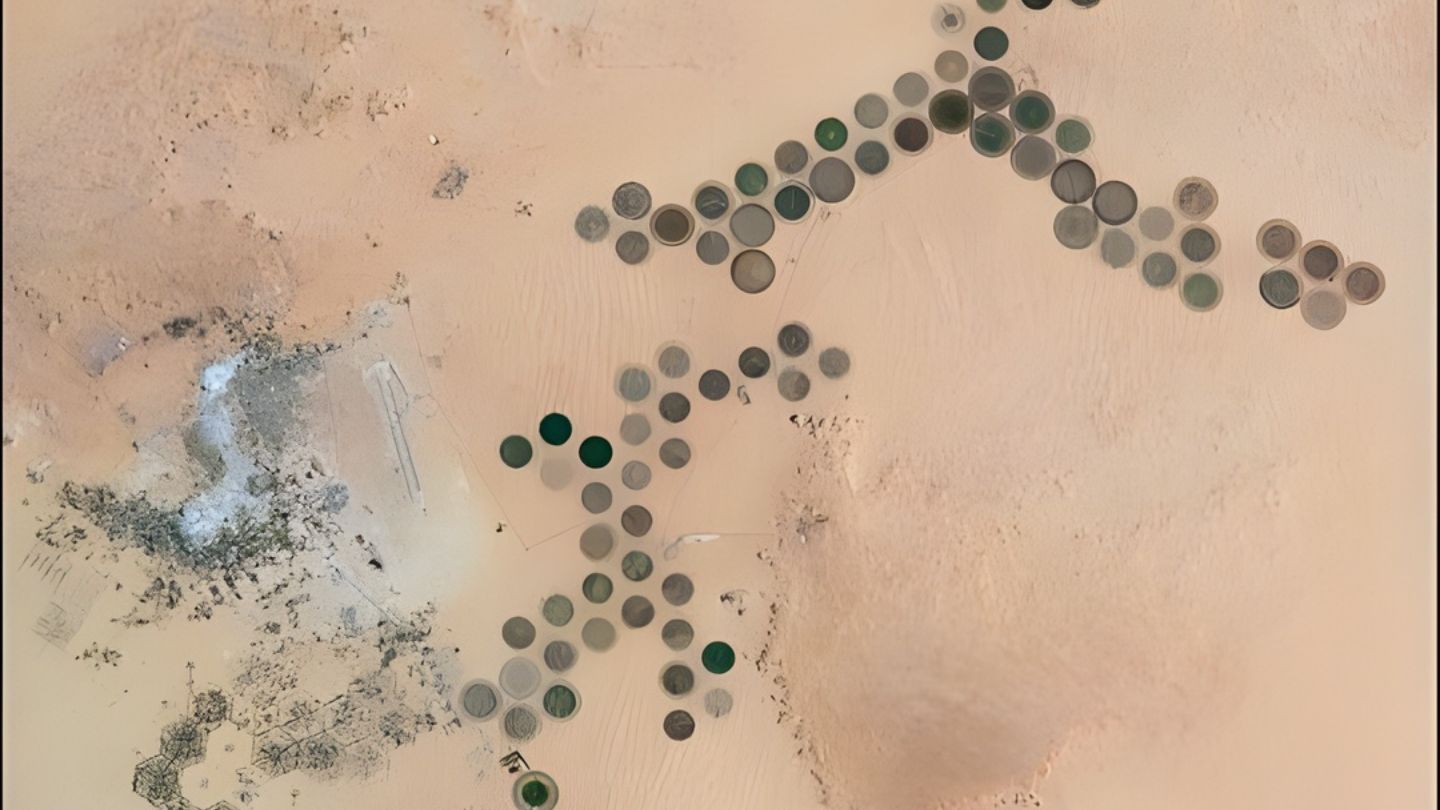
Giant circles in the Libyan desert are visible from space and reveal farms that use millennia-old groundwater in the Sahara.
In records released over the years by the NASA Earth Observatory, based on satellite images and also on observations made by astronauts on the International Space Station, an unlikely landscape draws attention in the southeast of Libya, in the Al Khufrah region. In the midst of one of the most arid areas on the planet, almost perfect circles emerge, forming geometric patterns that directly contrast with the surrounding desert. NASA itself describes these circles as agricultural areas sustained by center pivot irrigation, clearly visible in orbital records taken over the Sahara.
These structures are not natural phenomena. They represent a highly technological agricultural system implemented in the heart of the desert, supplied by fossil water extracted from a large underground aquifer, in a region where agriculture only becomes possible thanks to hydraulic engineering. In another official analysis, Water Beneath the Sand, NASA explains that the Kufrah area is situated over one of the largest irrigation projects in the world, connected to the Nubian Sandstone Aquifer and a network of infrastructure that has transformed the desert into a productive area. The image that appears from space as an artificial mosaic is, in practice, one of the most striking demonstrations of agricultural engineering in an extreme desert environment.
Perfect circles up to 1 km are the result of center pivot irrigation
The circular shape of these agricultural areas has a direct explanation in the technology used. It is the center pivot irrigation system, in which a rotating equipment distributes water evenly around a fixed point.
-
Sitting on the sidewalk at the end of the afternoon: the simple habit that brought neighbors together, slowed down the routine, and reveals why social interaction was stronger before the digital age.

-
Daughter of a public servant, a young woman from MA turns her fight for the environment into a victory and secures a full scholarship at a university in the USA.

-
Psychology explains why the generation that grew up in the 60s and 70s became so tough but still struggles to ask for help even when they are drowning, and the cost of this is extremely high.

-
The lemon that grows alone in Brazilian backyards has powers you can’t even imagine: it lowers high blood pressure, prevents kidney stones, fights cholesterol, and even removes rust from any surface.

This system consists of a long metal arm, equipped with sprinklers, that continuously rotates around a central axis. As the equipment completes the rotation, water is distributed in a radial pattern, creating an almost perfect circle.

Each of these circles can reach approximately 1 kilometer in diameter, making them easily identifiable in satellite images and even to the human eye in orbit. This geometric pattern is so characteristic that it has become one of the most recognizable visual marks of modern agriculture in arid regions.
The Al Khufrah region concentrates some of the most impressive patterns ever seen from space
The largest concentration of these circles is located in the Al Khufrah region, also known as Kufra, in the southeast of Libya. It is an extremely isolated area, surrounded by vast stretches of desert, where there are no permanent rivers or natural sources of surface water.
Images captured by NASA show dozens of circles distributed in an organized manner, forming true agricultural mosaics amid absolute aridity. The regularity of the patterns and the contrast with the surrounding environment create a landscape that, viewed from space, seems closer to an artificial project than to a common terrestrial formation.
These agricultural areas are used for growing food such as wheat, alfalfa, and other grains, essential for local food security.
Water used comes from an aquifer formed thousands of years ago
The factor that makes this system possible is the existence of a gigantic underground water reserve known as the Nubian Sandstone Aquifer. This reservoir extends across several countries in North Africa and is considered one of the largest in the world.
Unlike aquifers fed by recent rains, the water present in this system is classified as fossil water. This means it was accumulated thousands or even millions of years ago, in climatic periods completely different from the current ones.
By drilling deep wells, farms access this ancient water and use it for irrigation, creating green areas in an environment that would naturally not allow any type of agriculture.
This characteristic makes the project impressive, but it also raises questions about long-term sustainability.
Great Artificial River expanded irrigation capacity in the desert
The exploration of these water resources was expanded with the creation of one of the largest hydraulic engineering projects in the world, known as the Great Artificial River. Developed by the Libyan government since the 1980s, the system consists of a network of underground pipes that transport water from the aquifer to different regions of the country.
This system has allowed for the expansion of agriculture in desert areas and to supply urban centers far from water sources. The combination of the Great Artificial River and center pivot irrigation has made it possible to create an agricultural belt in the heart of the Sahara, something that would be unthinkable without technology.
Extreme contrast with one of the driest environments on the planet
The visual impact of these circles is mainly due to the contrast with the surrounding environment. The Sahara desert is known for its extreme conditions, with high temperatures, low humidity, and virtually no precipitation.
In many areas of Libya, annual rainfall is almost nonexistent. This means that any vegetation depends exclusively on artificial irrigation. In this context, the presence of perfectly delineated green areas creates an image that seems to defy the natural conditions of the planet.
This difference is so striking that the circles stand out immediately in satellite images, becoming a classic example of human intervention visible from space.
Colors observed in the images reveal the planting cycle
The color variations observed in the circles are not random. They reflect the stage of the agricultural crops in each area.
Circles with a more intense green indicate active vegetation, while lighter tones may represent areas in harvest, soil preparation, or resting periods. In some cases, reddish tones appear due to the type of crop or specific soil conditions.
This chromatic diversity transforms the landscape into a dynamic pattern, where each circle functions as an independent productive unit, with its own agricultural cycle.
Visibility from space reinforces visual impact and geographical importance
One of the aspects most cited by NASA is the ease with which these patterns can be identified from space. Astronauts on the International Space Station can observe the circles without the need for advanced equipment.

This visibility reinforces the scale of the project and its relevance as an example of human intervention in extreme environments. Few agricultural structures in the world present such a clear visual impact when observed from outside the planet, which contributes to scientific and public interest.
Intensive water use raises concerns about sustainability
Despite the success in creating agricultural areas, the use of fossil water raises important concerns. As the aquifer is not significantly replenished by current climatic conditions, continuous extraction may lead to resource depletion.
Studies indicate that, under certain conditions, the exploitation may not be sustainable in the long term, especially if demand continues to grow.
The use of water accumulated over thousands of years to sustain modern agriculture creates a scenario where the resource may become limited over time. This issue raises the debate on the balance between agricultural development and the preservation of natural resources.
Agriculture in the desert represents technological advancement and environmental challenge
The case of the circles in the Libyan desert represents a clear example of how technology can transform environments considered inhospitable into productive areas. At the same time, it highlights the limits of this transformation when it depends on finite resources.
The combination of hydraulic engineering, advanced irrigation systems, and aquifer exploitation has allowed for the creation of a new agricultural reality in the heart of the Sahara. However, the continuity of this model depends on careful management of the available resources.
This balance between innovation and sustainability is one of the main challenges faced by agricultural projects in arid regions, especially in the context of global climate change.
Human intervention in the Sahara becomes one of the most visible examples on the planet
The presence of these circles reinforces how human action can modify landscapes on a continental scale. What was once a continuous stretch of desert has come to house productive areas organized in highly visible geometric patterns.
This type of transformation not only alters the local environment but also becomes a symbol of technological capacity to adapt to extreme conditions. The landscape of the Sahara, viewed from space, begins to tell a new story, marked by the presence of structures created by modern engineering.
And you, do you believe it is possible to transform deserts into productive areas sustainably in the long term?
Leave your opinion in the comments and say whether projects like this can expand to other arid regions of the planet.








Seja o primeiro a reagir!