





 English
  Francês
  Alemão
  Italiano
  Japonês
  Norueguês
  Portuguese
  Spanish
  3 min of reading
  0 comments


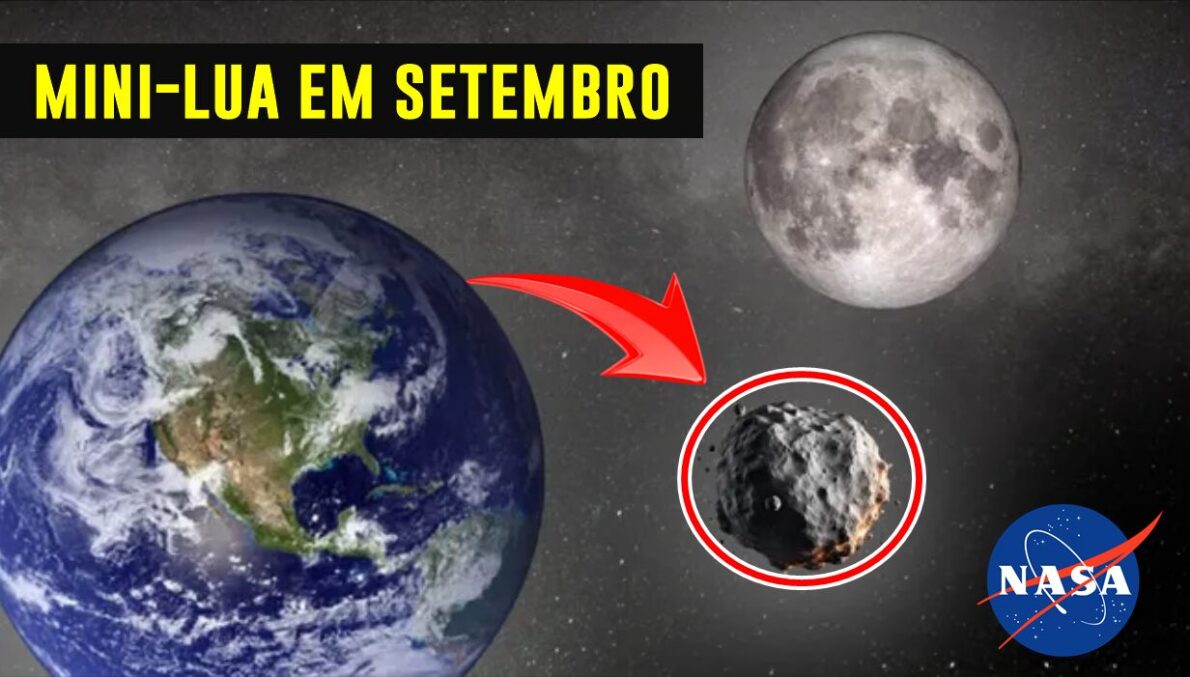
2024 PT5, A Temporary Mini-Moon, Will Orbit Earth Starting In September And Will Leave Us Again In November. Discover More About This Rare And Brief Celestial Visitor!
Starting at the end of September 2024, Earth will receive a special cosmic visit: a new mini-moon. Unlike our traditional moon, which has orbited the planet for billions of years, the newly discovered asteroid 2024 PT5 will be a temporary guest, remaining under the influence of Earth’s gravity for about two months.
This rare and exciting event will mark another chapter in the history of so-called mini-moons, small space rocks that occasionally join our planet before resuming their path through space.
What Is A Mini-Moon?
Mini-moons are small asteroids temporarily captured by Earth’s gravity. Although their presence is fleeting, these events occur more frequently than one might think.
-
The climate in 2026 may surprise with extremes even more intense than in 2025, with heatwaves, out-of-season cold, and irregular rainfall in Brazil.

-
Astronomers identify 45 rocky planets that could harbor life, and one of them is just 4.2 light-years from Earth, making it the closest neighbor with the potential to have liquid water on its surface.

-
Archaeologists discover 43,000 ostraca in Egypt with tax lists, drawings, religious texts, and everyday notes that reveal what life was like in ancient Athribis before Cleopatra.

-
China showcases laser defense systems that target drones flying very low and attempts to address a flaw that has been concerning armies worldwide.

The 2024 PT5, about 10 meters in diameter, is an example of a “captured temporary flyby,” meaning that it will come close enough to be affected by Earth’s gravity but will not complete a full orbit around the planet.
The asteroid was first detected on August 7, 2024, by a team of astronomers using NASA’s ATLAS alert system.
This system, which employs telescopes in different parts of the world, such as Hawaii, Chile, and South Africa, aims to identify objects that may pose a threat to Earth. However, the 2024 PT5, rather than posing any danger, will only be a brief visitor.
The Journey Of 2024 PT5

2024 PT5 originated from the Arjuna asteroid belt, which contains objects with orbits similar to Earth’s. Due to its low speed, it will be captured by the planet’s gravity on September 29, 2024.
The asteroid will briefly orbit before being launched back into space on November 25, 2024, without completing a full orbit.
Researcher Carlos de la Fuente Marcos from Universidad Complutense de Madrid highlighted that the phenomenon is a classic example of how Earth occasionally captures small space objects.
Observations
Although 2024 PT5 is a temporary visit, it will not be visible to most people. At approximately 10 meters in diameter, the asteroid is too small to be seen with the naked eye or even with amateur telescopes.
Professional astronomers, however, are eager to study this brief passage and plan to conduct spectroscopic and photometric observations to better understand its composition and origin.
An intriguing hypothesis raised by some scientists is that 2024 PT5 could be a fragment of Earth’s own moon, expelled after a collision in the past.
If confirmed, this would make the event even more significant, showing how asteroids and other celestial bodies interact with planets and their moons.
Other Mini-Moons And The Future Of Discoveries
This is not the first case of a mini-moon orbiting Earth. In 2020, NASA detected the asteroid 2020 CD3, which remained in orbit for about three years before escaping. However, events like 2024 PT5 generally involve smaller objects, making their detection more difficult.
Fortunately, advances in astronomical tools like ATLAS are helping scientists identify these temporary mini-moons more easily.
Researchers believe that many other asteroids may have briefly orbited Earth in the past and that there are dozens, or even hundreds, waiting to be discovered.
The capture of mini-moons raises questions about the possibility of other planets also capturing small asteroids. Planets like Mars, Venus, and Jupiter, with their large gravitational masses, could very well have their own unknown mini-moons.
The brief passage of 2024 PT5 is a fascinating reminder of the dynamics of our solar system. Although this mini-moon will not be visible to most, its discovery offers astronomers an opportunity to learn more about the asteroids that inhabit the space near Earth.
As detection tools improve, we can expect more mini-moons to be identified, providing new insights into the interactions between Earth and the cosmos.










-

Uma pessoa reagiu a isso.