





 Portuguese
  English
  Spanish
  4 min of reading
  0 comments


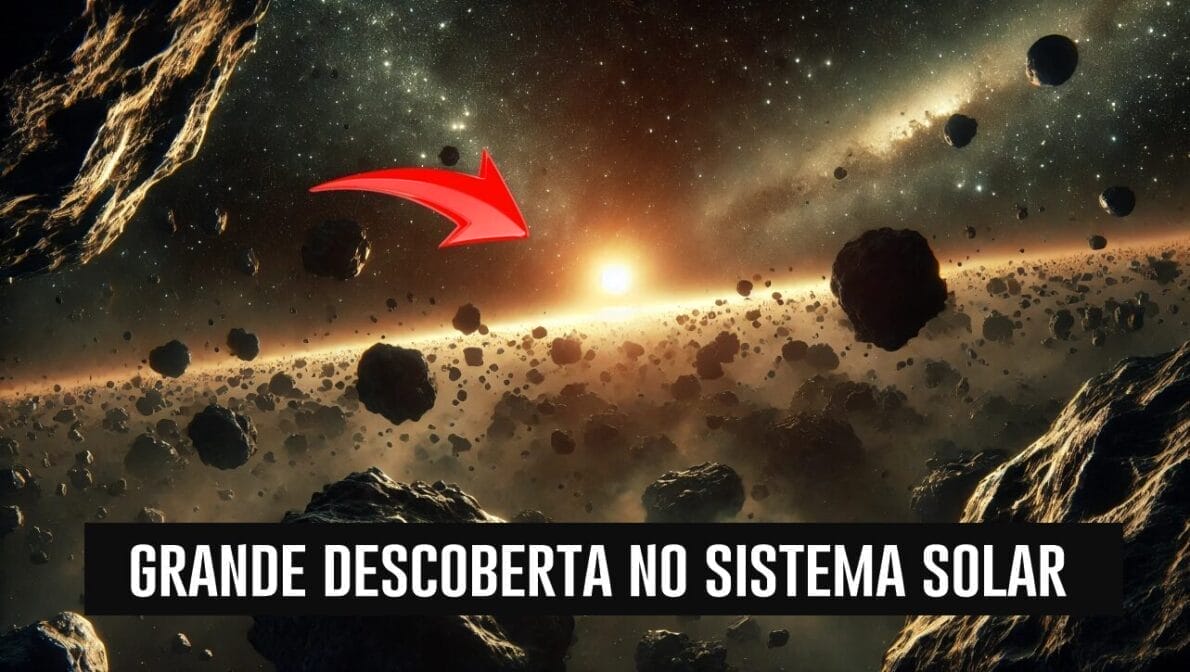
Evidence of a Hidden Structure at the Edge of the Solar System Has Been Detected, Opening New Doors for Space Exploration and Raising Intriguing Questions About the Limits of Our Solar System
The Solar System, a vast expanse filled with mysteries and enigmas, may be on the verge of revealing a surprising new discovery. Astronomers have detected signs of an unexpected structure located in the farthest regions of our cosmic neighborhood: a possible division in the Kuiper Belt, suggesting the existence of a second component that no one expected to find.
Beyond Neptune’s orbit lies the Kuiper Belt, a ring-shaped region composed of icy rocks and small celestial bodies.
Pluto, Arrokoth, and countless objects known as KBOs (Kuiper Belt Objects) reside in this cold and dark territory. These bodies represent the purest remnants of the primordial material that formed our Solar System 4.6 billion years ago.
-
100% Brazilian technology transforms agricultural waste into a meat-scented ingredient using fungi from the Amazon rainforest. The process does not use excessive water or chemicals, and it also increases the nutritional value of the final product.

-
Psychology reveals that adults who avoid conflicts at all costs are not balanced individuals, but rather children who learned in the worst way that expressing emotions brought punishment and now live paralyzed by the fear of expressing themselves.

-
Goodbye pet hair on clothes: a washer with an internal filter promises to remove up to 5 times more hair than regular machines and uses an XL trap dryer system to capture what remains.

-
The most overlooked waste in the electricity bill doesn’t come from the refrigerator or the air conditioner; it escapes through almost invisible cracks in doors and windows, operating all day long and can steal up to 20% of the energy used for climate control, while a low-cost seal takes just a few hours to eliminate this loss.


The Kuiper Belt extends from about 30 to 50 astronomical units (AU) from the Sun, where 1 AU is the average distance between the Earth and the Sun.
Because they are so distant, the objects in this belt are minimally affected by solar radiation, remaining virtually unchanged since the formation of the Solar System. This makes the region a true cosmic vault of the past treasure.
A Hidden Structure at the Edge of the Solar System
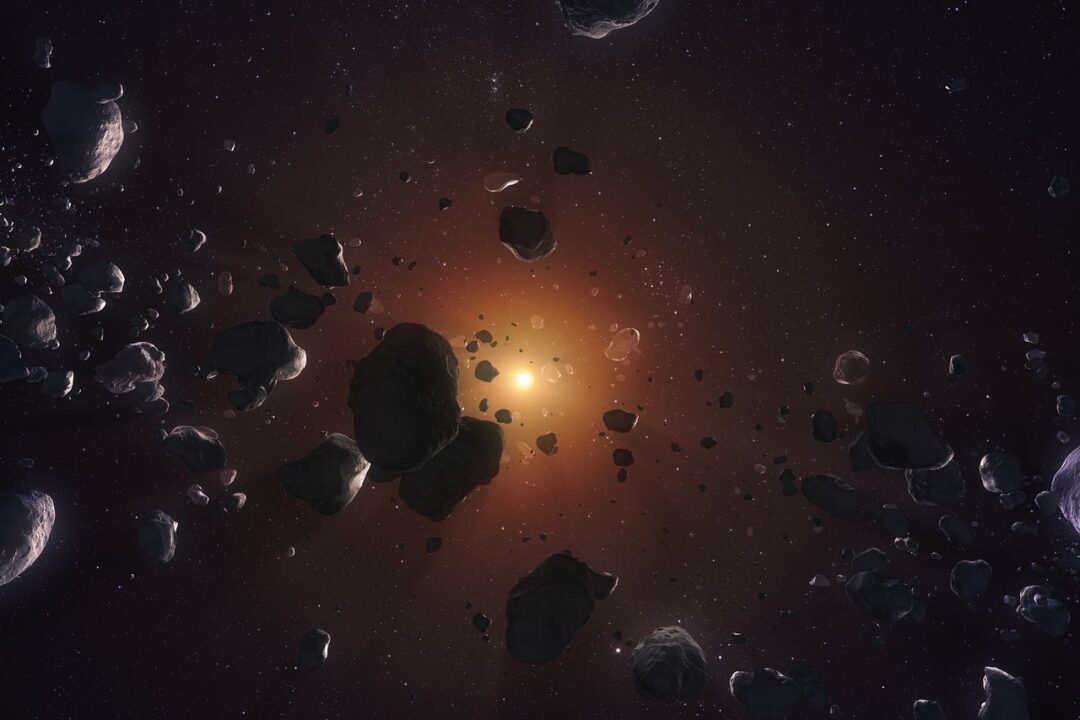
Recently, a team of astronomers led by Wesley Fraser from the National Research Council of Canada announced a fascinating discovery.
Observations made with the Subaru Telescope in Hawaii revealed the existence of 11 objects beyond 70 AU, much farther than previously thought the Kuiper Belt ended.
These findings suggest the presence of an outer ring, where the density of objects is significant enough to constitute a new structure in the Solar System.
Most intriguingly, between 55 and 70 AU, virtually no objects were found. This gap may seem strange, but it is not uncommon in forming planetary systems.
In fact, this type of structure has already been observed in other stellar systems, aligning our Solar System more closely with discoveries made in other parts of the galaxy.
A Discovery with Major Implications
According to Fumi Yoshida, a planetary scientist at the University of Occupational and Environmental Health and Chiba Institute of Technology in Japan, if confirmed, this discovery would have profound implications for our understanding of planet formation in the Solar System.
The presence of such a distant structure may indicate that the primordial solar nebula, the cloud of gas and dust from which the Sun and planets formed, was much larger than previously thought.
This revelation could also eliminate an observational peculiarity that has intrigued astronomers for decades. The Kuiper Belt, until now, appeared small compared to belts in other planetary systems.
However, as Fraser points out, this impression may have arisen due to the limitations of our observational technology. If the new component of the Kuiper Belt is confirmed, the Solar System may not be as uncommon as previously thought.
The Continuity of Observations
To gain a clearer understanding of this possible new structure, observations will continue. The next step will be to track the orbits of the 11 detected objects, ensuring that they are indeed part of an outer ring of the Kuiper Belt and not just a statistical coincidence.
The New Horizons spacecraft, which has been exploring the outer Solar System since its flyby of Pluto in 2015, is already about 60 AU from the Sun and could be crucial for this investigation.
Alan Stern, the principal investigator of the New Horizons mission, emphasized the importance of this discovery: “This is an innovative discovery that reveals something unexpected, new, and exciting at the far reaches of the Solar System.” He also highlighted the crucial role of the Subaru Observatory, whose advanced capabilities enabled astronomers to detect this previously invisible structure.
What This Discovery Means for the Future
If the observations are confirmed, the existence of a second component in the Kuiper Belt will have deep implications for how we understand the formation of the Solar System.
The presence of gaps and substructures in this region suggests that our planetary system may not be so different from other systems in the galaxy.
This also raises new questions about the impact of these peculiarities on the habitability of the Solar System and whether such features can be found in other stellar systems with habitable planets.
In summary, what appeared to be an unexplored and relatively homogeneous region of the Solar System may, in fact, hide a complex and unexpected structure. With more observations and investigations, we may uncover the secrets of this fascinating discovery and, perhaps, better understand our place in the universe.







Seja o primeiro a reagir!