





 Portuguese
  English
  Spanish
  9 min of reading
  0 comments


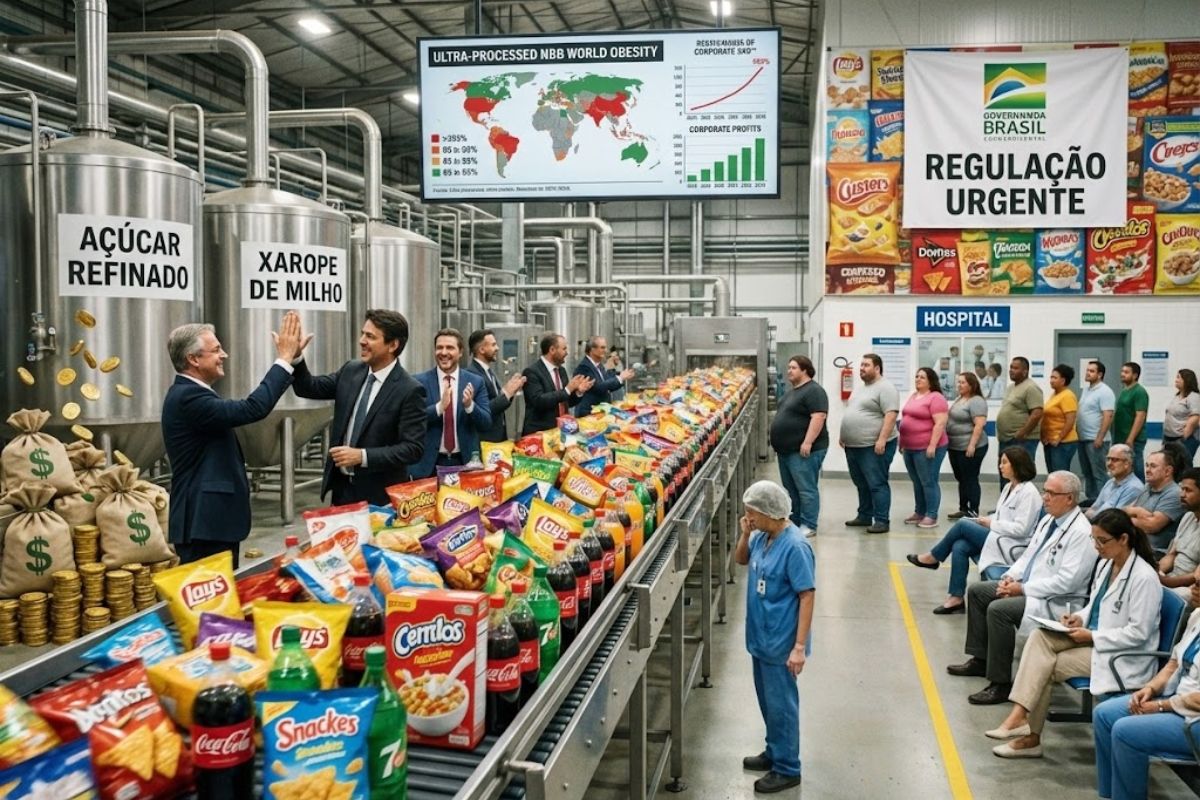
While The Food Industry Projects Ultra-Processed Foods Packed With Sugar, Salt, And Fat And Dumps Sugary Drinks Into The Global Market, 40% Of The Planet Is Getting Fat, Obesity Rises, Hospitals Are Crowded, Mexico Taxes Strong Labels, Switzerland Hesitates To Regulate And Giants Keep High Profits While Public Health Systems Slowly Collapse
In 1980, just under 7% of the population of Mexico was obese; today the rate is more than five times higher, while 40% of the global population is already overweight or obese, pushed by cheap, convenient, and hypercaloric products. At the center of this curve is the food industry, which for decades has transformed sugar, salt, and fat into a motor of ultra-processed foods designed to stimulate continuous consumption, without satiety proportional to the calories ingested.
Between 1994, when Mexico signed free trade agreements with the United States and Canada, and April 8, 1999, the date of a secret meeting of CEOs in Minneapolis about their role in the obesity epidemic, to more recent decisions such as the opposition of the Swiss government in 2020 to the Mexican labeling law and Nestlé’s internal presentation in 2021 recognizing that more than 60% of its products were unhealthy, the trajectory of the food industry exposes a sequence of corporate choices that prioritized profit, aggressive marketing, and product engineering over public health.
Sugar, Salt, And Fat As Technology For Continuous Appetite

At the base of ultra-processed foods is a simple and powerful triad.
-
Historic bankruptcy of Centauro shocks the market, and the century-old company puts more than 500,000 products, machines, and complete infrastructure up for online auction.

-
New shoe factory in Ceará is expected to create 400 jobs and strengthen the local economy.

-
No one imagined it, but a mixture of sawdust with a mineral that fights fires surprises scientists with a result that changes the course of fire-resistant construction.

-
From empty land to a high-end house, wooden construction uses a lightweight system, metal structure for the foundation, ventilated ceramic cladding, and special windows to create an efficient and comfortable living space throughout the year.


Sugar, salt, and fat are combined by teams of food industry scientists to reach the so-called bliss point, the “perfect” amount of sugar in a product, neither too little nor too much, calibrated to maximize pleasure and the desire to repeat the experience.
Salt is often applied to the surface of snacks and chips, functioning as an initial burst of flavor.
Fats ensure the so-called mouthfeel, that creamy or crunchy texture that makes it irresistible to bite into a grilled cheese sandwich or a stuffed snack.
Sugar, directed at our basic instinct to seek sweetness, completes the equation.
These products do not come about by chance, but from precise engineering aimed at producing intense desire, little control, and no real stimulus toward moderation.
Investigative journalist Michael Moss, who initially resisted comparing cookies to heroin, ultimately concluded that many of these ultra-processed foods may be more problematic than tobacco and alcohol, precisely because they are ubiquitous, socially accepted, and consumed daily, including by children.
The food industry avoids the word “addictive,” but systematically invests in formulas that increase recurrent consumption and exposure time to its products.
Carole, Rogelio, And Rebecca: When Food Becomes Refuge And Threat

The trajectory of Carole, 34, living in the Lausanne area, illustrates how the food industry occupies the emotional space of everyday life.
As a teenager, she started bingeing on chips, sweets, cookies, snacks, and sugary drinks in front of the television, responding to the constant stimuli of advertising.
The more she ate, the worse she felt about her own body and the gaze of others, and the worse she felt, the more she ate to relieve the pain.
The cycle resulted in extreme obesity, difficulties moving, and even breathing. Interned in the obesity clinic of the University Hospital of Lausanne, Carole underwent gastric bypass surgery that drastically reduced her stomach, and she has already lost about 35 kilos.
Even so, she needs to relearn basic sensations like hunger and satiety, and reconstruct the self-esteem destroyed by years of bullying and fatphobia.
In Mexico, Rogelio, a taxi driver, spends up to 12 hours a day inside the car, eating almost exclusively fried potatoes, greasy snacks, and sodas.
For him, ultra-processed food is practical, cheap, and “helps keep working without stopping to eat.”
The result is photos from a recent past at 120 or 126 kilos, shortness of breath, social isolation, and a late struggle to try to lose weight and survive longer alongside his children.
Rebecca, also in Switzerland, has been living with binge eating disorder for about 20 years.
In times of emotional stress, she fills her cart with ready-made pasta, creamy sauces, cheeses, cookies, and cakes, consumed in a few hours and in secret.
She reports that the first bites are pleasant, but then the pleasure disappears, and consumption continues until the stomach pain becomes unbearable, accompanied by intense shame.
The clinic in Lausanne tries to help her break this pattern, showing that it is not just a matter of individual willpower but also an alimentary environment designed to favor excess.
Obesogenic Environments: When The System Pushes To Excess

The multidisciplinary department of the University Hospital of Lausanne monitors about 1,500 overweight individuals, of which 220 suffer from obesity.
Doctors report an exponential increase in the most severe cases in recent decades and describe the current environment as obesogenic and toxic in calories.
Promotions, constant advertising, and foods of low nutritional quality and high energy value weaken the ability to choose, especially among the most vulnerable.
In Switzerland, 42% of the population is overweight and one in ten people is obese, with an estimated cost of more than 8 billion Swiss francs per year in healthcare.
Scientific articles point to growing evidence that ultra-processed foods, with many calories and little satiety, play a central role in the explosion of obesity observed in several countries.
For children and adolescents, the situation is even more delicate.
In Geneva, an educational program implemented 15 years ago now reaches one in three schools, teaching students to identify the sugar and fat content in processed foods and to differentiate products that should be avoided from those that can make up a healthy diet.
Educators stress that eating habits are formed before the age of 10, exactly the age group in which the food industry concentrates aggressive campaigns, mascots, and colorful packaging.
Mexico Reacts With Taxes, Labels, And Limits On Advertising
Mexico is one of the countries hardest hit by the obesity epidemic.
More than three-quarters of the adult population is overweight or obese, and the country ranks among the global leaders in childhood obesity.
The average consumption of sodas reaches 163 liters per person per year, exposing children and adults to continuous doses of liquid sugar.
For the Deputy Minister of Health, Hugo López-Gatell, one-third of all deaths in Mexico in the last 15 years are related to poor nutrition, mainly excess sugar, calories, fat, and salt.
He links the rise in obesity to the neoliberal turn of the 1980s, economic deregulation, and the trade opening, consolidated by the agreements with the United States and Canada in 1994, which flooded the market with cheap ultra-processed products.
In response to the crisis, the Mexican parliament approved three central measures: a tax on sugary drinks, restrictions on advertising targeted at children, and front warning labels on products with excessive sugar, calories, saturated fat, trans fat, or salt.
To avoid the dreaded black labels, many companies reformulated products, reducing sugar and other critical ingredients, while animal mascots were removed from children’s packaging.
The food industry’s reaction came in the form of lawsuits and communication campaigns. Manufacturers argue that the labels “prevent comparisons between healthy products” and unnecessarily alarm consumers.
Consumer organizations and groups like the one led by Doré Castillo counter-argue that warnings are essential tools to tackle overweight, obesity, and preventable diseases.
Switzerland Hesitates To Tax Sugar And Yields To Lobby Pressure
While Mexico implements taxes and front labels, Switzerland still has no specific legal restrictions to combat obesity and overweight, despite the billion-dollar costs.
A symbolic example is the comparison of a bottle of Fanta sold in Great Britain, where there is a tax on sugary drinks, with the same drink in Switzerland.
In the UK, part of the sugar has been replaced by sweeteners, reducing the content to 4.6 grams per deciliter; in the Swiss version, the value reaches 10.3 grams per deciliter, more than double.
Advocates for a sugar tax, like politician Delphine Bachmann, point out that there are at least 15 different names for sugar used on labels, making it difficult for the average consumer to understand.
Marketing tools and complex forms allow the food industry to hide the true concentration of sugar while exploiting the natural preference for sweet flavors.
Documents obtained under access to information laws show that Nestlé sought the Swiss government for support against the Mexican labeling law, classifying the model as radical, restrictive, and scientifically fragile, and claiming that the labels could generate unjustified fear.
In 2020, the Swiss government took a position against the Mexican legislation. Meanwhile, dozens of internal motions calling for tougher measures, such as taxes on sugary drinks, did not progress amid ideological resistance to market regulation and the influence of lobbying groups linked to sugar and beverages.
Neuroscience Links Sugar To The Logic Of Drugs
The experiments conducted at the University Hospital of Lausanne show that the power of sugar goes beyond metaphor.
In one of the experiments, rats quickly learn to press a pedal that releases doses of sugar, consumed frantically.
In comparative tests, they even prefer sugar to cocaine, indicating that the stimulation generated by the sweet may be even stronger under certain conditions.
Neurobiologist Benjamin Boutrel observes that the brain changes in people who lose control in the face of fatty and sugary foods are comparable to the changes observed in dependents of alcohol, cocaine, or tobacco.
For him, there is a clear parallel between the tobacco industry and the food industry: both have profoundly modified the nature of their products, adding textures, aromas, and other components to amplify the impact of the central substance and foster consumer loyalty.
Michael Moss describes sugar, salt, and fat as a “profane trinity” and points to the so-called 80/20 rule used by companies: 20% of customers consume 80% of the product.
It is these heavy consumers that the food industry seeks to reach with specific campaigns and formulations, exploiting emotional, economic, and social vulnerabilities to maximize sales.
Children, Human Rights, And The Dispute For The Future Of Food
Pediatricians like Nathalie Farpour-Lambert, who have cared for children with overweight for decades, affirm that minors are victims of a food system that manipulates them from an early age.
According to her, it makes no sense to hold only parents responsible if labels are confusing, advertising is omnipresent, and ultra-processed products are cheaper and more accessible than fresh foods.
The question that arises is whether we are willing to sacrifice one or two generations in the name of convenience and profit.
For public health experts, defending childhood involves separating economic interests from political power and placing the protection of children as the highest priority of any regulatory system.
This includes clear rules for labeling, limits on advertising, review of formulas, and, in many cases, specific taxation on high-risk products aligned with the scientific evidence accumulated.
At the same time, people like Carole, Rogelio, and Rebecca continue to fight individual battles, often in silence, against the direct consequences of corporate strategies that have operated for decades without robust brakes.
They carry in their bodies and psyches the costs of a global machine that considers it acceptable to lose lives as long as the financial balance remains in the black.
In light of this scenario, the question left by the obesity crisis, the rise of diabetes, and the explosion of cardiovascular diseases is whether society will continue to accept that the food industry treats sugar as a trivialized drug, sold in colorful packaging to children, or if it will demand a new pact between public health, profit, and corporate responsibility.
In your opinion, should the food industry be regulated with taxes, strong labels, and marketing restrictions like tobacco, or is the main responsibility still on the individual when it comes to choosing what to eat?










Seja o primeiro a reagir!