





 Portuguese
  English
  Spanish
  5 min of reading
  0 comments



With Millions of Hectares and Units Earning US$ 100 Thousand a Year, Industrial Vermicomposting Transforms Waste into Fertilizer and Drives a Billion-Dollar Market.
Entire sectors of global agriculture are undergoing silent changes — and one of them involves a protagonist that rarely appears in technological debates: the earthworm. Instead of heavy machinery, robots, or cutting-edge biotechnology, what spreads across farms, urban centers, and government projects is an army of annelids that drives one of the strongest and most sustainable markets today. This is industrial vermicomposting, a practice that transforms organic waste into a high-value fertilizer and today occupies millions of hectares just in India, being seen as a strategic alternative for regenerative agriculture, combating waste, and strengthening rural production chains.
The numbers are impressive. According to the Council on Energy, Environment and Water (CEEW), over 3.5 million hectares of Indian agricultural land are already involved in processes related to vermicomposting, whether in local production or in the systematic use of the material as a basis for fertilization. At the same time, medium-sized units report revenues exceeding Rs 10,22,400 — about US$ 125 thousand per year, as shown in a study conducted in the agricultural area of Rajendranagar, Hyderabad. These data reveal that, while many countries are trying to find expensive solutions to restore degraded soils, one of the most efficient paths remains extremely simple — but now operated on an industrial scale.
The Technical Leap That Turned Worms into a Billion-Dollar Chain
Vermicomposting is formed from the biological decomposition of organic waste by earthworms of the genus Eisenia fetida and Eudrilus eugeniae. The technique has existed for decades, but it was only in the last 15 years that it began to be treated as an industrial segment. The reason is twofold: first, the growing demand for organic fertilizers in the face of soil exhaustion and volatility in chemical input prices; second, studies that have proven significant productivity gains in crops that systematically use vermicomposting.
-
These living root bridges and ladders are over 700 years old and help indigenous people survive in one of the rainiest regions in the world.

-
From sertanejo star to international investor: Ana Castela invests millions in a mansion in the USA, creates a themed accommodation in Orlando, and shows that the “boiadeira” also wants to grow away from the stage.

-
The 10 most stunning motorhomes in the world: a $3 million trailer with a rooftop nightclub and garage for a Ferrari, “palaces on wheels” with Italian marble, private cinema, and five-star hotel luxury for billionaires.

-
Trump wanted to spend $400 million on the White House, but the courts prohibited the million-dollar construction.



Reports published by Zion Market Research estimate that the global vermicomposting market surpassed US$ 1.84 billion in 2024, with strong growth projections until the end of the decade. India, in turn, has become the epicenter of the sector, driven by state initiatives, agricultural credit lines, and rapid adoption by small farmers.
In various regions, automated vermicomposting systems have begun to emerge, featuring temperature control, drip irrigation, mechanized collections, and constant microbiological monitoring. The result is a highly standardized product, rich in nutrients, capable of replacing part of the costly and polluting nitrogenous chemical fertilizers.
The Gearing That Transforms Waste into High-Value Agricultural Inputs
One of the main drivers of this market is the enormous capacity of vermicomposting to transform waste that would go to landfills into agricultural inputs. In urban areas, market scraps, garden trimmings, fair waste, and food leftovers are collected by the ton and sent to industrial units capable of converting all this into high-quality fertilizer in just a few weeks.
This efficiency has caught the attention of lawmakers and environmental institutions. Reports from the CEEW show that municipalities that adopted large-scale vermicomposting reduced waste transport costs and drastically decreased methane emissions from landfills. The system has proven so efficient that states like Maharashtra, Kerala, and Telangana have created official programs to incentivize the practice, offering subsidies for constructing beds, composting tunnels, and collection structures.
For farmers, the economic impact is immediate. The partial replacement of chemical fertilizers reduces production costs, increases soil water retention, and improves indicators such as germination, structural stability of the roots, and pest resistance. This explains why India alone accounts for a significant share of global sales.
Units That Surpass US$ 100 Thousand a Year: How the Production Scale Works
The study that analyzed the production unit in Rajendranagar detailed the typical operation of a large-scale system:
- vermicomposting beds with the capacity to process tens of tons of waste,
- automated irrigation,
- internal temperature monitoring,
- manual collection only at the final stage,
- mechanized separation of humus and animals.
The profit margin observed in the study is high because operational costs are low: the worms reproduce quickly, require no sophisticated feeding, and transform waste that, in many cases, is obtained for free. Most of the investment is in initial infrastructure — warehouses, coverings, drainage, irrigation, and labor for handling.
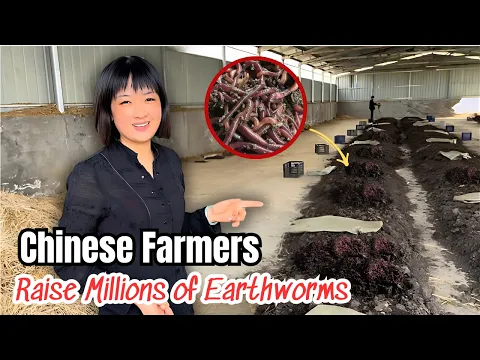
In addition to fertilizer, production may include the development of liquid leachates, popularly known as “worm tea,” used as foliar biofertilizers. In regions with high demand for organic products, these derivatives fetch even higher prices in the market.
Why Vermicomposting Became Valuable Agricultural Currency
The popularization of the practice is directly related to three main factors:
- Crisis in Chemical Fertilizers
The dependence on imported inputs became evident after geopolitical shocks between 2021 and 2023, driving the search for internal alternatives. - Climate Change
Degraded soils lose organic matter quickly. Vermicomposting replenishes carbon, improves the microbiota, and increases climate resilience. - Expansion of Organic and Regenerative Agriculture
With consumers pushing for chemical-free food, producers have begun adopting natural fertilizers on a large scale.
It is not an exaggeration to say that earthworms have become a strategic link between sustainability, modern agriculture, and rural economy. They reduce waste, restore soils, and generate stable income — something rare in many agricultural sectors.
A Market That Will Continue to Grow
Global projections indicate that the demand for organic fertilizers will continue to expand, driven by decarbonization policies, environmental certifications, and high chemical input costs. For developing economies, such as India and several African countries, vermicomposting represents a bridge between agricultural productivity and low operational cost.
The current scenario shows that the future of fertile soils may paradoxically lie in the hands — or rather, in the silent work — of millions of earthworms that today drive a billion-dollar market in constant acceleration.








-

-

-

-

-

-

37 pessoas reagiram a isso.