





 Portuguese
  English
  Spanish
  6 min of reading
  2 comments





With Record Efficiency of 15.96 g of Water per cm² per Hour, Janus Crystals Developed by Researchers Capture Moisture Directly from the Atmosphere Without External Energy and May Open New Technology for Potable Water Production
Researchers have developed a new type of material capable of capturing water directly from the humidity in the air without the need for external energy. The material, known as Janus crystals, demonstrated a record efficiency in collecting atmospheric water in laboratory tests. The advance was described in 2024 in a study published in the Journal of the American Chemical Society by researchers from Jilin University, China, and the Center for Smart Engineering Materials at NYU Abu Dhabi, in the United Arab Emirates. In the experiments conducted by the scientific team, the crystals achieved a collection rate of 15.96 grams of water collected per square centimeter per hour, the highest efficiency ever recorded for experimental fog and atmospheric humidity capture systems.
The discovery paves the way for the development of new technologies for producing potable water from the atmosphere, a plentiful natural resource that is still underexplored on a global scale.
Namib Desert Provides Ideal Natural Conditions for Studies on Fog Water Capture
Part of the research that led to the development of this technology was inspired by observations made in the Namib Desert, located on the southwestern coast of Africa. The desert is considered one of the oldest and driest on the planet. The region is directly influenced by the Benguela current, which runs along the African coast and cools the maritime air.
-
With a cost per shot close to zero, the DragonFire laser could change naval warfare in 2027 and provide British ships with nearly unlimited defense against drones.

-
A British startup creates tires that generate electricity in electric vehicles when passing over potholes, speed bumps, and cracks.

-
Scientists have created robots made with living cells that have their own nervous system, swim on their own, explore the environment, and self-organize without any genetic engineering, and now they want to do the same with human cells.
-
Students create a solar-powered ambulance that operates without a plug, without fuel, and still keeps medical equipment running in remote areas.


This ocean phenomenon creates specific atmospheric conditions that favor the formation of frequent coastal fog, especially during the early morning and dawn hours. Despite the constant presence of this fog, precipitation in the region is extremely low. In many areas of the desert, the average annual precipitation is less than 25 millimeters, making the environment incapable of sustaining conventional sources of surface water.
For this reason, the moisture present in the fog represents an important water source in the local ecosystem and has been the subject of various scientific studies aimed at atmospheric water capture.
Hydrophilic and Hydrophobic Structures Allow for Capturing and Transporting Fog Water
One of the physical principles explored by researchers involves the combination of hydrophilic and hydrophobic surfaces. Hydrophilic surfaces have a chemical affinity for water and facilitate the condensation of moisture present in the air. Hydrophobic surfaces, on the other hand, repel water, allowing the formed droplets to move across the surface of the material.
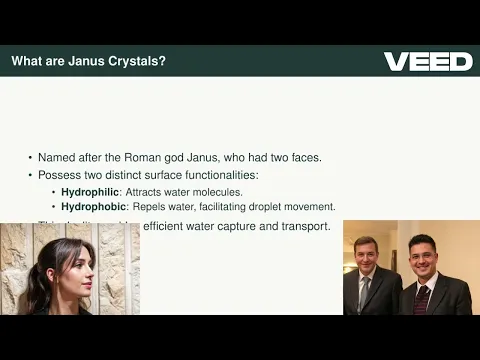

The combination of these two properties creates a highly efficient system for condensation and transportation of water droplets.
In this system, the humidity in the air initially condenses in the hydrophilic regions. As the droplets increase in size, they begin to move through the hydrophobic regions, being directed to a collection point. This physical principle has been widely studied by materials engineers and experts in atmospheric water capture technologies.
Biomimetics Drive New Air Water Collection Technologies
The development of surfaces capable of capturing atmospheric water is part of a scientific field called biomimetics, which seeks to create technological solutions inspired by natural structures. Researchers from various fields have been trying to replicate this type of surface architecture in artificial materials capable of collecting water from fog or relative humidity in the air.
Various experimental materials have been developed over the last two decades. Many of them have managed to increase the efficiency of water condensation in high-humidity environments.
However, a recurring challenge in these systems has always been to integrate water collection and transportation in a single material, without the need for external energy.
Janus Crystals Reproduce Natural Water Collection Systems in the Lab
The study published in 2024 presented a solution capable of integrating these two processes. The researchers developed the so-called Janus crystals, named after the Roman god Janus, represented with two faces facing opposite directions.
Each crystal has two surfaces with different physical properties. One face is hydrophilic, responsible for capturing the moisture present in the air and initiating the formation of water droplets.
The other face is hydrophobic, treated by a chemical process called partial layer silanization, which allows the collected water to be directed to a reservoir. This configuration enables the material to simultaneously perform condensation and transportation of water, without the need for pumps, electric power, or mechanical systems.
Record Efficiency in Fog Water Capture
During laboratory tests, scientists used 60 Janus crystals fixed on a glass plate, arranged in three groups of twenty crystals. The system was exposed to a controlled environment of artificial fog, simulating atmospheric conditions similar to those found in arid coastal regions.

The results demonstrated an efficiency of 15.96 grams of water collected per square centimeter per hour, a value that significantly surpasses traditional fog collection systems.
In comparison, conventional atmospheric water capture technologies — such as mesh nets installed in mountainous regions — typically operate at much smaller scales.
Transparency of Crystals Allows Real-Time Monitoring of Water Collection
Another relevant aspect of the developed material is its optical transparency. The crystals are sufficiently transparent to allow researchers to directly observe the process of formation and movement of water droplets using controlled lighting.
This feature enables real-time monitoring of where and when condensation occurs, turning the material into a kind of natural water collection sensor.
Additionally, the crystals exhibit elastic mechanical properties that allow repeated deformations during cycles of water absorption and release without significant structural loss.
Earth’s Atmosphere Contains Huge Freshwater Reserve
The importance of technologies capable of capturing water from the atmosphere is directly related to the volume of water present in the air. The Earth’s atmosphere contains a quantity of suspended freshwater equivalent to approximately six times the total volume of all the rivers on the planet.
This water exists in the form of vapor, fog, and relative humidity and is present in virtually all regions of the world. Despite this, most of this natural resource remains underexplored.
Global Water Scarcity Drives Research in Atmospheric Capture
While this reservoir remains underutilized, water scarcity is intensifying in various regions of the planet. According to the World Water Development Report 2024, published by the United Nations, about 4 billion people face severe water scarcity for at least one month each year.
Another 3.2 billion live in agricultural regions with high water stress, while the availability of renewable water per person has fallen by approximately 7% in the last decade, according to FAO data.
These numbers have driven research aimed at developing technologies capable of producing potable water from alternative sources.
Air Water Capture Can Complement Desalination and Traditional Systems
Traditional solutions for water scarcity have significant limitations. The desalination of seawater requires a large amount of energy and expensive infrastructure, in addition to being restricted to coastal regions. Transporting water by trucks or long-distance pipelines also involves high logistical costs.
Groundwater capture depends on the availability of aquifers, many of which are being exploited beyond their recharge capacity. In this context, technologies capable of capturing water directly from the atmosphere emerge as a potentially relevant alternative.
Janus Crystals May Open a New Generation of Water Production Technologies
The Janus crystals represent one of the most recent advances in this research field. By combining efficient condensation of atmospheric moisture with passive water transport, the material demonstrates that it is possible to develop systems capable of producing potable water directly from the air without significant energy consumption.
If the technology can be scaled for larger applications, materials of this type could contribute to the development of new systems for decentralized water production, especially in arid regions or ones with water scarcity.
Research indicates that the atmosphere may become an increasingly important source of potable water in the future, especially as new atmospheric capture technologies continue to evolve.







Tive muitas idéias agora, refleti o quão sensacional seria gerar de forma natural água potável!
Sensacional, pode ser a extinção dos desertos