





 Portuguese
  English
  Spanish
  7 min of reading
  1 comment


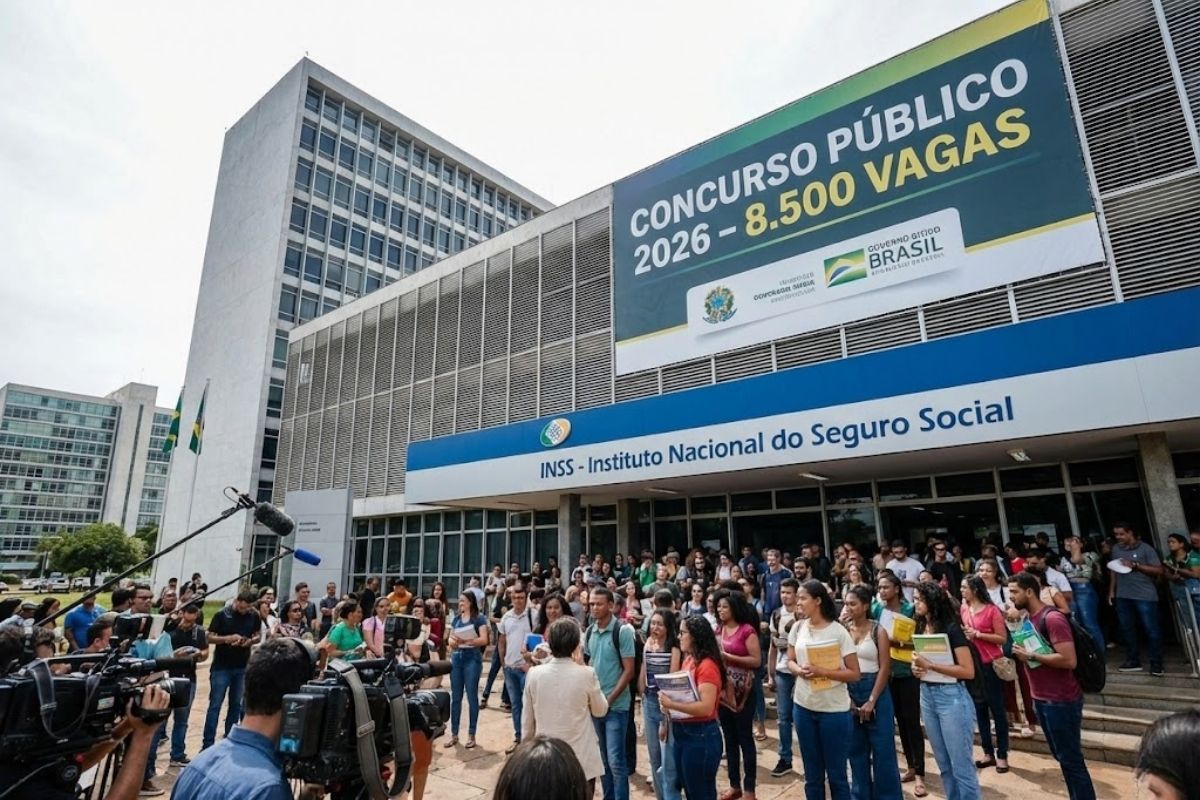


INSS Wants to Strengthen Service and Reduce More Than 23 Thousand Vacant Positions With a Contest Planned for 2026, Seeking Approval From the MGI to Open 7 Thousand Positions for Technician and 1.5 Thousand for Analyst, With Salaries Up to R$ 10,371.31 and National Impact in All Regions, Depending on Final Authorization.
The INSS is preparing a large-scale exam for 2026, with 8,500 positions distributed across all regions of Brazil. The declared intention is to replenish teams and make the service more sustainable in light of a deficit that already exceeds 23 thousand vacant positions within the institute.
The plan still depends on final authorization from the government, as the INSS submitted a formal request to the Ministry of Management and Innovation in Public Services (MGI). Internal expectations are that this approval will be granted in the coming weeks, unblocking the organization of the exam, the choice of the organizing body, and the preparation of the announcement.
Request to the MGI and What Changes When Authorization is Granted
The central point at this moment is the request sent to the MGI.
-
Work at Vale! The company is recruiting individuals with high school, technical, and higher education in areas such as maintenance, operations, and technology, with 400 immediate openings in 6 states, salaries of up to R$ 10,000, and 100% online applications.

-
Australia accelerates the search for foreign workers in 2026 with an official list of in-demand professions that includes drivers, programmers, and nurses, salaries starting from AUD 76,515 per year, and visas that can lead to permanent residency.

-
The Macaé City Hall starts the week with job openings that promise to boost hiring and open doors for qualified professionals and newcomers to the market, with a focus on offshore positions.

-
Future profession with immediate earnings: Specialist reveals how a solar energy technician earns R$ 8,000 per month by taking advantage of the explosion in demand across the entire country.


Without this green light, the exam does not advance to the practical stages that transform an intention into a calendar, rules, and registrations.
With authorization, the INSS can formalize the preparation of the announcement, define the organizing body, and consolidate the selection design.
This detail is significant because the announcement of the exam comes with numbers and a strategy: to fill positions on a national scale and address a personnel deficit that directly affects the agency’s response capacity.
In practice, 2026 becomes the window in which the government decides whether the replacement will be made through a broad selection, with thousands of positions, or if the plan remains stuck in the request phase.
Another point of attention is the order of the next decisions.
The planning itself already points out what depends on approval: organizing body and announcement.
In other words, the debate is still at the institutional phase, before any public schedule.
Therefore, the theme “authorization” appears as the piece that separates a desired exam from a contest actually taking place.
Distribution of Positions for High School and Higher Education
The design presented by the INSS separates the 8,500 positions into two blocks.
The largest of them targets the position of Social Security Technician, which requires a high school diploma, with 7 thousand positions.
The second block is for Social Security Analyst, a higher education function, with 1.5 thousand positions.
This division shows where the operational weight of the exam lies.
The larger volume at the high school level indicates priority at the front line and in internal flows, while the group of higher education reinforces functions that require specific training.
It is a snapshot of what the institute claims to need to replenish teams, with positions aiming for both reach and technical capacity.
It is also here that the national scale becomes clearer.
The positions are projected for all of Brazil, which increases the complexity of logistics and organization of the examination in 2026.
When the plan refers to all regions, it indicates a reach that usually attracts candidates in mass, precisely because it does not concentrate the positions in a single axis.
Salaries, Benefits, and Why the Exam Attracts Attention
The reported ceiling for initial remuneration reaches R$ 10,371.31, including salaries and benefits, within the planned exam proposal for 2026.
This level appears as one of the engines of attractiveness, especially for candidates with higher education.
At the same time, the INSS signals that there will also be competitive salaries for high school level, along with stability and a career plan.
This combination helps explain why an exam with thousands of positions, detailed salaries, and national distribution tends to attract attention from candidates in different regions of Brazil.
In practice, the salaries become the most immediately comparable data, as the rest still depends on approval and the announcement.
The situation is as follows: the institute details a salary ceiling, outlines the volume of positions, and details the division by level, but still awaits authorization to turn this into official rules for the exam.
Historical Deficit of Employees and the Impact on Attendance
The institute itself classifies the exam as strategic to face a deficit that already exceeds 23 thousand vacant positions.
When a federal agency operates with such a large void, each retirement, dismissal, or vacancy increases the pressure on those who remain, and the capacity for service tends to become more limited.
That is why the number of positions does not appear in isolation. The 8,500 positions come as an attempt for block replenishment, with potential effects on a national scale.
It is at this point that the INSS tries to align personnel replacement with practical needs: more people working, more capacity to organize demand, more breathing room to sustain routines of service and analysis.
The contrast is direct: a deficit above 23 thousand, a request for 8,500 positions. This does not erase the gap, but indicates the extent of the replenishment intended in 2026.
And it is precisely this difference between deficit and request that gives political and administrative weight to the issue, because it highlights that the institute speaks of a significant but still partial replenishment.
CNU 2025 and the Cut of 300 Positions for Social Security Analyst
While the request for a exam for 2026 awaits authorization, the INSS also appears in the Unified National Contest (CNU) 2025, with 300 positions for Social Security Analyst.
The written test was conducted in December 2025, in 228 cities, and candidates are awaiting the release of the preliminary score, expected for January 23, 2026, according to the schedule of the organizing body Getulio Vargas Foundation (FGV).
This cut serves as a short-term thermometer, as it involves positions, an organizing body, and already defined dates.
It also shows a movement in two fronts: on one side, a block of 300 positions already included in an exam that took place; on the other, a much larger request for positions for 2026, still dependent on authorization.
In practice, the scenario puts two volumes in perspective. The CNU 2025 brings 300 positions for Analyst.
The INSS‘s request for the exam for 2026 speaks of 1.5 thousand positions for Analyst and 7 thousand positions for Technician, totaling 8,500.
This helps to understand why authorization becomes the decisive point, as the scale jump is enormous.
Budget for 2026 and the Environment for Authorizations in the Executive
The discussion about authorization is also tied to the budgetary context.
The Annual Budget Law Proposal (PLOA) for 2026, sent to Congress in August, forecasts more than 42 thousand positions in the federal Executive.
Within this context, the request from the INSS gains an additional argument: there is a broader projection of positions in the Executive in 2026, which reinforces the expectation of approval and, later on, appointments.
Still, the decisive point remains the same: without authorization, the exam does not turn into an announcement.
With authorization, the pieces fit together and the schedule begins to depend on administrative definitions, such as the organizing body, rules, and publication of the announcement, keeping the focus on 2026 as the mark of planning.
What is clear is the combination of scale and timing.
The institute requests 8,500 positions, the Executive has a broader projection of positions in the PLOA, and the INSS exam targets 2026.
It is an alignment of numbers that supports the internal expectation mentioned: approval in the coming weeks to allow the contest to take shape.
Federal Medical Expert Until 2027 and Calls Already Made
In parallel, there is another piece of data that helps to complete the picture of replenishment: the exam for Federal Medical Expert remains valid until 2027 and has already called 250 approved candidates, according to publication in the Official Gazette of the Union.
This movement shows that part of the replenishment occurs through selections already underway, even while the institute structures a larger proposal.
The practical effect is a mosaic: on one side, there is a broad request for an exam for 2026 with 8,500 positions; on the other, there are calls within an exam valid until 2027; and in the middle, there is participation in the CNU 2025, with positions and a schedule already in progress.
In the end, what determines the actual size of the INSS exam in 2026 is the authorization. If the approval comes through, the next step tends to be the rush for the announcement, organizing body, and calendar, with special attention to salaries, positions, and national distribution.
If you want to compete for these positions in 2026, keep an eye on the authorization at the MGI and, when the announcement exists, check requirements, positions, stages, and salaries before creating a study plan.
In your region, a national exam from the INSS with 8,500 positions in 2026 seems sufficient to alleviate the deficit, or do you think more positions and salary adjustments are still needed?









Aqui a demanda é grande… Conheço muitos funcionários que se aposentaram nos últimos anos.