





 Portuguese
  English
  Spanish
  6 min of reading
  0 comments



Social Security Attorney Tais Santos explains why 11% guarantees rights, but 20% paves the way for a larger benefit in the future.
Contributing to the INSS is mandatory for those without a formal job who want to ensure retirement and protection in case of illness or death, but how you contribute determines the size of the benefit down the line. Paying 11% or 20% is not just a value choice, it is a decision about retirement planning that can prevent you from wasting money every month.
According to Tais Santos, Social Security Attorney, those who contribute 11% to the INSS have important rights guaranteed, such as retirement by age, sick leave, disability retirement, and death pension, all calculated based on the value of a minimum wage. On the other hand, those who contribute 20% can choose a higher contribution base, access more types of benefits, and seek a better-planned retirement, according to their financial capacity and the time of contribution they have already accumulated.
Who Is Responsible for Paying Their Own INSS
Not everyone has automatic contributions on their pay stub. Those without a formal job or without a signed work contract need to pay attention, because being responsible for your own INSS is what separates security from uncertainty in the future.
-
The new Civil Code could revolutionize marriages in Brazil with “express divorce” and changes that could exclude spouses from inheritance.

-
Banco do Brasil sues famous influencer for million-dollar debt and intensifies debate on delinquency, risks of seizure, and direct impact on Gkay’s credibility.

-
The Senate approves a bill that criminalizes misogyny, hatred, or aversion towards women, and includes the crime in the Racism Law with a penalty of up to 5 years.

-
Chamber Approves Bill That Allows Pepper Spray for Women Over 16 and Imposes Strict Rules for Purchase, Possession, and Use as Self-Defense


This group includes self-employed contributors, voluntary insured individuals, and those who work without an employment relationship, such as interns. This student provides services, receives compensation, but does not have a signed work contract. If they want social security protection, they need to contribute to the INSS on their own.
The housewife also falls into this scenario. She works, and a lot, at home, but does not have an official record. If the housewife does not contribute to the INSS, she remains completely uncovered in case of illness, disability, or death, without retirement and without death pension for dependents. In these cases, the husband, partner, or children may take on the monthly payment so that she can have protection in the future.
Contributing 11% to the INSS: Guaranteed Rights, but Benefit Value Ceiling
Those who choose the simplified withdrawal of 11% contribute 11% based on the minimum wage. It is a lower and more accessible amount, especially for those who do not have a high income or are returning to contributions just to complete the minimum retirement age.
With this 11% contribution, the insured secures:
- Retirement by Age
- Sick Leave in case of temporary incapacity
- Disability Retirement when unable to return to work
- Death Pension for dependents, in case of passing
The rule is clear: all these benefits will always be limited to the value of a minimum wage. It does not matter how much a person earned in practice; the benefit from the 11% contribution is confined to the minimum wage.
Furthermore, those contributing 11% do not have the right to retirement based on contribution time. For those who are older, nearing the minimum of 15 years of contribution, this modality can be interesting, as it grants the basic right to retirement by age at a lower cost.
On the other hand, attention is required. There are specific features of this simplified contribution that do not apply to everyone. Business owners, for example, cannot use the 11% code and need to contribute 20%, following the rules of their classification.
Contributing 20% to the INSS: When It Makes Sense to Seek a Larger Benefit
In the 20% contribution, the insured chooses the calculation base. It can be 20% of the minimum wage or 20% of higher amounts, up to the INSS ceiling. The higher the contribution base, the larger the future benefit is likely to be.
The big difference is that, in this model, the person can plan for better retirement, including the possibility of retirement based on contribution time, as long as they follow current regulations. The benefits cease to always be at the minimum and start to reflect the salary history on which contributions were made.
But that does not mean that contributing the maximum is always worthwhile. A specialist needs to look at three fundamental points:
- How much have you contributed to date
- What is your age and what stage of your social security life are you in
- What is your real monthly contribution capacity
If the person has a higher income, is a business owner or a self-employed individual with good earnings, it may be advisable to contribute 20% based on a larger base. However, if the chosen amount does not fit in the budget, there is a risk of delaying payments and turning a retirement plan into an unnecessary financial burden.
Social Security Planning: How Not to Waste INSS Money
The difference between 11% and 20% is not just numerical; it is strategic. Without social security planning, a person can spend years paying dearly for a contribution that does not significantly improve their benefits as they imagined.
Good planning analyzes:
- What type of insured individual you are today: voluntary, self-employed, business owner, intern, housewife
- How much contribution time you already have
- How much time is left to qualify for the retirement you desire
- Whether it is better to contribute with 11% or 20%
- Whether it makes sense to increase the contribution base or if that would only be spending without proportional return
It is common for the advice to be completely different for someone who has never contributed and someone who already has 13 or 14 years of contributions accumulated, for example. In many cases, it is enough to adjust the way to pay the INSS to transform a minimum retirement into a more comfortable benefit, as long as it aligns with the insured’s financial situation.
Social security planning is not a luxury. It is a targeted investment that can change decades of results down the line.
Make INSS Payments a Monthly Priority
A message is repeated in all practical examples: failing to contribute is not an option for those who want security in the future.
Even those who choose the 11% of the minimum wage, especially women who work at home or those without a fixed income, need to treat this amount as a monthly priority. If it is not possible to pay alone, they can seek help from relatives, such as a spouse or children, to ensure payment by the 15th of each month, avoiding delays that could compromise the right to the benefit.
For those with a higher income, especially business owners, the reasoning is different. The challenge is not just to pay, but to pay the right way. Contributing significantly without a strategy can mean wasting money every month, when it would be possible to balance value, contribution time, and desired benefits.
Therefore, talking to a social security specialist, understanding your contribution history, and defining a plan can be the turning point between merely achieving minimum retirement and a income that better matches the standard of living you have built.
11% or 20%: What Is the Best Path for Your INSS Today?
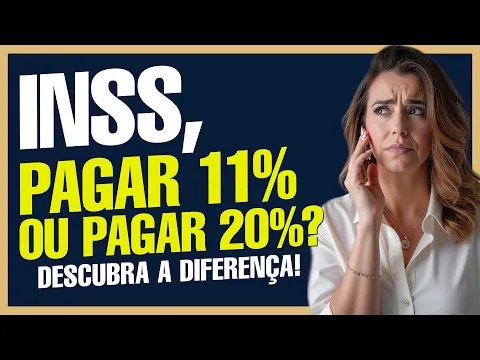

At the end of the day, there is no one-size-fits-all answer. Those who contribute 11% to the INSS do indeed have important rights guaranteed, such as retirement by age, sick leave, disability retirement, and death pension based on a minimum wage. For many, this is already a significant improvement compared to having no protection at all.
On the other hand, those who contribute 20% open the door to larger benefits and better-planned retirement, as long as it makes sense for their profile, contribution time, and budget.
What remains unchanged is the central point: planning, clarity about the type of contribution, and monthly payment prioritization are essential to prevent the INSS from becoming a wasted expense and instead turning it into concrete protection for you and your family.
And for you, looking at your current reality, which INSS contribution makes the most sense at this moment: ensuring the basics with 11% or building a larger benefit with 20%?










-

-

-

8 pessoas reagiram a isso.