





 English
  Francês
  Alemão
  Italiano
  Japonês
  Norueguês
  Portuguese
  Spanish
  2 min of reading


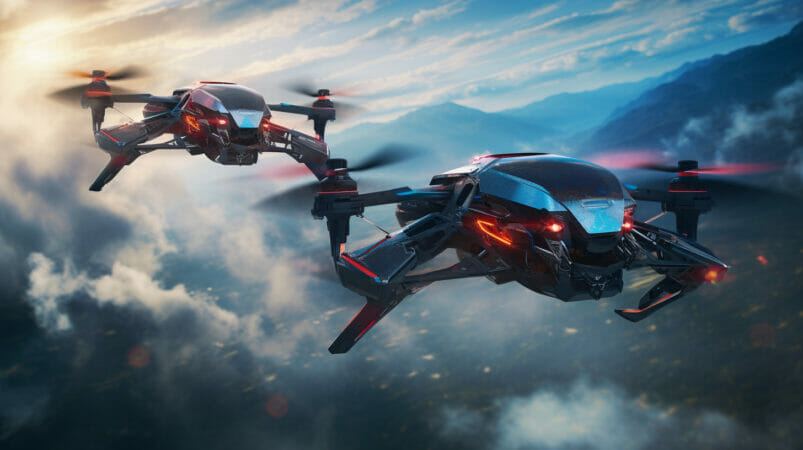
It Was a Day to Go Down in the History Books. For the First Time, an AI-Controlled Drone Defeated Human Champions in a Racing Competition.
Revealing potential advancements not only for sports but also for other fields such as industrial robotics and vehicle automation.
The study, published in the prestigious journal Nature, documents how the autonomous drone, named Swift, navigated through all obstacles and broke records. And we are talking about a quite complex circuit, 75 meters long with seven gates, where the machines easily reach 100 km/h. If you think Formula 1 is exciting, this drone race would leave you astounded!
Man vs Machine
The humans had an entire week to train. Among the participants was a former world champion in drone racing. But it was the machine that took home the trophy.
-
At just 14 years old, a boy creates a system without energy, using steel pipes buried in the ground, that irrigates seedlings with moisture from the air, to combat the water scarcity threatening reforestation in northern China.

-
Anti-tank mines appear near a missile base in Iran, causing fatalities and raising suspicion of a new move to block underground launchers.

-
Contaminated water from uranium threatens mining areas, and Chinese scientists have created a solar-powered living filter that could change environmental decontamination.

-
Archaeologists find in Mexico a sacrifice altar over 1,000 years old, surrounded by skulls, human bones, and signs of rituals from the Toltec Empire.


Inside the Swift
The Swift is not just any drone. It was equipped with a technology called “deep reinforcement learning”, which allowed it to adjust its course in real time and send up to 100 new commands per second. “That’s faster than a blink of an eye,” explains Elia Kaufmann, one of the authors of the study.
While human-controlled drones can benefit from quick adaptation to changes in light and environment, they cannot compete with the processing speed and accuracy of the Swift. However, this speed can be a double-edged sword, as the machine takes significant risks, always operating at the limit.
The success of the Swift is not limited to the world of drone racing. Experts, including military personnel and academics, are keeping an eye on these advancements, as they may impact a much wider range of applications.
Energy Efficiency
According to Kaufmann, the biggest challenge now is how to make these autonomous drones more energy-efficient. After all, what good is speed if you can’t fly for long?









Seja o primeiro a reagir!