





 Portuguese
  English
  Spanish
  6 min of reading
  2 comments





Invasion of Buffaloes in Brazil Advances from Marajó Island to Rondônia, Occupies Reserves, Dries Wetlands, Forces Fish Out, Increases Conflicts with Riverside Communities, Spreads Diseases to Cattle, Triggers Attacks on Boats and Forces Government to Act in Light of Explosive Population Growth Compared to Wild Boars by the Federal Public Ministry as Early as 2025
In February 2025, when the Federal Public Ministry demanded an emergency plan to remove thousands of feral animals from the Guaporé Valley, the invasion of buffaloes in Brazil ceased to be a regional problem and began to symbolize an environmental, health, and social crisis in the heart of the Amazon.
What started in the late 19th century, with the arrival of Asian buffaloes to Marajó Island to replace European cattle in flooded areas, turned into uncontrolled herds that now advance over reserves, riverside communities, and entire rivers in Rondônia, due to decades of neglect and poor management.
From Exotic Species to Announced Crisis in the Amazon

The presence of exotic species outside their original habitat has already transformed the Brazilian countryside into a laboratory of difficult-to-control problems, from wild boars to Asian deer that escaped from farms and spread throughout crops and natural areas.
-
Agricultural drone sprayed poison into the air and destroyed the neighbor’s crops, causing 1 million in damages; 48 cows died from nitrite poisoning in the pasture, and Russia is hiding a possible outbreak of foot-and-mouth disease: the week was brutal for the rural sector.
-
Russia cut fertilizers, China cut fertilizers, and oil prices soared with the war in the Middle East: sugarcane producers in the interior of São Paulo are seeing costs explode from all sides and warn that the effects will take months to be absorbed.
-
It does not come from flowers, is produced only every two years, and more than 90% goes straight to Europe: meet the bracatinga honeydew honey from Santa Catarina, considered one of the rarest in the world and overlooked by Brazil itself.
-
They said no to 26 million dollars and would do it all over again: mother and daughter from Kentucky reject a million-dollar offer from a mysterious company that wants to build the largest data center in the state on more than 2,000 acres of rural land.


In this context, the invasion of buffaloes in Brazil ceased to be an isolated curiosity and began to represent a new cycle of large-scale ecological imbalance.
Originating from Asia, the Asian buffalo was brought to the country precisely for its ability to survive in flooded areas, pull plows, provide meat, milk, and leather, thriving in environments where European cattle failed due to heat, humidity, and waterlogged soil.
Marajó: When the Buffalo Seemed the Perfect Solution
On Marajó Island in Pará, the buffalo became so integrated into daily life that today there are more animals than inhabitants, found on dirt roads, in carts, in milk turned into cheese, and even in mounted police patrols.
The choice was not by chance, but rather the result of decisions made as far back as the late 19th century. In 1890, farmer and police chief Vicente Chermont de Miranda introduced animals from French Guiana.
A few years later, in 1895, new batches brought by Leopoldina Lobato de Miranda, this time from Italy, mixed Asian and European lineages, consolidating what is now known as the black buffalo of Marajó.
Resistant to humid heat, flooded land, and sparse vegetation, these animals began to sustain the local economy with meat, milk, leather, and draft power, giving the impression that the country had found a productive ally adapted to flood-prone environments.
From Experience in Rondônia to Feral Herd within Reserves
The productive success in Pará inspired expansion to other regions. Buffaloes were brought to Amapá, São Paulo, Goiás, and finally Rondônia, initially in official projects for meat and milk production.
In the 1950s, a group of 36 animals was established on an experimental farm, but the program was abandoned without a consistent management or removal plan.
The animals were left to their own devices, crossing rivers, entering forest areas, and forming wild herds that now advance over conservation units.
Surveys indicate that since 2016, more than 5,000 feral buffaloes have been documented in Rondônia, with projections suggesting up to 50,000 individuals by around 2030 if effective control is not implemented.
This silent advance illustrates how the invasion of buffaloes in Brazil has transcended productive borders and has begun to occupy precisely the areas created to protect sensitive ecosystems.
A large portion of these animals is concentrated in the Guaporé Biological Reserve, established to protect the transition between the Amazon and the Cerrado, and in the extractive reserve of Pedras Negras, where riverside families depend directly on the forest and rivers for survival.
Dried Mud, False Drought, and Accelerated Loss of Flooded Areas
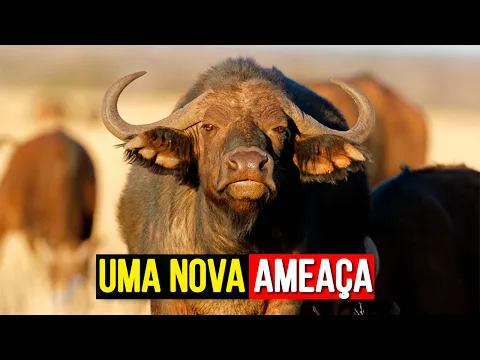

The most visible impact of the invasion of buffaloes in Brazil appears on the soil and in the water. The constant trampling of herds weighing hundreds of kilograms compacts the ground, reduces water infiltration, and prevents vegetation regeneration.
Areas that were once flooded fields now display cracks, shallow puddles, and deep trails opened by hooves, in a process that researchers describe as false drought, where rain continues, but water simply drains away.
Studies indicate that the Guaporé Biological Reserve has already lost a significant portion of its wetland areas, precisely those that served as nurseries for fish, amphibians, aquatic insects, and birds.
Today, buffaloes occupy around 96,000 hectares, equivalent to approximately 16 percent of the protected area, with tens of thousands of additional hectares deemed vulnerable to future occupation.
As the animals open channels and trails, they alter the natural course of water, transforming lagoons into dried mud and reducing habitat availability for native species that depend on flooded landscapes.
Attacks on Boats, Dangerous Roads, and Communities under Pressure
The advance of feral herds is not limited to land use maps.
More and more, residents report dangerous encounters with buffaloes on trails, riverbanks, and Amazon roads.
Videos recorded in the Guaporé Valley show small boats being pushed by animals weighing nearly a ton, charging against the hull in shallow waters and forcing fishermen to retreat hastily to avoid serious accidents.
On poorly marked roads, especially at night, the presence of buffaloes on the asphalt increases the risk of head-on collisions with vehicles, with the potential for tragedies similar to those already recorded in regions dominated by free-roaming cattle.
In extractive and riverside communities, the problem is twofold.
In addition to the fear of direct attacks, families see fishing lagoons turned into mud, trails destroyed, and traditionally used areas for gathering food and forest medicines taken over by hoof trails.
The result is a loss of security, income, and autonomy for populations that depend on stable ecosystems to maintain their livelihoods.
Diseases, Vulnerable Livestock, and Public Health Risk
Unlike commercially managed herds on farms, the feral buffaloes spreading through reserves are neither vaccinated nor routinely monitored.
By circulating near pasture areas with cattle, they create a bridge for the spread of diseases such as brucellosis, tuberculosis, and leptospirosis, directly impacting meat and milk production.
Any focus of disease that establishes in wild herds can generate million-dollar losses for regional livestock and, in extreme scenarios, necessitate sanitary embargoes on animal-derived products.
Some of these diseases also affect humans, especially in areas where the population has frequent contact with water contaminated by animal urine and feces.
In flooded areas transformed into trampled mud, the risk of exposure to pathogens increases, amplifying the vulnerability of riverside communities that depend on the same water bodies for fishing, bathing, and domestic supply.
Government Under Pressure, Ethical Impasse, and Fear of Another Major Plague
The pressure for the government to react grows as the problem gains national dimensions.
In February 2025, the Federal Public Ministry summoned the government of Rondônia and the Chico Mendes Institute for Biodiversity Conservation, demanding an action plan within ten months to control feral herds and restore degraded areas, along with millions of reais in compensation to fund reforestation and habitat restoration.
Before this, in 2016, the state approved a law to eradicate buffaloes in the Guaporé Valley, but lack of budget, logistics, and consensus on slaughter methods prevented any animals from being effectively removed.
On one side, biologists point to the need to drastically reduce the population to prevent the invasion of buffaloes in Brazil from reaching a scale comparable to or even greater than that of wild boars.
On the other side, animal rights advocates argue that buffaloes are victims of human abandonment and reject solutions based on extermination.
As the impasse persists, the herds continue to advance over reserves, roads, and communities, pushing the country into a crossroads between conserving ecosystems and figuring out how to practically deal with an exotic species that has become an environmental security problem.
In light of this scenario, the question that remains is simple and urgent: what kind of response do you consider acceptable to prevent this situation from becoming an even more devastating plague than the wild boars in the coming years?








Não tem que trazer **** que não é da,fauna do Brasil. Depois “não dá certo” e simplesmente os abençoados largam a própria sorte, sem controle algum e dá nisso. Depois os coitados é que pagam. Foi assim c o peixe palhaço e c o caracol africano, soltam na natureza e acaba virando praga, já que não tem predadores naturais.
Deixem os animais em paz, cada um no seu devido lugar
MAIS UM PROBLEMA QUE O HOMEM CRIA E TEM QUE RESOLVER.