





 Portuguese
  English
  Spanish
  6 min of reading
  0 comments


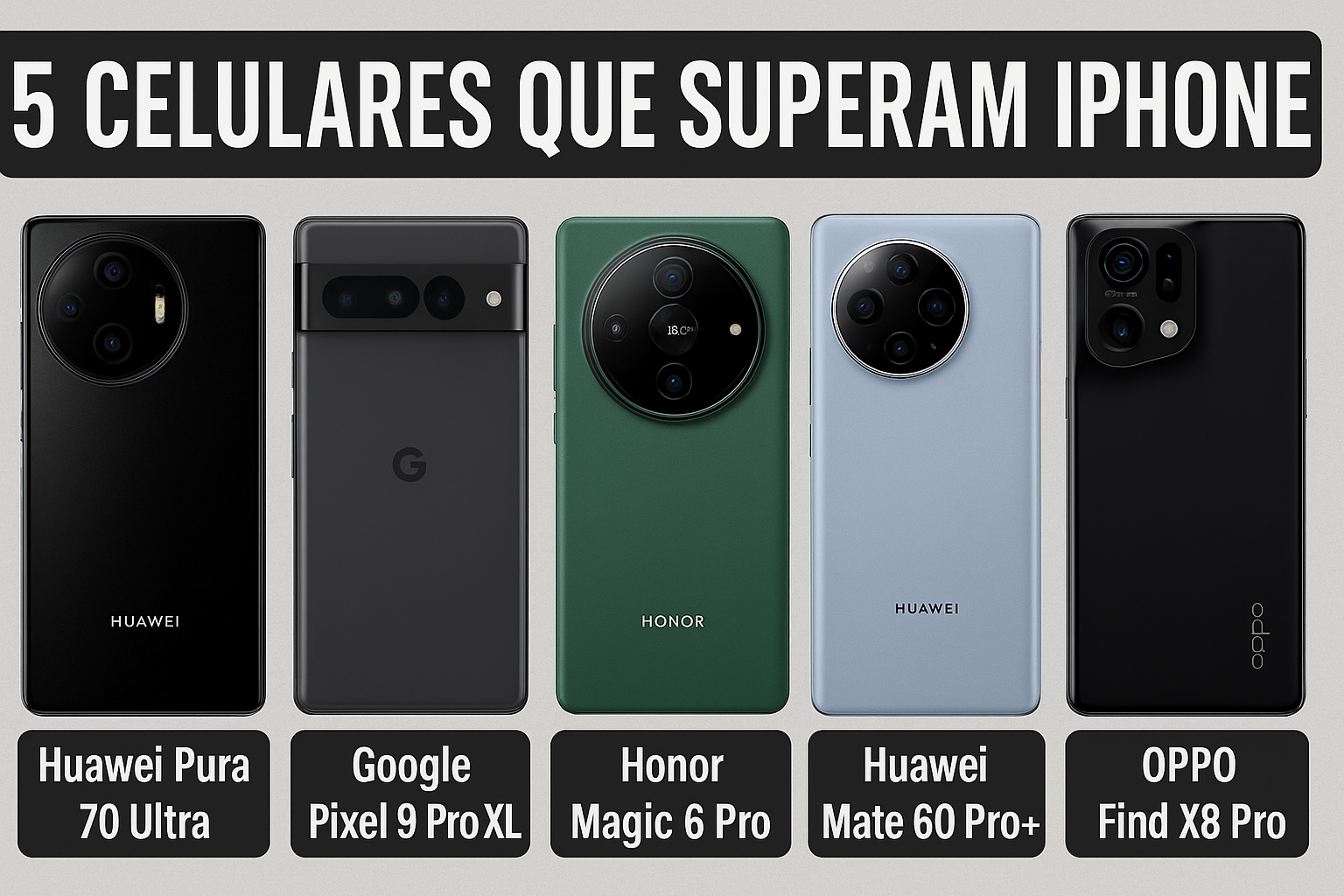
Meet 5 Smartphones With Cameras Better Than the iPhone in 2025. Models from Huawei, Google, Honor, and OPPO Surpass Apple in DXOMARK Tests. See the Complete Comparison.
For years, Apple ruled supreme in the smartphone photography segment, combining high-quality sensors with impeccable image processing. The iPhone was a reference point for both enthusiasts and professionals, especially in video recording. However, the year 2025 marks a turning point: several smartphones with cameras better than the iPhone released by Asian competitors not only matched the iPhone’s performance but also surpassed it in independent tests and specialized benchmarks.
This is revealed by the updated ranking from DXOMARK, a platform recognized worldwide for technically and impartially evaluating aspects such as camera, battery, audio, and screen of mobile devices. According to the latest tests, at least five models have more advanced cameras than the iPhone 16 Pro Max, which is currently Apple’s most complete photographic device.
The Ranking That Shook the Apple Throne: What Is DXOMARK?
Before diving into the models, it’s important to understand what makes DXOMARK so relevant. The French company uses laboratory equipment and scientific protocols to measure the performance of cameras in various scenarios: daylight, low-light environments, moving photos, zoom, portrait, exposure, texture, and noise. Each device receives a final score, which serves as a reference for comparisons between devices.
-
The change in weather arrives tomorrow: heavy rains and storms return to the Central-South after a hot week, with a cold front along the coast bringing instability between Santa Catarina, Paraná, and the Southeast, affecting capitals strongly until Thursday.

-
The rapporteur of the critical minerals project said today that Brazil will not create a state-owned mining company, but Lula has already discussed the creation of Terrabras with ministers last Friday, and the United States has already invested 565 million dollars in a Brazilian mining company without waiting for a response from the government.

-
Roads made with recycled plastic, crushed tires, and construction waste are already being applied in several countries, reducing tons of waste in landfills and increasing the durability of the pavement by replacing traditional materials.

-
Drones have become “insects” and spread native seeds to recover inaccessible areas; the Bacias & Florestas program, for 15 years, has planted 3 million trees and restored 15 thousand hectares, despite costs of up to R$ 25 thousand/ha.


In 2025, the iPhone 16 Pro Max achieved 157 points. An excellent result, but no longer enough to lead. Models from Huawei, Google, Honor, and OPPO surpassed this mark and put Apple on the defensive — at least concerning photography.
Huawei Pura 70 Ultra: The Best Smartphone on the List of Smartphones With Cameras Better Than the iPhone in 2025


At the top of the ranking is the Huawei Pura 70 Ultra, launched in April 2024. With 163 points, the device is currently the global leader in smartphone photography according to DXOMARK, placing a margin of six points over the iPhone 16 Pro Max.
The Chinese model boasts a top-notch photography package, featuring a main camera with 50 megapixels equipped with a 1-inch sensor and a variable aperture of f/1.6 to f/4.0 — providing enormous flexibility in light entry, something lacking in Apple devices.
This main lens includes optical stabilization via sensor shift, a technology that physically moves the sensor in various directions to compensate for shakes and sudden movements, resulting in sharper photos even in low light or with the phone in motion.
The system is complemented by a 40 MP ultrawide lens and a 50 MP telephoto lens, which also acts as a macro camera. The combination ensures not only versatility but also excellence at all focus distances.
Even though it is not officially sold in Brazil, the Huawei Pura 70 Ultra has already established itself as the smartphone with a camera better than the iPhone, with superior performance in almost all evaluated categories: texture, color, noise, focus, zoom, and stabilization.
Google Pixel 9 Pro XL: Computational Photography Taken to the Limit

The Google Pixel 9 Pro XL, launched in August 2024, represents the pinnacle of computational photography on the list of smartphones with cameras better than the iPhone. The device scored 158 points on DXOMARK, surpassing Apple’s flagship by one point. Although it has the same 50 MP sensor as the previous generation, Google’s model stands out for its image processor, which utilizes artificial intelligence to enhance texture, exposure, and color.
The optical setup consists of a main camera with a 1/1.31-inch sensor, f/1.68 aperture, and optical stabilization. It also integrates a 48 MP ultrawide lens with autofocus, as well as a 48 MP periscope telephoto lens with 5x optical zoom, all with hardware stabilization (OIS).
In DXOMARK tests, the Pixel 9 Pro XL notably delivered realistic skin tones, refined light control in challenging environments, and high performance in zoom, with little loss of detail even at 10x.
It is the best pure Android for those seeking an advanced photographic experience, without sacrificing a lean software and guaranteed updates.
Honor Magic 6 Pro: The Power of Zoom at 180 Megapixels

If the criterion is zoom capacity, no current smartphone surpasses the Honor Magic 6 Pro. Launched in January 2024, the model scored 158 points in the DXOMARK ranking, the same score as the Pixel 9 Pro XL. However, its differentiator lies in the impressive 180 MP periscope telephoto lens, with 2.5x optical zoom and up to 100x digital zoom, along with optical stabilization.
The main camera of the Magic 6 Pro has 50 MP, with variable aperture between f/1.4 and f/2.0, allowing dynamic adjustments according to the lighting. The ultrawide lens, also 50 MP, performs excellently in wide scenes with many light sources.
In technical tests, the Honor model excelled in sharpness at long distances, excellent color balance, and performance in nighttime photos. For those prioritizing zoom, whether for distant portraits or detailed landscapes, the Honor Magic 6 Pro is today one of the best alternatives available — and clearly one of the models that surpass the iPhone in the field of photography.
Huawei Mate 60 Pro+: Intelligent Autofocus and Balanced Performance

Launched in September 2023, the Huawei Mate 60 Pro+ still remains among the global leaders, with 157 points, the same score obtained by the iPhone 16 Pro Max. However, the device stands out for unique features, such as a variable aperture that automatically adjusts based on the number of faces detected in the image, optimizing focus in group portraits.
The optical system features a main lens of 48 MP with stabilization and variable aperture, a 48 MP periscope lens with 3.5x optical zoom, and a 40 MP ultrawide lens. Together, the three lenses work with AI algorithms to adapt focus and exposure to the captured scene.
The distinguishing factor compared to the iPhone lies in wide-angle details, faithful color reproduction even in complex lighting conditions, and photo stability in moving environments. Additionally, the device features a high-resolution OLED screen with a refresh rate of 120 Hz and an ultrafast charging battery of 88 W, which recharges the device in under 30 minutes.
OPPO Find X8 Pro: Four Cameras to Dominate All Distances
Closing the list of smartphones with cameras better than the iPhone, the OPPO Find X8 Pro stands out for its set of four rear cameras, something rare even among flagship models. It also achieved 157 points in the DXOMARK ranking.

The main camera has 50 MP, f/1.6 aperture, and two-axis stabilization, ensuring stable photos even in motion. The model also has two telephoto lenses, each with 50 MP — one with 3x optical zoom and the other with 6x optical zoom, both with advanced stabilization. To complete the setup, there is a 50 MP ultrawide lens.
This configuration offers unmatched versatility. According to DXOMARK, the Find X8 Pro stands out particularly in portraits and zoom, surpassing the iPhone 16 Pro Max in sharpness and optical range categories. In video, the device falls short compared to Apple, but in pure photography, it is superior in over 70% of the tested scenarios.
Is It Still Worth Buying an iPhone for Photography?
The iPhone 16 Pro Max still delivers one of the best performances in the market, especially in video, recording in Dolby Vision, focusing speed, and color fidelity. However, its limitations of fixed aperture, absence of long-range optical zoom, and smaller sensors put it at a disadvantage against the competition.
For those prioritizing photography in challenging environments — such as concerts, nighttime portraits, macro, or telephoto photos — the options from Huawei, Honor, Pixel, and OPPO offer more quality, depth of field, and sharpness in 2025.
Apple remains a reference when it comes to smartphone cameras, but the latest technical tests show that the throne is being occupied by new brands. With larger sensors, technologies such as variable apertures, periscope lenses, and enhanced AI, the smartphones from Huawei, Google, Honor, and OPPO are clearly and objectively surpassing the iPhone.
If your priority is photography — especially in demanding conditions — there are now superior alternatives to the iPhone. And as new generations are launched, the future of mobile photography seems increasingly competitive.







-

-

3 pessoas reagiram a isso.