





 Portuguese
  English
  Spanish
  5 min of reading
  0 comments


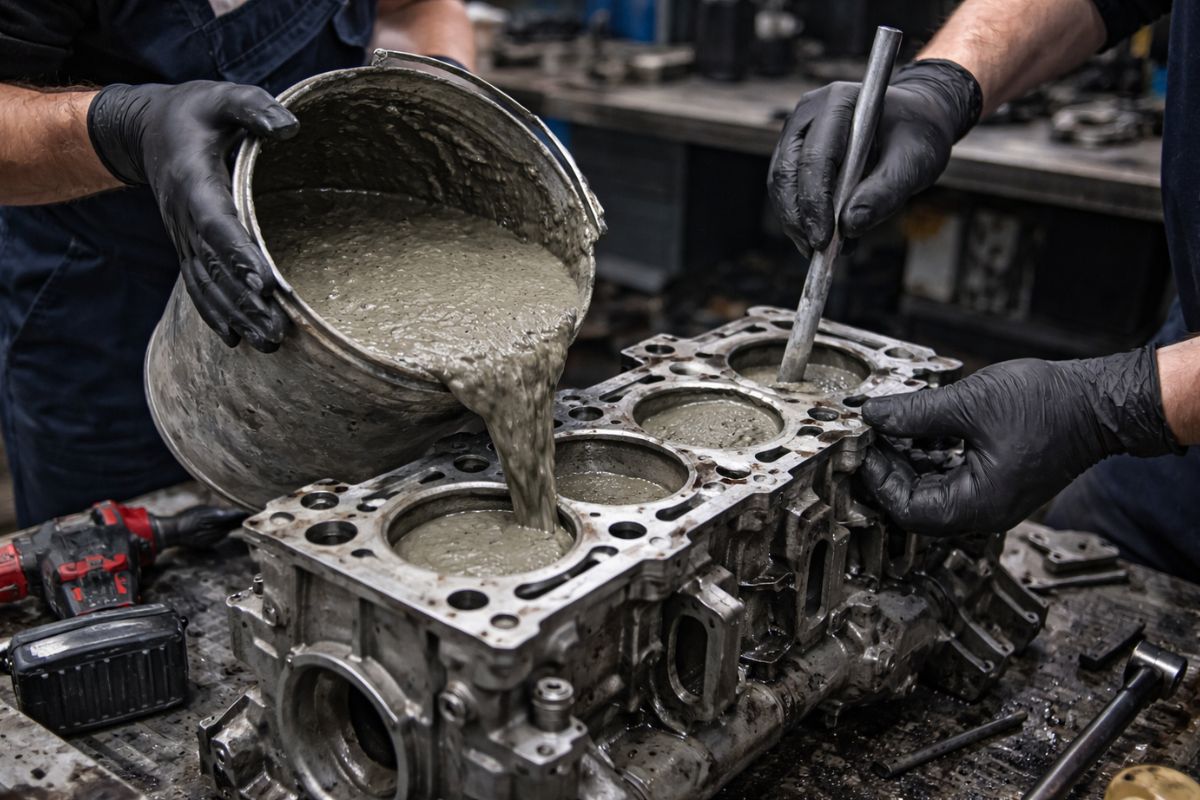
High-performance mechanics are filling engine blocks with concrete to eliminate empty spaces that flex under extreme pressure, making the structure stiffer and preventing failures in engines prepared for drag racing and high-power projects.
When you see someone pouring concrete inside an engine block, the first reaction is to think they are destroying the part. But mechanics specialized in high-performance engine preparation do this on purpose, and the technique has a logic that makes sense when you understand what happens inside an engine subjected to extreme power. The concrete, or similar substances like the Rokblock product, fills the internal cooling passages of the block, eliminating empty spaces that can flex and compromise the structure when the engine operates at its limit.
The technique is not for just any car. Mechanics apply concrete filling exclusively in special projects, such as engines prepared for drag racing or competition vehicles where the power far exceeds what the original block was designed to withstand. The procedure transforms the block into a monolithic structure that is stiffer, keeping the cylinders aligned and allowing the piston rings to maintain proper sealing even under extreme pressure and temperature. It is unconventional applied engineering, but with solid technical foundations.
Why mechanics pour concrete inside engine blocks

In a normally functioning internal combustion engine, each cylinder generates a large amount of pressure and heat with each cycle. The rotating assembly transmits vibrations throughout the block, and the internal empty spaces, such as the cooling passages, can start to flex under this load.
-
BYD was caught testing 1,500 kW chargers in China that are three times more powerful than Tesla’s, and the system promises to recharge electric cars in minutes with energy that costs less than one real per kilowatt-hour.

-
The best-selling car in history, the new Toyota Corolla will have ‘ultra-efficient’ turbo engines with up to 30% more efficiency, more powerful 1.5 and 2.0 options, support for ethanol, hydrogen, and plug-in hybrids, as well as a radical design expected for 2026.

-
Jeep launches the 2027 Renegade with a 1.3 turboflex engine producing 176 hp, a 48V mild hybrid system, a new 10.1” multimedia system, a digital dashboard, and a starting price of R$ 129,000.

-
In four years, all taxis in New York will be required to have zero emissions, and Kia has just shown how the future will work with an electric vehicle featuring an automatic ramp, 30-minute charging, and a design that prioritizes accessibility.

For everyday use, this microscopic flexibility is perfectly normal and does not cause problems. But when mechanics prepare an engine for power levels far above the original, even slight flexing can become catastrophic.
Flexing compromises the sealing of the piston rings and causes performance losses or even serious mechanical failures. When the cylinders deform slightly under extreme pressure, the rings cannot maintain the perfect seal against the cylinder walls.
The result is loss of compression, gas escape, and reduction of power precisely when the engine needs to deliver the most. Mechanics working with high performance have identified that the weak point is not in the moving parts, but in the very structure of the block that supports them.
How concrete transforms the structure of the engine block
The material is poured into the internal passages that originally served to circulate the coolant. By filling these empty channels, mechanics transform the block into a solid piece that resists flexing far better than the original block.
The concrete, or specific products like Rokblock, infiltrates the cavities and creates a continuous base that prevents the cylinder walls from deforming under stress.
This extra stiffness brings two main benefits that mechanics value in high-performance preparations. The first is to keep the cylinders perfectly aligned under any level of pressure, ensuring that the piston rings maintain the seal.
The second is to reduce harmful vibrations, known as harmonics, which can accelerate the wear of internal components and cause cracks in the block over time. Eliminating weak points with solid material makes the entire system more resistant to mechanical stress.
The real risks of filling an engine block with concrete
The technique is not without consequences. The channels that mechanics fill with concrete exist for a reason: to circulate the coolant that keeps the engine at a safe operating temperature.
By eliminating these channels, the engine completely loses the ability to cool with liquid and relies solely on air cooling. The result is significantly higher operating temperatures.
That is why mechanics apply this technique only in special projects and not in everyday cars. An engine filled with concrete will not survive the traffic of a hot city nor withstand prolonged operation at cruising speed.
It is designed to operate in short bursts of maximum power, such as drag races that last only a few seconds. The engine delivers everything it has in an explosion of performance and then needs to cool down before being used again. Filling the block of a car used for commuting will quickly destroy it.
The drag engines where mechanics most use this technique
Drag racing is the perfect scenario for engines with filled blocks. The mechanics who prepare dragsters and drag racing vehicles deal with powers exceeding a thousand horsepower in engines that were originally designed to deliver a fraction of that value.
The internal pressure in the cylinders during a drag launch is brutal, and the original block simply was not sized to withstand that level of stress.
In this context, the mechanics’ decision to fill the block with concrete is a matter of engine survival, not aesthetic preference. The engine needs to withstand a few seconds of absolute maximum power without the block cracking, without the cylinders deforming, and without the piston sealing failing.
The concrete adds the mass and stiffness that the original block lacks to withstand loads that go far beyond any factory specification. It is brutal, it is unconventional, but it works.
What this technique reveals about the limits of automotive engineering
The practice of mechanics filling blocks with concrete exposes a truth about engine engineering. The blocks are designed with cooling passages that create structurally weaker points, a necessary compromise for the engine to operate under normal temperature conditions.
When mechanics eliminate these passages with solid material, they are essentially saying that, for extreme applications, cooling is expendable in exchange for structural integrity.
This is not a backyard hack. Professional preparation mechanics calculate the filling, choose specific materials, and know exactly which channels to block and which to keep. Products like Rokblock have been specifically developed for this application.
The technique is a clever solution to a real problem: how to make a mass-produced engine block withstand powers for which it was never designed. And as long as there are drag races and mechanics willing to push the limits, concrete will continue to be poured inside engines.
Did you know that mechanics pour concrete inside engine blocks to increase strength in drag racing? Do you think it’s genius or still think it’s crazy? Let us know in the comments. This is the kind of technique that divides opinions between those who understand engines and those who are just discovering it now.










Seja o primeiro a reagir!