





 Portuguese
  English
  Spanish
  6 min of reading
  0 comments


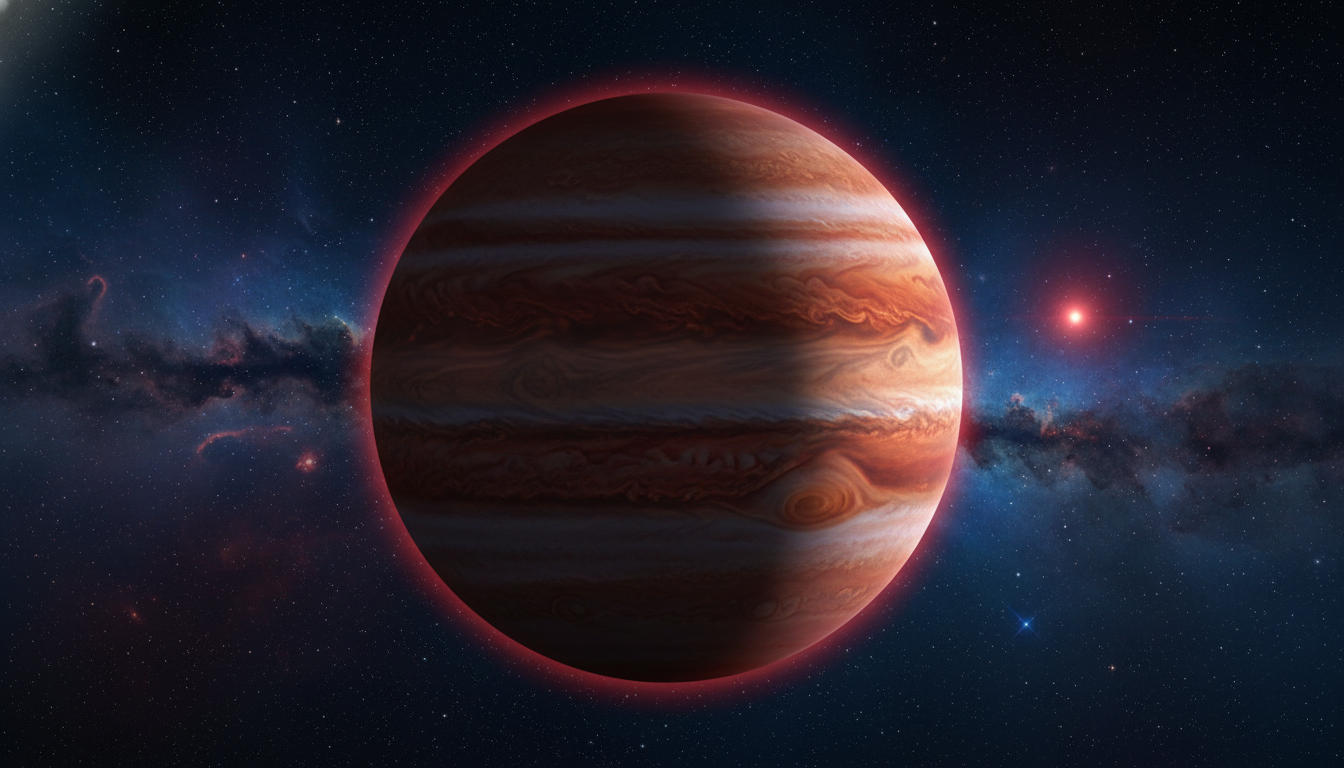
The exoplanet TOI-5205 b, 280 light-years from Earth, orbits a star too small to have created it and has an astonishingly metal-poor atmosphere — contradicting two pillars of planetary science at once
An international team led by astrophysicist Caleb Cañas from NASA’s Goddard Space Flight Center published a study in April 2026 in The Astronomical Journal that could reshape astrophysics textbooks. The James Webb Space Telescope (JWST) analyzed the atmosphere of the forbidden planet TOI-5205 b — and what it found there makes no sense for any current theoretical model.
In addition to being a gas giant that, by the rules of physics, should never have formed around its small star, the planet also exhibits an atmospheric composition that directly contradicts scientists’ predictions. In other words, it shouldn’t exist — and even if it does exist, it shouldn’t be this way.
What makes the forbidden planet TOI-5205 b so extraordinary
TOI-5205 b is a Jupiter-sized exoplanet located approximately 280 light-years from Earth. Up to this point, nothing unusual — hundreds of gas giants have already been cataloged in distant systems.
-
Sixteen years after the largest environmental disaster in oil history, BP has just received approval to open its first new field in the Gulf of Mexico, and the 10 billion barrels are 10 kilometers below sea level.

-
An Italian company has created an underwater drone that lives on the ocean floor for 12 consecutive months without returning to the surface, and the embedded artificial intelligence allows it to inspect and repair oil pipelines on its own.

-
Seen from space, an image taken by an astronaut shows in Argentine Patagonia the exact point where a colossal glacier, a turquoise-blue lake, and a greenish arm of water meet, creating one of the rarest and most impressive landscapes in the region.

-
Workers are being forced to train the AI that will replace them in their jobs.

However, what makes this world a true cosmic puzzle is the star it orbits. It orbits a red dwarf star of type M, with only 40% of the mass of our Sun.
And why is this a problem? Because, according to core accretion models — the most accepted mechanism to explain how giant planets form — such small stars simply do not have protoplanetary disks with enough material to generate a gas colossus the size of Jupiter.

To understand the scale of the paradox, consider this comparison:
- The host star has only 40% of the mass of the Sun
- The planet TOI-5205 b is similar in size to Jupiter, the largest planet in the Solar System
- The ratio between planet and star is, therefore, much larger than any model predicts as viable
- No protoplanetary disk of a red dwarf star of type M should contain enough matter for this outcome
For this reason, astronomers dubbed it the “forbidden planet.” However, as we will see next, the surprise did not stop there.
How the James Webb investigated the atmosphere of the exoplanet
To uncover the secrets of the forbidden planet TOI-5205 b, Caleb Cañas’s team used the most powerful instrument ever sent into space: the James Webb telescope.
The JWST observed 3 transits of the planet — that is, three moments when TOI-5205 b passed directly between its star and the telescope. During each transit, part of the starlight passes through the planet’s thin atmospheric layer before reaching the Webb’s sensors.

High-precision spectrographs analyzed this light filtered by the atmosphere, breaking it down into different wavelengths. Each chemical element absorbs light in a specific way, leaving a “fingerprint” in the spectrum. In this way, scientists can identify which substances are present in the atmosphere — even 280 light-years away.
This technique, known as transit spectroscopy, has been used on other exoplanets. However, the results obtained for TOI-5205 b surprised even the most experienced researchers.
Surprisingly metal-poor atmosphere: the second paradox
If the very existence of the planet was already difficult to explain, its atmospheric composition added an even deeper layer to the mystery.
The James Webb’s spectrographs revealed that the atmosphere of TOI-5205 b is surprisingly poor in metals — that is, in elements heavier than hydrogen and helium. Even more impressively, the planet’s metallicity is lower than that of its own host star.
This directly contradicts what planetary formation models predict. According to core accretion theory:
- Giant planets form when a massive rocky core accumulates gas around it
- This process should result in planets rich in metals (heavy elements)
- The planet’s metallicity should be equal to or greater than that of the star
- In the case of TOI-5205 b, the opposite occurs

No current theoretical model can explain how a gas giant, formed around a red dwarf star, can have such low metallicity. The discovery thus challenges two paradigms simultaneously: the possibility of forming giants in red dwarfs and the expected relationship between the metallicity of a star and that of its planets.
Two pillars of astrophysics questioned at once
To gauge the impact of this discovery, it is essential to understand that modern planetary science relies on some principles considered solid. The study of the forbidden planet TOI-5205 b questions two of them at the same time.
The first shaken paradigm is that of core accretion formation in low-mass stars. Red dwarfs of type M are the most common stars in the galaxy, but their protoplanetary disks are typically modest. Consequently, the scientific community has always considered it unlikely that they would generate Jupiter-sized planets.
The second questioned paradigm involves the correlation between star-planet metallicity. Until now, observations of dozens of exoplanetary systems supported the idea that giant planets inherit — and often amplify — the chemical composition of their stars. TOI-5205 b breaks this rule categorically.
Just like other discoveries that challenge our understanding of the universe, this finding opens the door to new hypotheses about how planetary systems can form under conditions previously considered impossible.
Why this discovery matters for the future of astronomy
Red dwarfs of type M represent approximately 70% of all stars in the Milky Way. Therefore, understanding whether they can host gas giants — and how — has enormous implications for estimating how many planets exist in the galaxy.

Moreover, the unusual atmosphere of TOI-5205 b suggests that there may be unknown planetary formation mechanisms. Some possibilities that researchers consider include:
- Gravitational instability of the disk: the planet may have formed by direct collapse of a dense region of the disk, without needing a prior rocky core
- Migration from another system: the giant may have formed under different conditions and migrated to its current position
- Atmospheric mixing processes: unmodeled interactions may have altered the atmospheric composition over billions of years
The study published in The Astronomical Journal does not provide a definitive answer. However, as Cañas’s team highlighted, the data collected by James Webb is robust enough to demand a revision of current models.
The discovery also reinforces the importance of missions like the NASA Artemis program and next-generation telescopes to expand our understanding of the cosmos. Each new instrument opens the possibility of finding more worlds that challenge existing theories.
Next steps and limitations of the study
Although the results are extraordinary, it is important to note that the study is based on 3 observed transits. Future observations may refine the metallicity measurements and confirm — or nuance — the current conclusions.
The authors themselves acknowledge that more sophisticated atmospheric models will be necessary to fully interpret the JWST data. Furthermore, the transit spectroscopy technique captures only the outermost layer of the atmosphere, which may not represent the planet’s total composition.
Still, the forbidden planet TOI-5205 b has already established itself as one of the most intriguing objects in contemporary astronomy. Its mere existence — and now its inexplicable atmosphere — forces the scientific community to rethink how giant worlds can arise in the most unlikely corners of the universe.
As is often the case in science, the most valuable answers do not always come from confirmations — but rather from discoveries that simply should not exist.






Seja o primeiro a reagir!