Portuguese
  Spanish


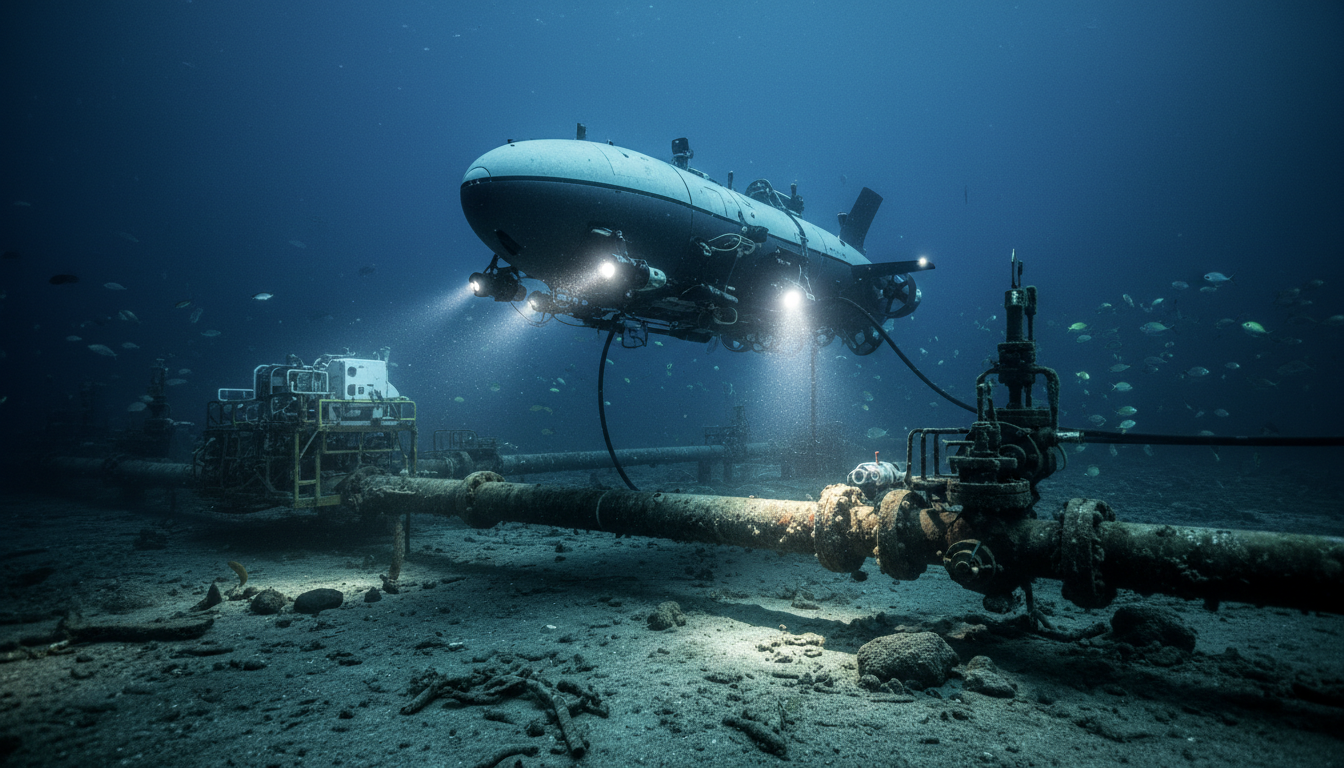


The Hydrone-R from Saipem is the world’s first resident underwater drone, capable of remaining submerged for 12 months using AI for inspections and repairs on oil pipelines at depths of up to 3,000 meters in Equinor’s Njord field in the Norwegian Sea
At the icy bottom of the Norwegian Sea, about 300 meters deep, an underwater drone from the Italian company Saipem works day and night without ever returning to the surface. The Hydrone-R is the world’s first Underwater Intervention Drone (UID) designed to stay submerged for up to 12 consecutive months. In this way, it inspects, monitors, and even repairs underwater oil equipment using artificial intelligence, without needing a support vessel or human operator on site.
Since 2023, the underwater drone has been operating exclusively in Equinor’s Njord field and has already accumulated over 500 days of subsea residency, with a world record of 240 continuous days on the seabed. Therefore, while traditional ROVs rely on vessels that cost tens of thousands of dollars per day, the Hydrone-R works alone 24 hours a day, 7 days a week, 365 days a year.
An underwater drone that sees, decides, and repairs itself at 3,000 meters

The Hydrone-R operates at depths of up to 3,000 meters and has a range of 300 meters in ROV mode or over 20 km in autonomous AUV mode. Additionally, the system has 12 kW of power, compatible with electric and hydraulic tools for valve manipulation and emergency interventions.
-
Oceanographer Turns Abandoned Fishing Nets from Brazilian Waters into Bags, Creating Jobs and Earning Over $7,000 Monthly

-
Australia deploys poisoned sausages and uses traps, shooting, and fences in a battle against invasive cats that kill over 1.5 billion native animals annually, threatening more than 200 species.

-
NASA Rover Captures “Tired Face” on Mars, Highlighting Human Brain’s Tendency to See Faces in Rock Formations

-
Ancient Stone City in the Desert, Once Home to 30,000, Puzzles Scientists with Nabateans’ Water Mastery 2,000 Years Ago




- Depth: up to 3,000 meters
- Residency: 12 months designed, 6 months proven, record of 240 days
- Range: 300 m (ROV) / +20 km (autonomous AUV)
- Embedded AI: route planning, obstacle detection, pipeline tracking
- Communication: satellite, 4G-LTE, 5G, or radiolink
The AI of the underwater drone performs path planning, pipeline tracking, and obstacle detection autonomously. Consequently, in April 2026, the Hydrone-R completed an autonomous mission over an Arctic coral area in the Njord field, without cables or surface support.
10-year contract with Equinor changed the offshore maintenance paradigm

In October 2019, Equinor selected the Hydrone-R for the Njord-A field, establishing the first global 10-year contract for services with underwater drones in the offshore energy sector. Thus, the decision represented a long-term bet on resident technology, eliminating the dependence on support vessels for routine inspections.
At the end of 2025, with 12.5-meter waves, the Hydrone-R enabled the commissioning of a well in Njord while traditional ROVs simply could not operate. Therefore, the underwater drone proved that it can work in extreme conditions that paralyze conventional systems. The technology won the Spotlight on New Technology at OTC 2021.
The future of underwater drones and what still needs to be resolved

The Hydrone-R does not replace heavy-duty ROVs but complements the fleet with unprecedented resident capability. However, the system still relies on remote communications and has limited range in ROV mode. Additionally, Saipem is negotiating the potential sale of Sonsub, the division that developed the Hydrone, to Fincantieri, which may affect the future of the program.
Still, the concept of a resident underwater drone is paving the way for a new era in offshore maintenance, where robots permanently reside on the seabed and humans supervise from solid ground. The trend of oil companies investing billions in technology reinforces that this is a one-way path for the global industry.