





 Portuguese
  English
  Spanish
  6 min of reading
  0 comments


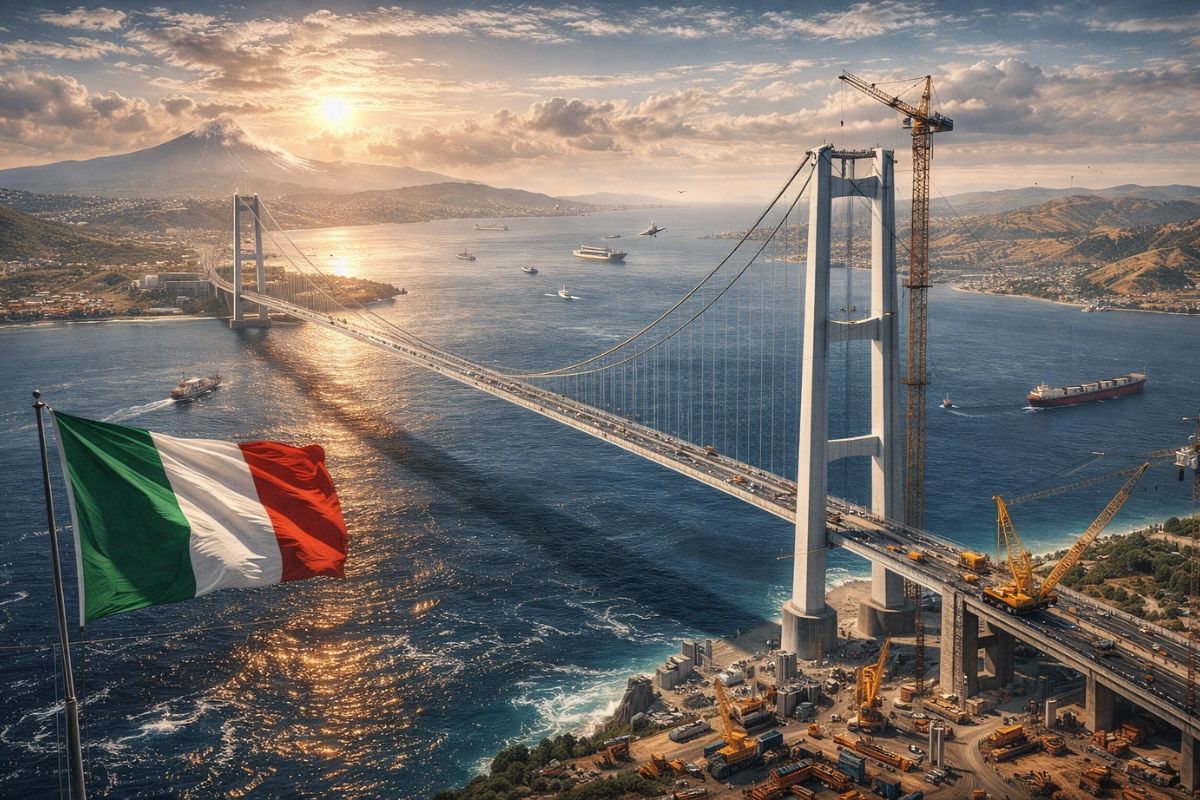
Italy will invest nearly 16 billion dollars in the world’s largest suspension bridge, an engineering challenge with 3,300 meters, 400-meter towers, and two railway lines, built over the Strait of Messina, where two active geological faults intersect.
Italy has approved the construction of what will be the world’s largest suspension bridge, a project costing nearly 16 billion dollars that will connect the mainland to the island of Sicily by crossing the Strait of Messina. At 3,300 meters long, the structure will far exceed the current world record holder, the Çanakkale Bridge in Turkey, which is 2,022 meters long. The Italian Minister of Transport, Matteo Salvini, described the project as “the largest infrastructure project in the West”, with completion expected in 2033.
But the ambition of the numbers coexists with a geological reality that no engineering can ignore. The Strait of Messina is not a stretch of calm water over stable ground. It is the convergence of two active geological faults that make the region one of the most earthquake-prone in all of Europe. A study published in the journal Basin Research in 2023 confirmed that the seabed is continuously shifting between these faults, creating conditions that challenge any permanent construction. The co-author of the research, Rebecca Dorsey, was straightforward: “This is a dynamic and constantly changing landscape, and the risks are high.” The world’s largest suspension bridge will be built right there.
The numbers that make the world’s largest suspension bridge an engineering record

The dimensions of the project are impressive by any standard. The world’s largest suspension bridge will have a total length of 3,300 meters, of which 3,200 meters will be suspended by cables anchored in two 400-meter high towers. These towers will transfer the entire weight of the deck to the ground without the need for support pillars in the strait itself, a solution that avoids the problem of building supports on a geologically unstable seabed.
-
Small house with natural light becomes a trend in sustainable architecture and shows how smart designs reduce energy consumption and enhance comfort in compact spaces.

-
Trump revealed today the design for the world’s largest triumphal arch, standing 76 meters tall, more than double the height of the Lincoln Memorial, with a golden Lady Liberty on top, four golden lions at the base, and the inscription “One Nation Under God” engraved in gold. When asked who the monument was for, he replied, “for me.”

-
Imagine a building that absorbs air pollution, regenerates itself, and becomes more resilient with each passing year: scientists from ETH Zurich have just turned this idea into reality using cyanobacteria and 3D printing.

-
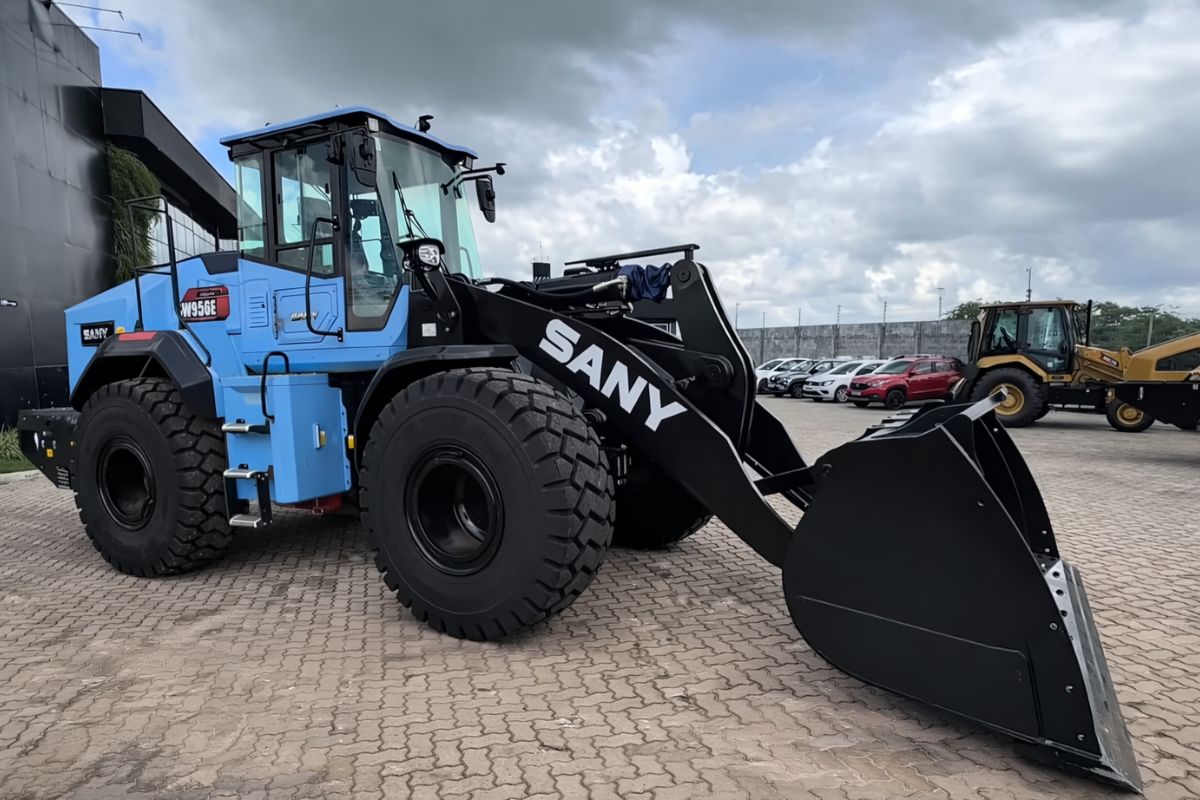
Ceará receives the first 100% electric 19-ton loader: the SW956E model promises zero diesel, low maintenance costs, a 3.5 m³ bucket, and fast recharging in 1 hour and 10 minutes for mining and construction.
According to the portal indiandefencereview, the planned infrastructure goes far beyond the bridge itself. The project includes six lanes of road traffic, two railway lines, an emergency lane, two service lanes, and sidewalks. Around the main structure, 40 kilometers of new roads and railway lines are planned, three underground train stations, tunnels, and 10 viaducts, with approximately 80% of the new routes built underground. Pietro Salini, CEO of Webuild, the Italian engineering company responsible for the project, described the work as “transformative for the entire country,” promising to stimulate growth, employment, and legality throughout southern Italy.
Why Greek mythology already warned about the dangers of the Strait of Messina
The choice of location for the world’s largest suspension bridge is not just a contemporary engineering challenge. It is a problem that the ancient Greeks already recognized, although they expressed it in mythological language. Scylla and Charybdis, the monsters that supposedly guarded each side of the strait in Homer’s Odyssey, represented the real dangers of navigating a passage where violent currents and rocky formations threatened any vessel. The 2023 study published in Basin Research used this mythology as a lens to understand the current seismic behavior of the region.
Researchers confirmed that the difficult passage described by the Greeks is a direct result of the meeting of two geological faults. The study documented how the seabed has shifted over time, dipping between the faults and creating what scientists described as a “tectonic narrowing of the strait” caused by the internal migration of opposing normal faults and rapid uplift driven by the Earth’s mantle. In practical terms, the Strait of Messina is not stationary: it moves, deforms, and produces earthquakes. Building the world’s largest suspension bridge over this scenario is an act of extreme confidence in modern engineering.
The seismic risks that the world’s largest suspension bridge will have to face
The geology of the Strait of Messina presents two distinct challenges for the construction of the world’s largest suspension bridge. The first is seismic activity: the region is subject to earthquakes that have historically caused massive destruction in Sicily and Calabria. The two geological faults that intersect beneath the strait generate tectonic stresses that can release energy unpredictably, and the transfer of stress between the faults adds a layer of complexity that needs to be incorporated into any risk analysis.
The second challenge is the instability of the seabed. As the bottom of the strait continues to shift, the bridge’s anchoring points need to be designed to accommodate ground movements that may occur over decades. The decision not to use pillars in the middle of the strait, supporting the 3,200 meters of deck solely with cables anchored to the side towers, is a direct response to this reality. Webuild stated that the project will be “equipped with the most advanced technologies in safety and maintenance,” a promise that carries special weight given the ground conditions.
The political and social obstacles surrounding the project
In addition to geology, the world’s largest suspension bridge faces a list of objections ranging from cost to social impact. Critics point out that the nearly 16 billion dollar budget in public resources could be directed to existing infrastructure in southern Italy, a region historically underfunded compared to the north. The construction requires the forced removal of 550 residences to make way for access infrastructure, a process that has generated resistance among affected residents.
There are also historical concerns about the influence of the Sicilian mafia on large-scale projects in the region. The Italian government has sought to address this issue with explicit commitments to keep organized crime out of the construction process, but analysts point out that the scale of the investment and the duration of the work create infiltration opportunities that are difficult to monitor completely. Despite these objections, the project has advanced with significant institutional support: the government has classified it as of “preeminent national importance” and essential for the connectivity of trans-European transport networks.
The centuries-long history behind the dream of crossing the strait
The idea of building the world’s largest suspension bridge over the Strait of Messina may seem like a modern daydream, but the desire to cross this passage is ancient. Pliny the Elder recorded a legend about a temporary bridge used to transport war elephants across the strait as early as 251 BC, during the Punic Wars. Since then, every generation of Italian rulers has considered, at some point, the possibility of connecting the mainland to Sicily by land.
The modern project has taken shape in recent decades but has faced repeated cancellations, revisions, and political deadlocks before receiving final approval. If the current version finally materializes as a permanent structure, Italy will have achieved what no previous empire, kingdom, or republic has accomplished in over two millennia of attempts.
The world’s largest suspension bridge will be, at the same time, a testament to human engineering capability and a long-term test of coexistence between monumental infrastructure and unpredictable geology. The strait that inspired mythological monsters will receive, in 2033, the definitive answer from modern engineering.
Italy will build the world’s largest suspension bridge over two active geological faults. Do you think modern engineering is capable of overcoming geology, or is this project too ambitious for the terrain? Leave your opinion in the comments.






Seja o primeiro a reagir!