





 Portuguese
  English
  Spanish
  5 min of reading
  0 comments


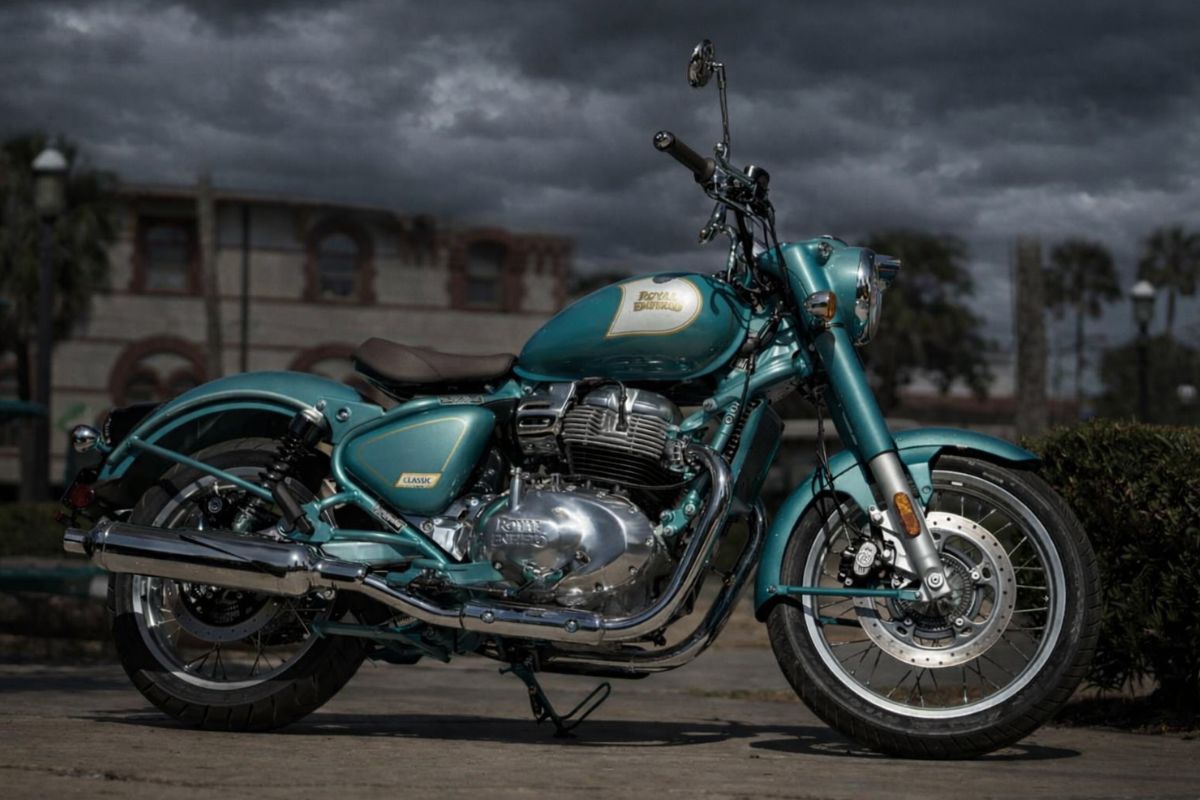
Royal Enfield launches the Classic 650 in Brazil, a motorcycle with a 648 cm³ parallel twin engine, vintage design with a teardrop-shaped tank, Showa suspension, and a price starting at R$ 34,490, expanding the Indian brand’s offering in the mid-displacement segment and challenging established competitors.
The Royal Enfield has just introduced a motorcycle to the Brazilian market that seems to have traveled through time. The Classic 650 uses the Indian manufacturer’s 650 Twin platform and combines a 648 cm³ parallel twin engine with a design reminiscent of British motorcycles from the 1950s, including teardrop-shaped fuel tank, round headlight, curved fenders, and chrome finish. Reservations start from April 11 through the online system adopted by Royal Enfield in recent launches, and the model comes in three versions with prices ranging from R$ 34,490 to R$ 35,490.
What makes the arrival of the Classic 650 relevant for the Brazilian market goes beyond its looks. Royal Enfield already sells models like the Interceptor 650, Continental GT 650, Super Meteor 650, and Shotgun 650 in Brazil, all on the same twin-cylinder platform. But the Classic 650 occupies a different space: it is the brand’s bet for those who want a mid-displacement motorcycle with retro personality, accessible riding, and a price that directly pressures Japanese and European competitors vying for the same market segment.
The engine of the Royal Enfield Classic 650 and what changes compared to other models
The 648 cm³ parallel twin engine of the Classic 650 is the same mechanical set used in other models of Royal Enfield’s 650 Twin platform, but with an important difference: the calibration has been specifically adjusted for this model, focusing on torque delivery at low revs and progressive throttle response. In practice, this means that the motorcycle has been designed to offer a more relaxed and predictable ride, rather than prioritizing raw power or sporty behavior.
-
Volkswagen admits to Reuters that the value of its cars is falling in Brazil due to the aggressive entry of Chinese companies like BYD, but asserts that it will not enter a price war and believes it is well-positioned to hold back the advance.

-
Used BYD Dolphin Mini becomes a standout among semi-new cars by selling in 15 days, surpassing HB20, Onix, and Polo in stores, and showing that used electric cars are gaining strength in the Brazilian market in 2026, according to a survey by Indicata released in April.

-
Toyota launches Wigo cheaper than Fiat Mobi, Citroën C3, Argo, Polo Track, HB20, and Onix in Brazil, with a 1.0 three-cylinder engine, 5-speed manual transmission or CVT, and rear camera in the top version; the urban hatch shows an entry-level Toyota that Brazilians don’t have in the Philippines.
-
BMW X7 priced at R$ 1 million impresses with absurd technology, extreme luxury for seven people, and a self-parking system in Brazil


According to the CNN Brasil portal, Royal Enfield describes the riding experience as linear, with reduced vibrations and predictable responses in acceleration and pickups. This smoother calibration aligns the Classic 650 with the proposal of the Classic line, which historically positions itself as a family of motorcycles for those who value cruising, comfort, and visual presence over cornering performance or top speed. The chassis is shared with other models of the 650 platform, meaning that the structural engineering has already been tested and validated in thousands of units sold globally.
Vintage design with details reminiscent of Royal Enfield from the 1950s
The design of the Classic 650 is undoubtedly the main selling point for Royal Enfield in this launch. The teardrop-shaped fuel tank, round headlight, and curved fenders are elements present in historical models of the brand that date back to the 1950s, a period when Royal Enfield produced motorcycles that defined the aesthetic standard of British motorcycling. The chrome components and metallic finish scattered throughout the body reinforce the retro identity without appearing as a forced replica.
One detail that deserves attention is the so-called “pilot lights,” a visual element present on Royal Enfield motorcycles since the 1950s and retained in the Classic 650. The main headlight uses LED lighting, while the dashboard combines analog instruments with an LCD digital screen that displays the odometer, fuel gauge, clock, gear position, and maintenance reminders. It is a deliberate mix of contemporary technology with classic aesthetics that seeks to please both vintage visual purists and motorcyclists who demand modern functionalities.
Showa suspension and what Royal Enfield delivers in the dynamic set
The choice of Showa suspension, one of the most respected brands in the motorcycle component segment, indicates that Royal Enfield did not skimp on the dynamic set of the Classic 650. Both the front and rear suspension are supplied by the Japanese manufacturer, which theoretically guarantees a standard of irregularity absorption and stability superior to what is found in motorcycles of similar price range in the Brazilian market.
The tires of the Classic 650 have also been sized with wider dimensions than some previous models from Royal Enfield, enhancing stability in different usage conditions, from urban asphalt to rural roads. For a motorcycle positioned as an option for cruising and daily use, the combination of Showa suspension with more generous tires could be the differentiator that convinces buyers who are torn between the Classic 650 and competitors that prioritize other attributes, such as power or electronic equipment.
Price and versions of the Royal Enfield Classic 650 in Brazil
Royal Enfield opted for an aggressive pricing strategy for the Classic 650 in the Brazilian market. There are three versions available: the Vallam Red, entry-level, with a suggested price of R$ 34,490; the Teal Green, mid-range, for R$ 34,990; and the Black Chrome, top-of-the-line, for R$ 35,490. The difference between the cheapest and the most expensive version is only one thousand reais, suggesting that the variations are concentrated in finishing and color options, not in mechanical or technological equipment.
In the R$ 34,000 to R$ 36,000 range, the Classic 650 competes directly with mid-displacement models that offer very different proposals. For Royal Enfield, the pricing position is a statement of intentions: to deliver a 648 cm³ twin-cylinder engine, premium brand suspension, distinctive design, and a riding experience that no competitor in the same range offers with this combination. The bet is that the vintage look, combined with cost-effectiveness, will attract an audience that is not satisfied with generic catalog motorcycles.
What the Royal Enfield Classic 650 represents for the Brazilian market
The arrival of the Classic 650 consolidates Royal Enfield’s presence in Brazil as a brand that bets on a strong visual identity and competitive prices in the mid-displacement segment. With six models from the 650 Twin platform now available in the country, the Indian manufacturer offers a diversity of proposals ranging from the café racer style of the Continental GT 650 to the cruiser of the Super Meteor 650, now including the classic retro of the Classic 650.
For the Brazilian market, where the mid-displacement range is still dominated by Japanese brands with decades of presence, Royal Enfield represents an alternative that does not try to compete on technology or pure performance, but on character and experience. The Classic 650 is a motorcycle that sells itself by its personality, not by its technical specifications. And at a price starting at R$ 34,490, the argument that soulful motorcycles cost more simply does not apply.
The Royal Enfield Classic 650 arrives in Brazil with a retro look, twin-cylinder engine, and a price starting at R$ 34,490. Do you think it has the potential to challenge the Japanese mid-displacement bikes? Would you buy a motorcycle with this look? Leave your opinion in the comments.







Be the first to react!