





 Portuguese
  English
  Spanish
  8 min of reading
  4 comments


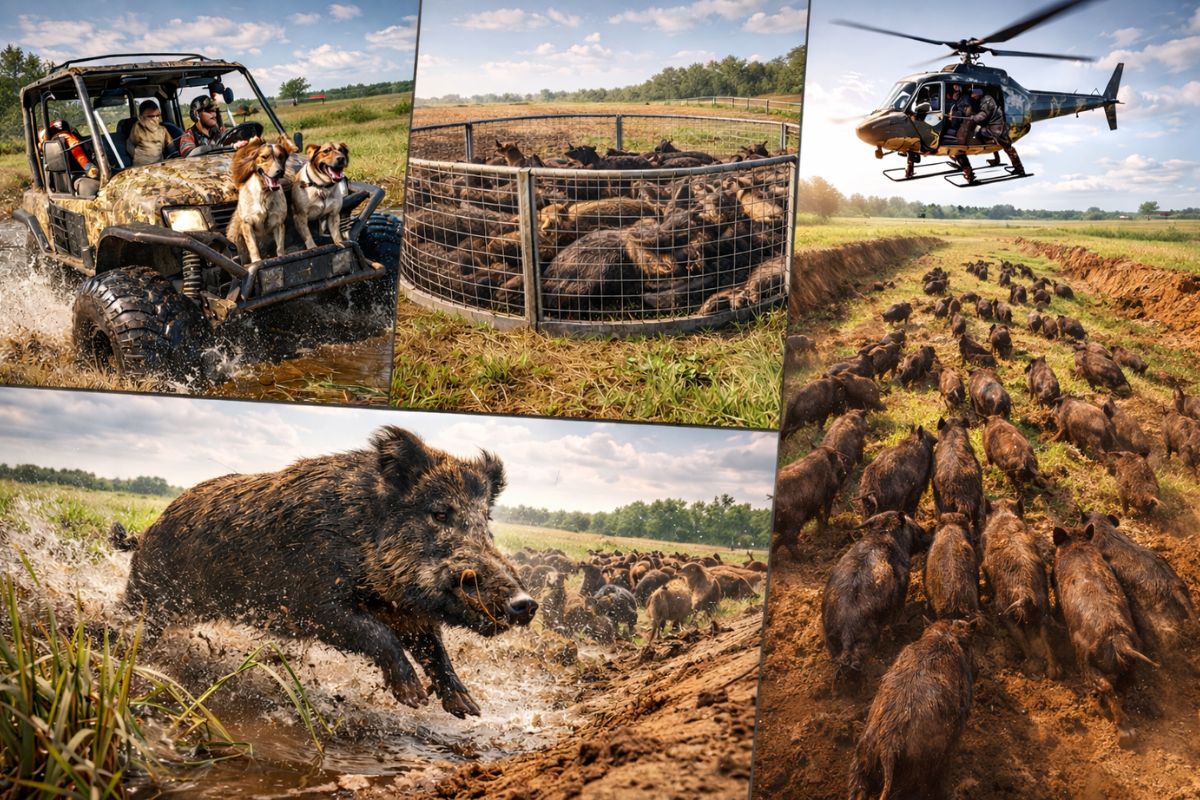


From Swamp Buggies with Hunting Dogs to Traps for Wild Boars That Capture Entire Herds, The Control of Wild Boars Has Become a Matter of Survival for Many Farmers.
Wild boars have ceased to be just a curiosity from other countries and have established themselves as a nuisance in various regions of the world. With rapid adaptation, almost no natural predators, and accelerated reproduction, this exotic species has made it to the list of the world’s top one hundred invasive species. On farms, the result is destroyed crops, broken fences, and threatened livestock. In response, farmers began to invest in increasingly creative ways of wild boar control, mixing tradition, technology, and a culture of wild boar hunting that, in some places, is part of daily life.
While some producers still try to solve the problem manually, hunting animal by animal in the woods, others have turned to more radical solutions. Special vehicles, giant fenced traps for wild boars, armed helicopters, and deep trenches around properties have emerged as responses to the advance of wild boars in the fields. Common to all these strategies is that the dispute between agricultural production and these wild pigs is far from simple.
Why Wild Boars Became One of the Worst Pests in Agriculture
Those who follow daily life in the countryside know that the problem didn’t start yesterday. Farmers in Brazil and other countries have been reporting difficulties in dealing with wild boars for years, as they spread quickly, feed on almost anything, and can survive in very different environments. They are strong, resilient, intelligent animals capable of moving efficiently in groups.
-
The eggshell that almost everyone throws away is made up of about 95% calcium carbonate and can help enrich the soil when crushed, slowly releasing nutrients and being reused in home gardens and vegetable patches.

-
This farm in the United States does not use sunlight, does not use soil, and produces 500 times more food per square meter than traditional agriculture: the secret lies in 42,000 LEDs, hydroponics, and a system that recycles even the heat from the lamps.

-
The water that almost everyone throws away after cooking potatoes carries nutrients released during the preparation and can be reused to help in the development of plants when used correctly at the base of gardens and pots, at no additional cost and without changing the routine.

-
The sea water temperature rose from 28 to 34 degrees in Santa Catarina and killed up to 90% of the oysters: producers who planted over 1 million seeds lost practically everything and say that if it happens again, production is doomed to end.


The absence of natural predators in many of the areas they have invaded only worsened the situation. In many regions, wild boars have been included among the hundred worst invasive exotic species in the world. In practice, this means direct losses for those who depend on the land.
When a group of wild boars enters a crop, the damage can be significant in just a few hours, as they turn up the soil, uproot seedlings, knock down plants, and leave the ground thoroughly marked.
This impact is also repeated around livestock. In cattle, sheep, or goat breeding areas, the constant presence of wild boars increases the risk of attacks, accidents, and disease transmission.
That is why, in many places, the topic of wild boars in crops has ceased to be just an environmental issue and has come to be treated as an economic and safety problem in the countryside.
Swamp Buggy: Wild Boar Control in Any Terrain

In some regions of the United States, groups of farmers and hunters have decided to take wild boar control to another level.
The idea was to adapt every detail of a gigantic vehicle capable of traversing swamps, mud, shallow rivers, logs, and obstacle-filled terrain. Thus, the so-called swamp buggies were born.
These vehicles are used to cross marshy areas and waterlogged fields where a regular car would never pass.
With large wheels, high suspension, and reinforced structure, the swamp buggy becomes a mobile platform for wild boar hunting, allowing hunters to advance through regions where the animal usually hides.
In videos recorded there, these vehicles can be seen easily crossing rivers and underbrush.
On top of the buggy, several people can ride, sometimes entire families. Some groups go equipped with guns, while others also bring professionally trained hunting dogs.
When they spot the wild boars, they release the dogs, which chase the animals across the terrain while the hunters keep track from the top of the vehicle.
This combination of the swamp buggy’s mobility with specialized dogs makes wild boar hunting much more efficient in hard-to-reach areas, according to the very groups that adopted the practice. In many cases, the meat from the hunted animals is consumed right there, in meals prepared at the end of the day.
Trap for Wild Boars That Catches an Entire Herd

On one hand is the quest for mobility; on the other is the quest for volume. Instead of hunting one by one, some owners have decided to invest in a wild boar trap on a much larger scale.
The idea is simple on paper and impressive in practice: a large, round enclosure with only one entrance that can be quickly closed.
In the center of this enclosure, the owner spreads feed or other food that can attract wild pigs.
Wild boars, naturally suspicious, enter gradually. First, one or two, then more, until the rest of the herd feels safe enough to enter and compete for food.
In one of the videos documenting this technique, within minutes dozens of wild boars enter the enclosure, and the trap’s operator only closes the entrance when they judge the quantity to be sufficient.
When the gate drops, the chaos begins. The animals crash against the structure, which shakes from the force of their impacts.
In another recording, made during the day, you can see the wild boar trap working again, with several wild pigs captured at the same time.
The central point of the technique is precisely this: to catch the herd all at once rather than trying to reduce the problem by taking down a few individuals each night.
Wild Boar Hunting from Helicopters

If swamp buggies seem like something out of a movie, wild boar hunting from helicopters takes the subject to another level.
On specialized channels outside Brazil, such as Pork Choppers Aviation, teams can be seen flying over open fields and rural areas, armed with rifles and heavy ammunition, hunting wild boars from above.
In some operations, more than one aircraft participates in the wild boar hunt simultaneously, surrounding the moving animals. From the perspective of the groups engaged in this activity, the helicopter has an obvious advantage.
No matter how fast the wild boars run, they cannot escape the sight of the pilots and shooters, who track their movement in straight lines or tight curves. The animals try to hide, but the low altitude allows for quick identification of movement.
These teams do not hunt only wild boars. In certain U.S. states, they also focus on controlling coyotes and other animals considered problematic.
The hunting culture is more deeply ingrained in these areas than in Brazil, and the abundance of invasive fauna fuels this type of activity.
Even so, it is a technique far removed from the reality of most Brazilian farmers, who need to find other ways to deal with wild boars in their crops.
Giant Trenches and Fences to Keep Wild Boars in the Fields
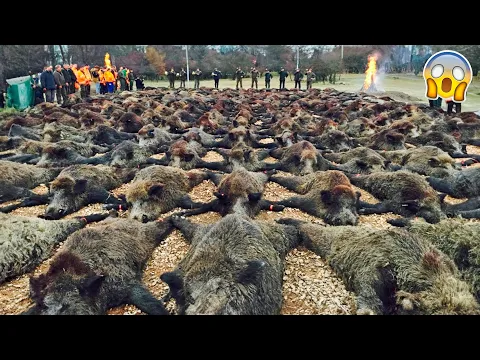

Faced with the difficulty of coexisting with the constant presence of wild boars in crops, some Brazilian farmers decided to invest in a heavy yet permanent solution.
The idea is to dig wide, deep trenches around the planting or along the boundary with wooded areas. These trenches function like a moat: the wild boar comes from the woods, climbs the bank, and, when trying to access the crop, ends up falling into the hole.
In one account, a producer shows the trench being dug on the farm and explains that it was specifically designed to prevent the entry of wild pigs.
According to him, the wild boar falls into the trench and cannot get out, or it exits through the wooded side, without reaching the plantation. In another video, another farmer films the number of wild boars already captured inside such a hole, emphasizing that for him, the strategy resolved the invasion problem in the productive area.
It is a costly and labor-intensive task. Digging a trench around the entire property or crop requires machinery, fuel, labor, and time.
Even so, many producers consider it a smaller cost compared to the constant losses caused by bands of wild boars. For those who have already lost entire harvests, spending on trenches is seen as a protective investment rather than an isolated expense.
Other Physical Barriers and the Use of Electric Fences and Herding Dogs
It is not always possible or feasible to dig trenches on a large scale. Therefore, in addition to the trench, some producers adopt more traditional physical barriers, such as reinforced fences.
In many cases, wild boar control involves wire fences with high mesh, designed with a robust structure and thicker wires at the bottom, specifically to make it difficult for the animals to lift or deform the base and pass underneath.
Another common recommendation is to bury part of the fence, creating a sort of “baseboard” for added protection. This buried section makes it difficult for wild boars to dig and lift the structure.
In some regions of the country, electric fences have also started to be used with considerable success, creating an unpleasant stimulus that keeps animals away from the perimeter without relying on strong physical contact with the structure.
In livestock farming, especially in Rio Grande do Sul, there are interesting experiences with the use of herding dogs to protect livestock.
These dogs are trained to position themselves strategically and respond to the approach of wild boars, keeping the invasive animals away from the herd.
Reports indicate that this type of dog helps keep wild boars away from the herd, providing an additional layer of protection alongside fences and specific management practices.
Between Creativity and the Limits of Coexistence with Wild Boars
Swamp buggies with dogs, wild boar traps in the form of giant enclosures, armed helicopters, deep trenches, reinforced fences, electric fences, herding dogs, and many hours of observation in the fields.
The combination of these solutions highlights the scale of the challenge that wild boars represent for those who live off the land. There is no single answer that fits all regions, nor is there a miraculous method that eliminates the problem instantly.
What is common is the awareness that ignoring the presence of these animals is no longer an option. Farmers living with wild boars in crops know that each lost harvest, every broken fence, and every injured animal weighs on the farm’s accounts.
Thus, many organize, share experiences, test solutions, and evaluate what makes the most sense for their realities, always taking into account costs, environmental impact, and safety.
Ultimately, the advance of wild boars across the countryside reveals how a species introduced carelessly can turn into a significant problem in a short time.
Among impressive hunting videos and creative experiences on farms, there lies a warning: the sooner the problem is addressed with planning, the less dramatic the conflict between rural production and invasive animals.
And you, if you were the owner of a farm surrounded by wild boars, which of these wild boar control strategies would you like to see working up close: the swamp buggy, the wild boar trap that captures the entire herd, or the trenches and fences keeping the wild boars in the crops?








E sobre as abelhas estão moendo no veneno né agora quando porcos ataca esperneam
Mandem para África ,-ha muita fome aqui
I think the university in Louisiana has had some success with a bait poison that kills the boar but doesn’t damage the meat nor is poisonous to other animals.