





 Portuguese
  English
  Spanish
  5 min of reading
  1 comment


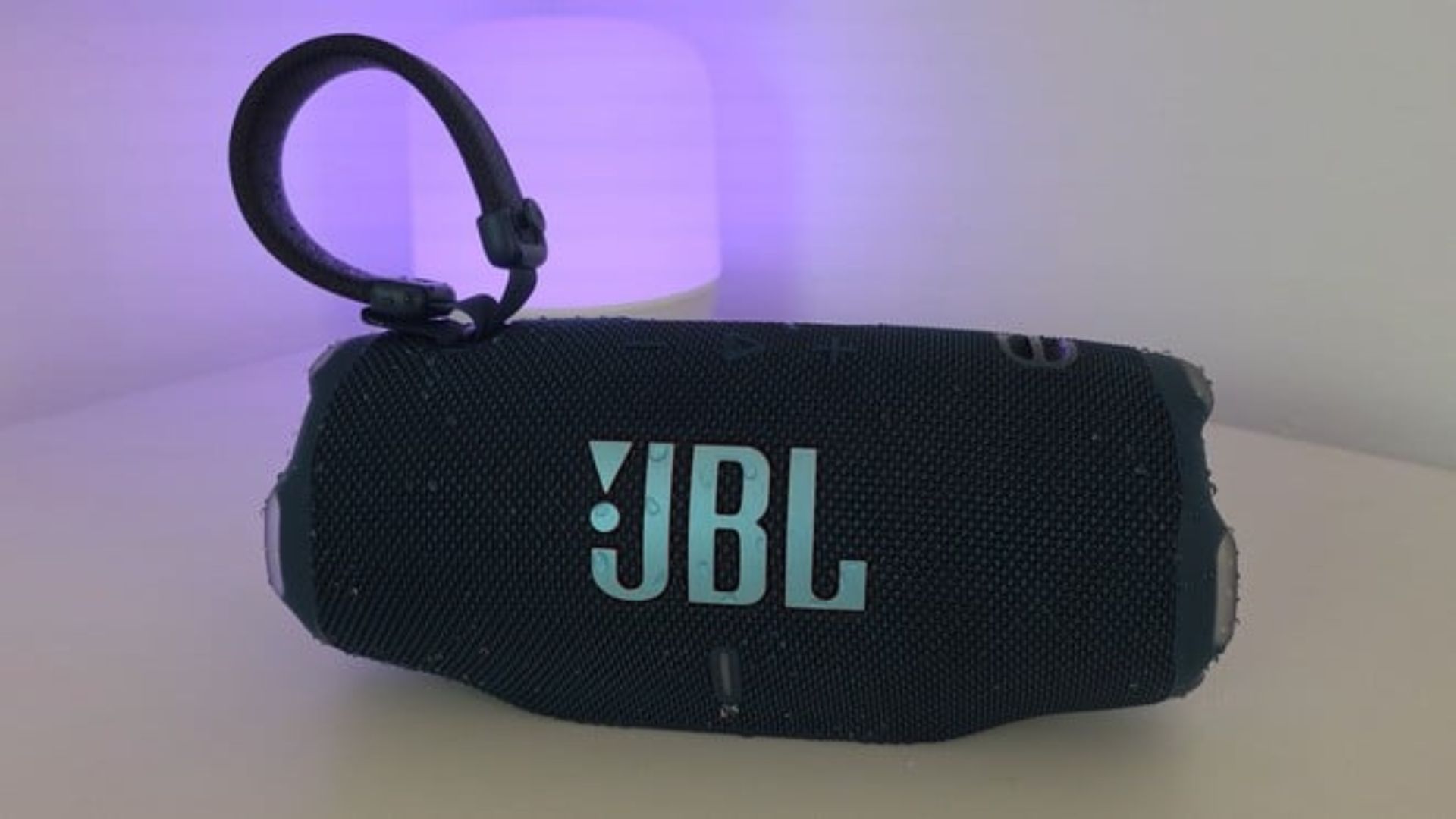

Launched In May, The JBL Charge 6 Arrives In Brazil With 45W Sound, Up To 28 Hours Of Battery Life, And IP68 Certification. The Model Promises Power, Resistance, And A Power Bank Function In A Compact And Portable Body.
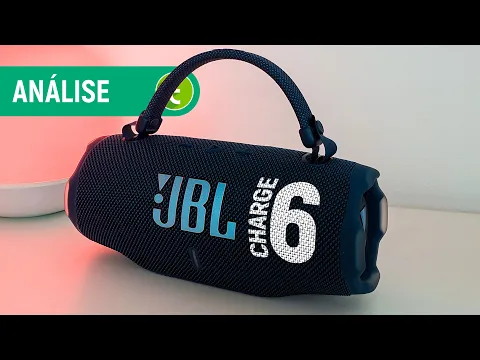
The JBL revamped its mid-sized portable speaker in May, and the Charge 6 arrives in Brazil with 45W of power, a promise of up to 28 hours of autonomy with Playtime Boost mode, IP68 certification against water and dust, and a power bank function via USB-C.
With a price around R$ 1,200, the model places the brand in the center of the competition for those seeking a robust, portable speaker with extra features.
Updated Design And More Robust Proposal
Visually, the Charge 6 distances itself from the Charge 5 by adopting JBL’s recent design language. The power, Bluetooth, and PartyTogether buttons appear in relief, while the media controls — play/pause, volume +, and volume − — are raised on the front face.
-
The gigantic steel shell built to contain Chernobyl for a century has been pierced by a drone, exposing a critical system and creating a hole that could cost over 500 million euros to repair.

-
Brazilian Navy reaches a new level by taking over an airport with a 1,600-meter runway used by 1,800 military personnel and autonomous attack drone testing.

-
The Himalayas continue to grow to this day, with tectonic plates advancing 5 cm per year, mountains rising up to 10 mm annually, and the 2015 earthquake that killed 9,000 people may have increased the risk of an even larger seismic mega-event.

-
At an altitude of 400 km by astronauts from the International Space Station, Paris transforms at night into a golden mesh so precise that it reveals the outline of the Seine River, avenues, and entire neighborhoods like a luminous map drawn over the Earth.

The design evokes the newer Flip line but with a larger body and a more solid appearance, suitable for the Charge series. In addition, JBL included a transport strap on the speaker.
The accessory can be used in two ways and even allows hanging the speaker, which helps propagate the sound in open environments.
Although it doesn’t bring the PushLock mechanism seen in the Flip 7, the solution expands versatility without losing portability.
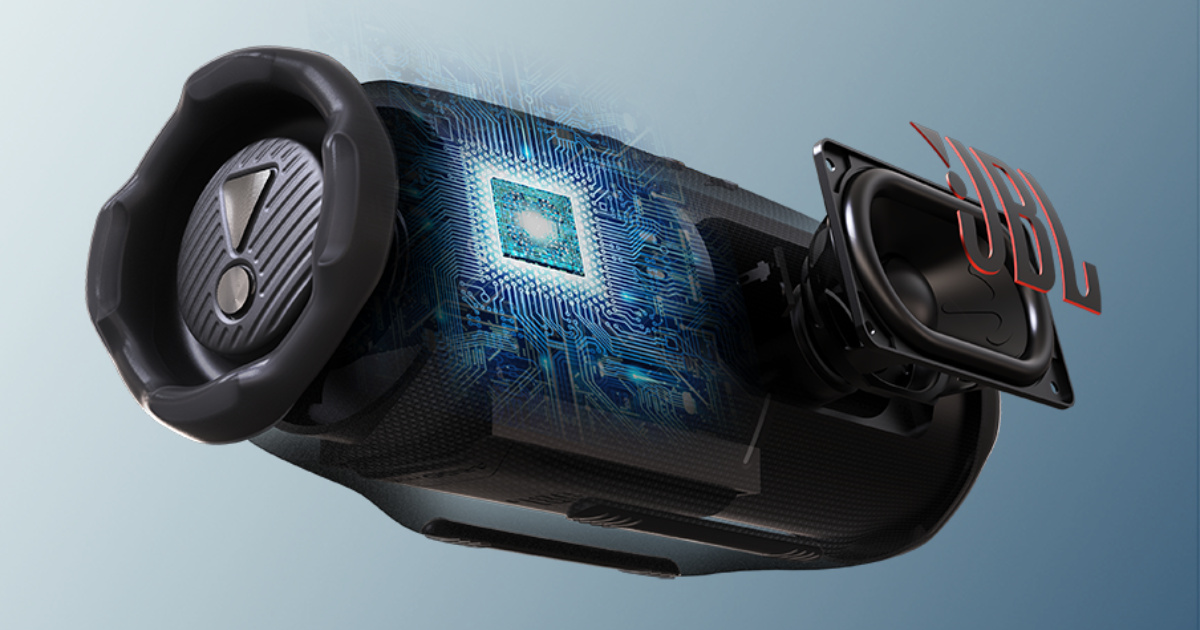
Construction, Materials, And IP68 Resistance
The structure combines rigid plastic, rubberized ends, and the brand’s characteristic fabric. JBL claims to use post-consumer recycled materials in the grille, as well as certified paper and soy-based ink in the packaging.
According to the company, the base now features two rubberized “feet” instead of the diagonal stripes from the previous generation, providing more stable support.
The certification has evolved from IP67 to IP68, which means total protection against dust and immersion in water, with the manufacturer also indicating resistance to drops of up to 1 meter on concrete. The packaging includes a USB-C cable, manuals, and the strap.
Size And Weight: Still Portable, But More Substantial
The internal and external changes have made the Charge 6 heavier. The gain is about 400 grams, nearing 1.4 kg. The height approaches 10 cm, and the width is around 23 cm.
Despite the increase, it remains a compact product enough for daily commutes or short trips.
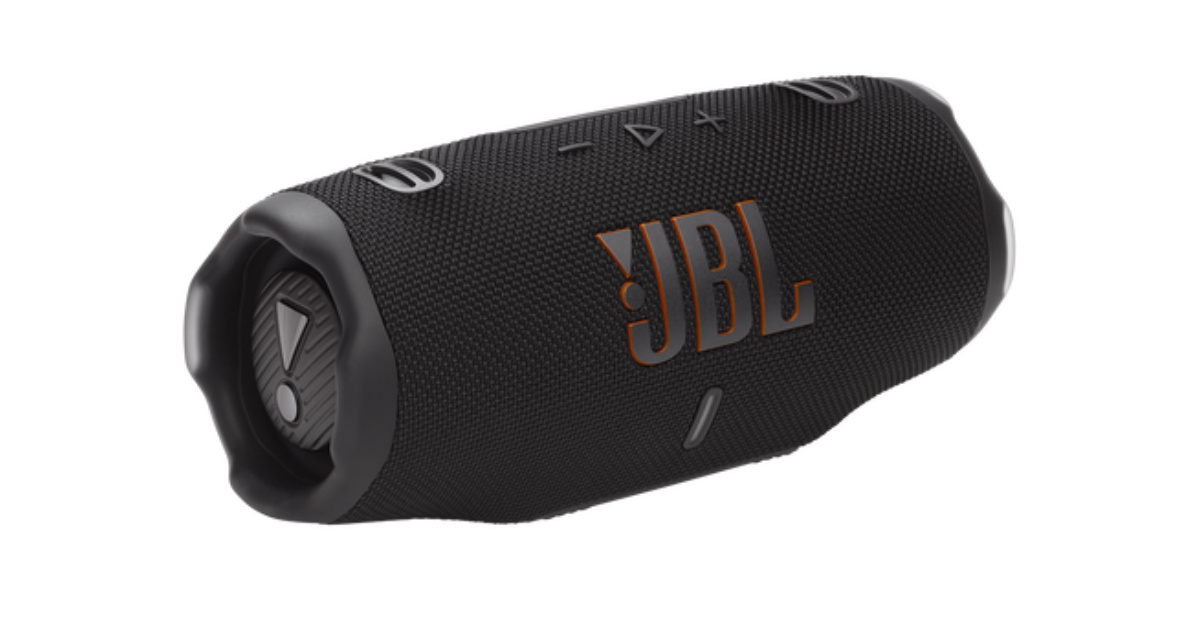
Ports And Physical Connectivity: All Via USB-C
The back has been simplified. The set with USB-C for input and USB-A for output is gone; a single USB-C now serves for recharging the speaker, as well as for charging the smartphone and for lossless audio playback from the notebook.
This decision aligns with the widespread adoption of USB-C cables on both ends, reducing cables and freeing up internal space.
Audio: Drivers, Power, And Passive Radiators
Internally, the Charge 6 combines a 53 x 93 mm (30 W) woofer and a 20 mm (15 W) tweeter, summing up the 45 W advertised, with passive radiators on the sides.
The setup delivers present bass — characteristic of JBL — good separation of mids and highs, and sufficient volume to easily fill small spaces. In open areas, the power gain is evident without compromising control.
The frequency response has changed to 56 Hz–20 kHz, allowing more room for noticeable sub-bass and clean highs.
The AI Sound Boost technology analyzes the track in real-time to optimize frequencies and levels, acting dynamically according to the music genre and selected volume.
Equalization And Listening Modes
For customization, JBL offers four profiles: JBL Signature, Chill, Energetic, and Vocal. For those who prefer fine adjustments, there is a seven-band equalizer in the app.
There is also the Playtime Boost, which disables equalizations — including real-time processing — to reproduce the “raw” sound of the source, with the bonus of extending autonomy by up to 4 hours depending on use.
App And Software Features
The Charge 6 is compatible with JBL Portable for Android and iOS.
The app displays the battery level, allows choice of sound profiles, activates Playtime Boost, updates firmware, and manages group pairing for larger parties via PartyTogether.
The interface is straightforward, with clear menus and quick responses to commands.
Wireless Connectivity And Auracast
Although it does not include Wi-Fi, the Charge 6 relies on Bluetooth 5.4 with Auracast, a feature that facilitates connection with multiple devices and transmission to several compatible receivers.
In party scenarios, this capability helps distribute audio wirelessly with stability and reduced latency, provided the other equipment supports the standard.
Battery And Reverse Charging
The 4,722 mAh battery lasts up to 24 hours of playback under standard conditions and can reach 28 hours with Playtime Boost, depending on the volume. The total recharge time is around 3 hours, varying with the charger.
As a differentiator for the line, the Charge 6 also acts as a power bank: just plug the smartphone into the USB-C to ensure extra power while the music continues to play.
The output is not of high power, but it covers emergencies and prolongs smartphone use.
Daily Sound Experience
In practice, the 45 W ensures headroom for genres with an emphasis on bass, such as pop and electronic, maintaining defined mids for vocals and highs without harshness at typical living room volumes.
Tracks with prominent sub-bass, like “Boom Boom Pow” (Black Eyed Peas) and “Believer” (Imagine Dragons), highlight the performance of the side radiators.
At very high volumes, processing prevents noticeable distortions, preserving the body of the sound.
What Is Left Out
Some choices prioritize simplicity.
The absence of Wi-Fi and an integrated microphone limits voice commands and smart home integrations, and the strap does not use the PushLock seen in another model from the brand.
For those who prioritize streaming via network and control by assistants, these points may weigh in the decision, even though the Charge 6’s proposal focuses on portability, resistance, and autonomy.

Price And Direct Competition
At the level of R$ 1,200, the Charge 6 faces rivals like the LG XBOOM XG8T, which bets on a more robust sound system and lighting for parties.
On the other hand, the competitor usually delivers a smaller battery, previous generation Bluetooth, and does not function as a power bank, in addition to being larger and heavier.
The comparison helps understand JBL’s strategy: prioritize a balanced package of power, mobility, and practical features without sacrificing resistance.
Considering the set of 45 W, IP68, Bluetooth 5.4 with Auracast, up to 28 hours of battery with the appropriate mode, and reverse charging, does this level of delivery meet what you expect from a speaker for home parties and outdoor use, considering the investment of R$ 1,200?






Hell naw if im spending that kind of money why wouldnt you just get a soundbox? Yes its bigger but its kicking the snot out of the 6 or even buy the branded partybox? This is just for ppl who got to much money and want yo be the first at something when there is so many better options for that kind of money