





 Portuguese
  English
  Spanish
  4 min of reading
  0 comments


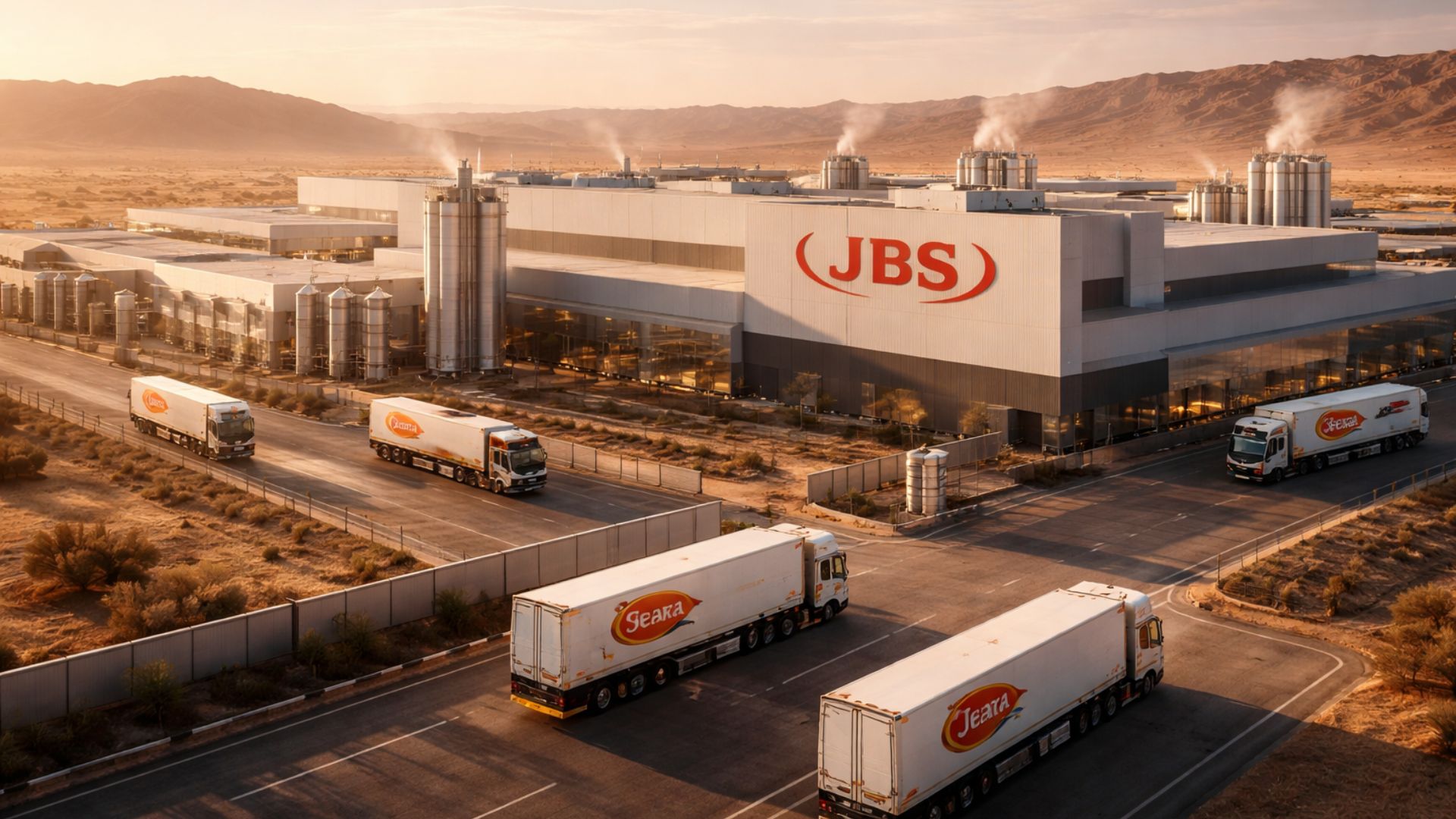
Industrial Opening Reinforces JBS’s Productive Presence in the Middle East and Anticipates Expansion Movement in One of the Most Strategic Markets for Halal Food, Focusing on Local Production, Regional Distribution, and Building a Private Brand Amid Saudi Arabia’s Quest for Self-Sufficiency.
JBS opened a processed food factory in Jeddah, Saudi Arabia, on January 22.
In the same announcement, the company stated that it intends to double the capacity of the unit by the end of 2026.
The project is part of a total investment of US$ 85 million in the country.
-
The institute that trained the greatest aerospace engineers in Brazil has just opened its first campus outside São Paulo after 75 years: ITA Ceará will have R$ 445 million, new courses in energy and systems, and classes are expected to start in 2027.
-
Luciano Hang, owner of Havan, goes to Juiz de Fora after the tragedy in February, brings R$ 1 million, hands out R$ 2,000 cards, and donates up to R$ 15,000 to victims in the region.

-
The Brazilian passport allows legal residence in dozens of countries without the need for a prior visa, and most Brazilians are unaware that they can apply for residency directly upon arriving in nations in South America, Africa, and even Europe.

-
Petrobras sends a message to Brazilian truck drivers after fuel collapse and reveals plan to have 100% domestic diesel.

This amount includes, besides the Jeddah plant, an already operational unit in Dammam and the local distribution structure.
The strategy focuses on supplying the Saudi market and expanding regional exports of halal products under the Seara brand.
According to Seara’s CEO, João Campos, the decision to accelerate expansion was motivated by the rapid absorption of production.
“When it came, it quadrupled our volume in Saudi Arabia, and now we are doubling the volume of this plant due to the acceptance of the Seara brand in the local market,” he stated in an interview.
Local Production in Jeddah Expands Regional Reach

The Jeddah unit focuses on processed food production.
Among the items manufactured are battered and halal-certified chicken cuts.
Part of the volume is already destined for export.
Currently, the products are shipped to seven countries in the region, including Kuwait, Oman, and the United Arab Emirates.
Although the priority is the Saudi market, the operation creates a logistics base to expand regional reach.
The company stated that it does not disclose the installed capacity of the plant or the projected volumes after the expansion.
Still, the declared plan is to gradually increase the level of local production.
Dammam Was the First Step of the Productive Strategy
Before the inauguration in Jeddah, JBS was already operating a processing plant in Dammam.
This unit has around 250 employees.
The reported annual capacity is 10 thousand tons.
The operation started in 2025 and served as a basis for expanding industrial scale in the country.
With the new factory, the company reported the creation of 500 direct jobs in Jeddah.
Combined, JBS’s workforce in Saudi Arabia reaches approximately 950 employees.
Saudi Self-Sufficiency Changes the Logic of Exports
The expansion of productive presence reflects a strategic adjustment by the company in the Middle East.
For decades, Saudi Arabia has been one of the main destinations for chicken exported from Brazil.
In recent years, however, the country has accelerated policies to reduce reliance on imports.
This movement is linked to the food security agenda and the Saudi Vision 2030 program.
Estimates cited by analysts indicate that the share of domestic production in local chicken consumption rose from 38% in 2013 to 68% in 2024.
Projections point to levels exceeding 80% in the coming years.
In this context, producing locally has become a way to preserve commercial relevance.
Pressure on Exports Has Already Been Acknowledged by JBS
The advancement of Saudi production had already been cited by JBS itself as a factor of impact.
In the third quarter of 2025, global CEO Gilberto Tomazoni stated that the increase in local supply affected regional performance.
According to him, the sector began to compete directly with the Saudi domestic industry.
This reading reinforces the logic of investing within the country to maintain presence in a strategic market.
Building the Seara Brand with Local Consumers
Although it has been exporting poultry to Saudi Arabia for more than 30 years, JBS began structuring the Seara brand for local consumers about four years ago.
The strategy involves processed products, in-house distribution, and investment in communication.
According to Campos, the model aims to replicate in the country a formula already used in Brazil.
The focus is on quality, innovation, and strengthening the brand on shelves and in food service.
Halal certification is treated as a central element for scale and market penetration.
Partnership with ENTAJ Expands Portfolio in the Country
In addition to industrial expansion, JBS announced a partnership with the Arabian Company for Agricultural and Industrial Investment, known as ENTAJ.
The agreement provides for the local production of fresh chicken under the Seara brand.
According to the CEO of the division, production should begin in the coming months.
The initiative will allow offering a more complete portfolio to the Saudi retail and food service.
Organic Growth Remains a Priority
When asked about acquisitions in the region, João Campos stated that the current focus is on organic growth.
This position comes after market speculations the previous year.
In March 2025, it was reported that JBS evaluated the purchase of Al Watania.
The company is considered the largest producer of chicken and eggs in Saudi Arabia.
The negotiation, estimated at up to US$ 530 million, did not advance.
According to the executive, the goal remains in the long term in the Saudi market.
The company stated that it is evaluating other investments to support the growth of the brand and operation.
With the factory already in operation and an expansion planned by the end of 2026, will Seara’s local production redefine JBS’s role in a market that has historically depended on Brazilian exports?









-

-

-

-

-

-

28 pessoas reagiram a isso.