






 Portuguese
  Spanish


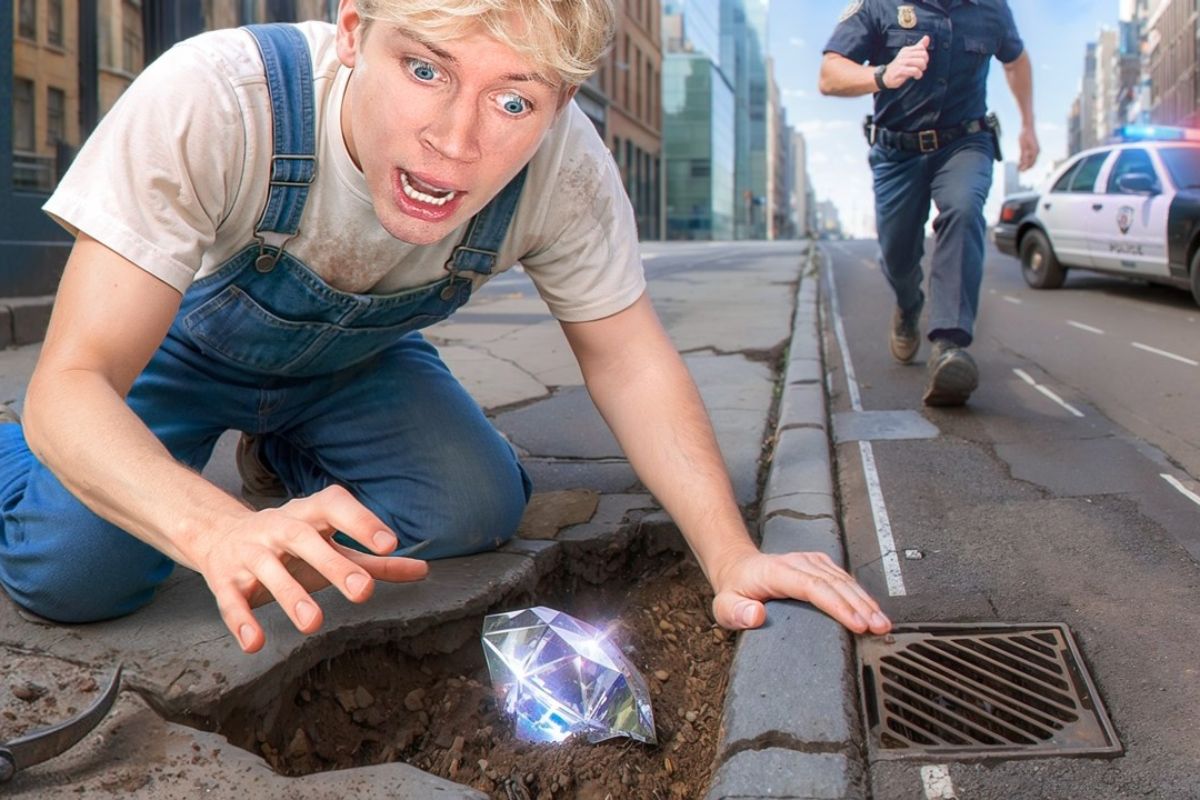


On The Sidewalks Of New York, A Young Man Decides To Mine Cracks In The Diamond District After His Grandmother Buys A Necklace That Turned Green In Two Weeks; With Tweezers, Buckets, And A Crack Cleaning Machine, He Chases US$ 1,000, Finds Gold, A Pearl, And Two Real Diamonds Valued At US$ 150.
On the sidewalks of New York, the initiative began as a response to a loss at home and quickly turned into a street operation with goals and method. After seeing his grandmother being scammed into buying a necklace that turned green in two weeks, young Claw and Clem decided to search for diamonds, gold, and jewelry in the very cracks of the concrete that could fund a quality necklace.
The chosen setting was the jewelry district, but the raw material was under the feet of passersby: compacted dirt in sidewalk cracks. The group had previously reported, a month earlier, that they had converted six hours of collecting into about US$ 260 in “golden gemstones”. This time, the bet was more aggressive: to reach US$ 1,000 in a single day, accumulating enough weight to justify professional sorting and evaluation.
The Family Revenge That Shifted The Focus From The Windows To The Ground

The engine of the story is straightforward: a purchase that seemed valuable turned out to be a mistake, and the reaction was to try to recover value through another means.
-
The North Face Co-Founder Donates Vast South American Lands to Create National Parks in Patagonia, Turning Private Wealth into Environmental Legacy

-
From Rural Brazil to Global Tech: Entrepreneur Builds a 800-Employee Company with Over $40 Million Annual Revenue in 19 Countries

-
Brazilian Farmer Transforms Soybean Land into Thriving Banana Plantation with 15,000 Trees Using Solar Power and Irrigation, Selling at $5 per Kilo
-
Canadian Entrepreneur Sells Company to Build Community with 99 Tiny Homes for the Homeless, Offering Jobs and Solar-Powered Amenities




The disappointment with the necklace that changed color became a justification to search for gold, diamonds, and jewelry outside the counter, in a practical, albeit improvised, “repair”.
On the sidewalks of New York, this motivation took on tactical contours.
Instead of entering stores and accepting prices, the group began to observe where dirt accumulates, particularly in cracks near jewelry commerce areas, where circulation and handling of pieces increase the chance of fragment drops.
Cracks As An Urban Mine And The Tools Used To Extract Dirt

The routine began with delays and pressure for productivity.
The group arrived around 9 a.m., despite planning to start at 7, and began work with a tool to loosen the dirt and dump it into buckets.
The technique is based on repetition: choose a promising crack, remove the dirt, move to the next one, and keep up the pace.
The method needed clear limits to avoid conflict with public space.
After being confronted by a merchant, the group asserted that they were not “tearing up” the pavement, just removing already loose dirt and restoring cleanliness to the location.
From that point, the selection became more rigorous: prioritizing deep cracks with dark dirt and avoiding any attempts to break the concrete, keeping the search for gold and jewelry within what they called “cleaning”.
Weight As A Central Variable And The Goal Of US$ 1,000

The promise of an expensive diamond serves as a narrative, but the real indicator was weight. After two hours, the group estimated they had only 2 pounds of dirt, much below what was needed to sustain the goal.
The calculation they presented was straightforward: they would need at least 40 pounds, about 18 kg, for sorting to have a chance of yielding diamonds and gold in a relevant quantity.
To speed up collection, the group moved along 47th Street and decided to use a “crack cleaning machine 9000”, cited as a physical relief and efficiency gain.
The reasoning is operational: the larger the volume, the greater the chance of capturing particles of gold, pieces of jewelry, and small diamonds that mix with urban waste and accumulate in cracks.
What Residents Reported About Lost Jewelry And Money Found
The street provided stories that served as motivation and calibration of expectations. One resident claimed to have seen the practice and said he had been visiting the area for 18 years, mentioning earnings of US$ 1,000 in a week.
Another shared that he found US$ 2,000 after discovering a canary yellow Tiffany & Co. ring a few years prior, reinforcing that jewelry can disappear from fingers and reappear on the ground.
These accounts also brought a scale of values explaining why urban hunting is appealing. It was said that a small stone can fetch US$ 3,000, and that a piece can lose tens of thousands of dollars if a specific stone is missing.
On the sidewalks of New York, this creates a probability game: a real diamond is possible, but most of the shine tends to be glass, common metal, or synthetic material.
When The Shine Turns Into Noise And Persistence Becomes Protocol
In one of the most emblematic moments, the group found a large stone and treated it as a possible diamond, but the test indicated it was fake.
The episode did not end the search; it forced a change in stance, focusing more on volume and less on visual reading. Volume First, Confirmation Later became the rule, with the decision to accumulate dirt and leave validation for sorting and an evaluator.
The operation continued into the night with increasing fatigue. At one point, the tester used to check diamonds stopped working, which reinforced the decision to concentrate on the dirt and rely on professional assessment.
With the streets emptier, the group described fatigue and increased awareness of their surroundings, mentioning rats and the presence of people in drug dependency situations in the area.
Still, they continued because the goal of 40 pounds was close and there was a logistical deadline: the flight in a few hours, which turned every new crack into a final chance for gold, diamonds, and jewelry.
Team Separation, Collection In Busy Areas, And The Role Of Volume
With time running out, the group split up to cover more points. One member stayed in the Diamond District, while another searched busy areas, including Central Park, operating on the principle that thousands of people pass through there and may leave behind jewelry fragments.
More Traffic Means More Potential Losses, and this translates to more material to sift through.
There was also an operational communication problem when one member stopped responding for over an hour, increasing anxiety during collection.
The incident emphasized that hunting on the sidewalks of New York is limited not only by luck and method but also by coordination, bucket transport, and time. In the end, the decision was to conclude, bag the dirt, and bet on sorting to separate what was trash from what could be gold or diamonds.
From The Sidewalk To The Sorting Process In Buffalo
The bagged dirt was taken to Buffalo, where the group set up a multi-step sorting process described as a “trifasic” to separate lightweight materials from heavier ones.
Right from the first passes, low-value items and relevant clues appeared: a piece of necklace with a clasp that could be gold, tiny gold specks, and worthless metals.
Tension Grew when they reported that 20% of the material had already been analyzed with limited returns.
The sorting was adjusted to gain speed. As each “pan” took almost eight minutes, the group adopted equipment called SLE, described as capable of carrying heavy material and concentrating what matters.
This led to the emergence of a coin, more signs of gold, pieces that seemed to be jewelry, and several “potential diamonds”.
The central point is that the chance increases with volume: on the sidewalks of New York, the find does not come from a single crack but from the sum of dozens of cracks.
The Evaluation At The Jewelry Store And What Turned Into Real Money
The final confirmation occurred at the jewelry store Kirk’s, during an evaluation conducted by Adam. The materials were organized into three groups: random items, stones, and diamonds.
Among the common finds, there were discards due to forgery and pricing of small pieces: a sterling silver chain link for US$ 5, a 1 g silver bar for about US$ 1, and a clasp that “looked like gold” for approximately US$ 15.
The score changed when a pearl was deemed real and valued at US$ 60. Among the colored stones, the evaluator separated glass from gems: an onyx around US$ 20, a peridot estimated at US$ 30, a sapphire valued at US$ 70, and a garnet for about US$ 30.
With the diamonds, the frustration came partly: two larger stones were classified as CZ, and out of five smaller ones, only two were real diamonds, with a total value of US$ 150. Adding up the items, the evaluator pointed to about US$ 460, enough to buy a solid gold necklace with stones and complete the goal that motivated the search.
What The Hunting On The Sidewalks Reveals About Consumption, Risk, And Expectation
The balance exposes the gap between fantasy and accounting.
The story began with the image of a US$ 5,000 diamond and ended with a sum of small values that turned into a concrete purchase.
The Real Money Came From Fragments Of Gold, A Real Pearl, And Two Confirmed Diamonds, while much of the initial shine was glass, common metal, or synthetic stone.
There is also a component of urban limits that defines what is acceptable. In searching for gold, jewelry, and diamonds in cracks, the group needed to justify that they were not damaging the pavement, and the operation was restricted to the removal of accumulated dirt.
On the sidewalks of New York, this boundary is crucial: urban hunting only sustains itself when it does not turn into vandalism, and when the expectation of instant fortune gives way to method, volume, and technical evaluation.
In the end, the sidewalks of New York became the backdrop for a microscopic economy, made up of particles of gold, lost jewelry, and rare diamonds mixed with urban waste. If you have ever bought something that seemed precious and later disappointed you, what sign did you ignore at the time of purchase? And, looking at your city, where do you think lost jewelry accumulates the most: near stores, parks, or busy areas?


