





 Portuguese
  English
  Spanish
  4 min of reading
  0 comments


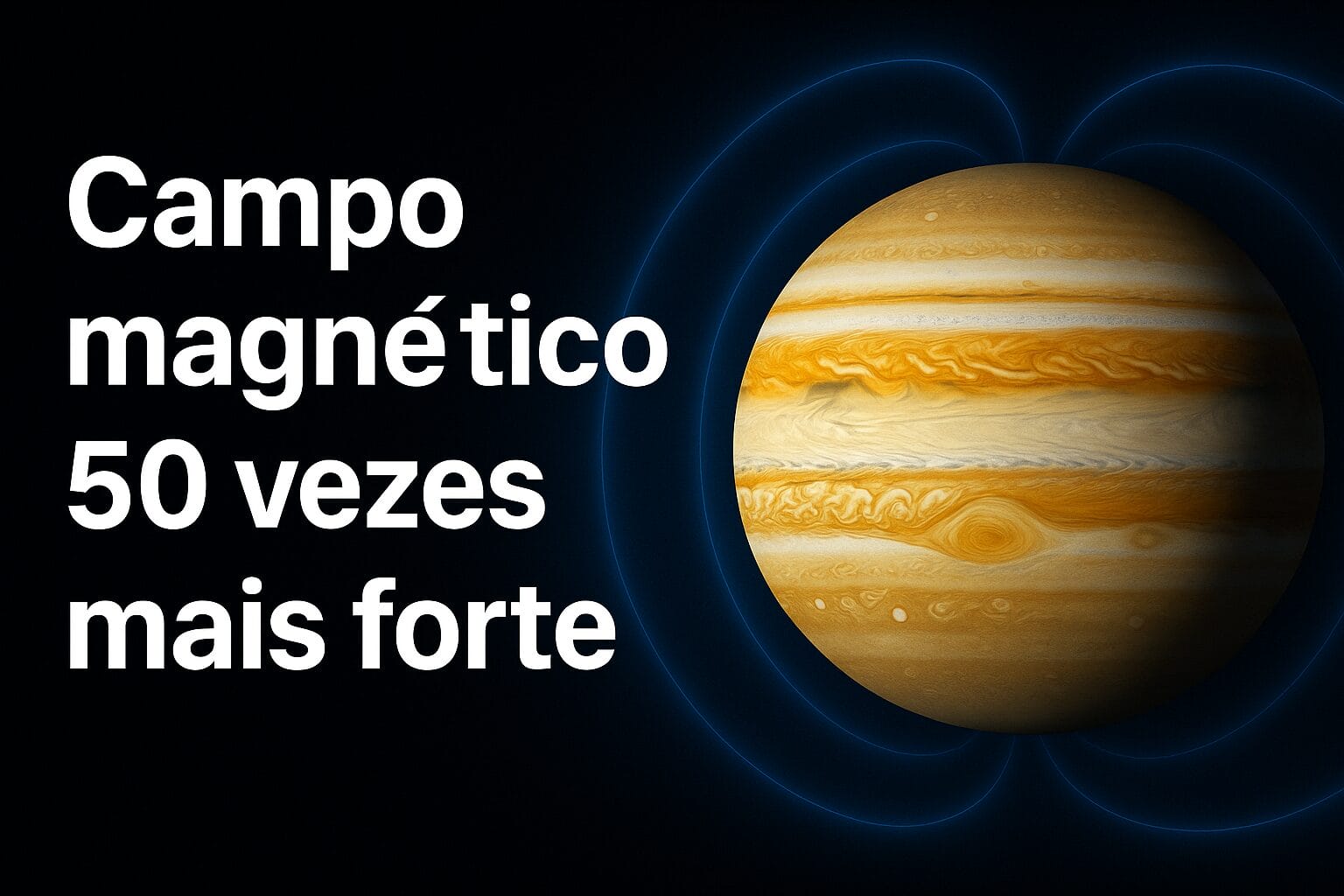
Study Reveals That Jupiter Was Once Twice The Current Size And Housed A Magnetic Field Up To 50 Times More Intense Than The Current One Shortly After Its Formation.
In the early days of the Solar System, Jupiter was not the planet we know today. A new study indicates that, in its first millions of years, the largest planet in the system was even more impressive.
With twice its current size and a magnetic field about 50 times more intense, Jupiter underwent dramatic transformations shortly after its formation.
This discovery is the result of the work of scientists Konstantin Batygin from the California Institute of Technology (Caltech) and Fred Adams from the University of Michigan.
-
Ten undergraduate students received an astronomy homework assignment, began sifting through data on the university’s computer, and ended up discovering the oldest star ever recorded in the universe, a cosmic immigrant that formed shortly after the Big Bang and was wandering alone towards the Milky Way.
-
Scientists reveal that Saturn’s rings may have formed after the destruction of a moon, and a study indicates that the planet’s bright structure is only 100 million years old.
-
A Brazilian who does not work at any space agency calculated a round trip route to Mars in just 7 months using asteroid trajectories as cosmic shortcuts, and the study was accepted by one of the most prestigious scientific journals in the world.
-
A continent of plastic that keeps growing: what no one tells you about the largest garbage dump in the world, which continues to grow endlessly.

The study reconstructs what the planet was like 3.8 million years after the birth of the first solid particles of the solar system.
The Inflated Giant
During the period known as the “end of the protoplanetary disk,” the Sun was still young, and a cloud of gas and dust was beginning to dissipate around it.
It was the perfect setting for the birth of planets. At this stage, Jupiter had just completed its gas absorption phase. This left it in a temporary state of swelling, with a radius up to 2.5 times greater than its current one.
In practice, this means it had enough volume to house more than 2,000 Earth-sized planets within it.
It was a stormy, hot sphere surrounded by an extremely intense magnetic field. According to the authors of the study, this size reveals important details about how gas giants form.
Hidden Clues in the Moons
The information was not extracted directly from the planet. The clues about this giant and magnetized Jupiter came from its inner moons.
Among the 97 known moons of the planet, two stand out in this study: Amalthea and Thebe.
These satellites orbit Jupiter in regions closer than Io, one of the largest and most famous moons. The orbits of Amalthea and Thebe exhibit subtle inclinations, the result of ancient forces.
During the youth of the solar system, larger moons like Io migrated to more distant orbits under the influence of gravitational tides.
As they moved, these larger moons resonated with neighboring satellites.
These gravitational interactions altered the orbits of the smaller moons, imprinting marks on them that persist to this day. Batygin and Adams used these inclinations as archaeological clues.
Based on them, they calculated where Io was in the past, and from that, inferred what size Jupiter must have been at that time.
The Spin That Tells a Story
Another key piece of information to understand Jupiter’s past lies in its rotation. Just as a figure skater spins faster by bringing their arms closer to their body, Jupiter accelerated its rotation as it shrank.
The researchers calculated the speed at which the planet was spinning when it was larger and managed to estimate its initial structure.
These insights also helped to estimate the intensity of Jupiter’s magnetic field in the past. According to the study, the planet’s magnetic strength reached 21 millitesla, a value approximately 50 times greater than the current one.
This intensity created a massive magnetosphere, capable of protecting the planet from solar winds and influencing the formation of its rings and moons.
No Assumptions, Only Physics
The study is notable for not relying on traditional models that make assumptions about the timescales of planet formation or the characteristics of their atmospheres. Instead, the scientists based their analyses on fundamental laws of physics, such as the conservation of angular momentum and orbital mechanics.
This makes the results more robust. Moreover, they coincide with an earlier study from 2023 on the magnetism present in meteorites. This study indicated that the solar nebula dissipated exactly 3.8 million years after the formation of the first solids. It is the same moment now indicated for the phase when Jupiter was swollen and highly magnetic.
The Role of Jupiter in System Formation
Jupiter has always been viewed as a central piece in the history of the Solar System. Its mass and gravity shaped the orbits of various celestial bodies.
The planet deflected comets, influenced the formation of neighboring planets, and may have even prevented another planet from forming between Mars and Jupiter, in the region we now know as the asteroid belt.
Understanding how the planet developed in its early moments helps to piece together the puzzle of the origin of everything. “Our ultimate goal is to understand where we came from,” said Batygin. Knowing Jupiter’s past also reveals how other planetary systems may form around distant stars.
Hot Start or Cold Start?
The study supports the core accretion model theory, which says that gas giants form from rocky cores that absorb large amounts of gas.
Additionally, the findings contribute to an old debate among scientists: do planets form with a “hot start” or a “cold start”?
The answer may be in the middle ground. The data suggest that Jupiter had a hot start, but still allows room for future revisions on what happens in the first millions of years after a planet’s birth.
The work of Batygin and Adams offers a rare portrait of what a planet was like in its early years. Based on orbital clues and the laws of physics, the duo managed to see the past more clearly.
The findings were published in Nature Astronomy.









Seja o primeiro a reagir!