





 Portuguese
  English
  Spanish
 5 min of reading
  0 comments


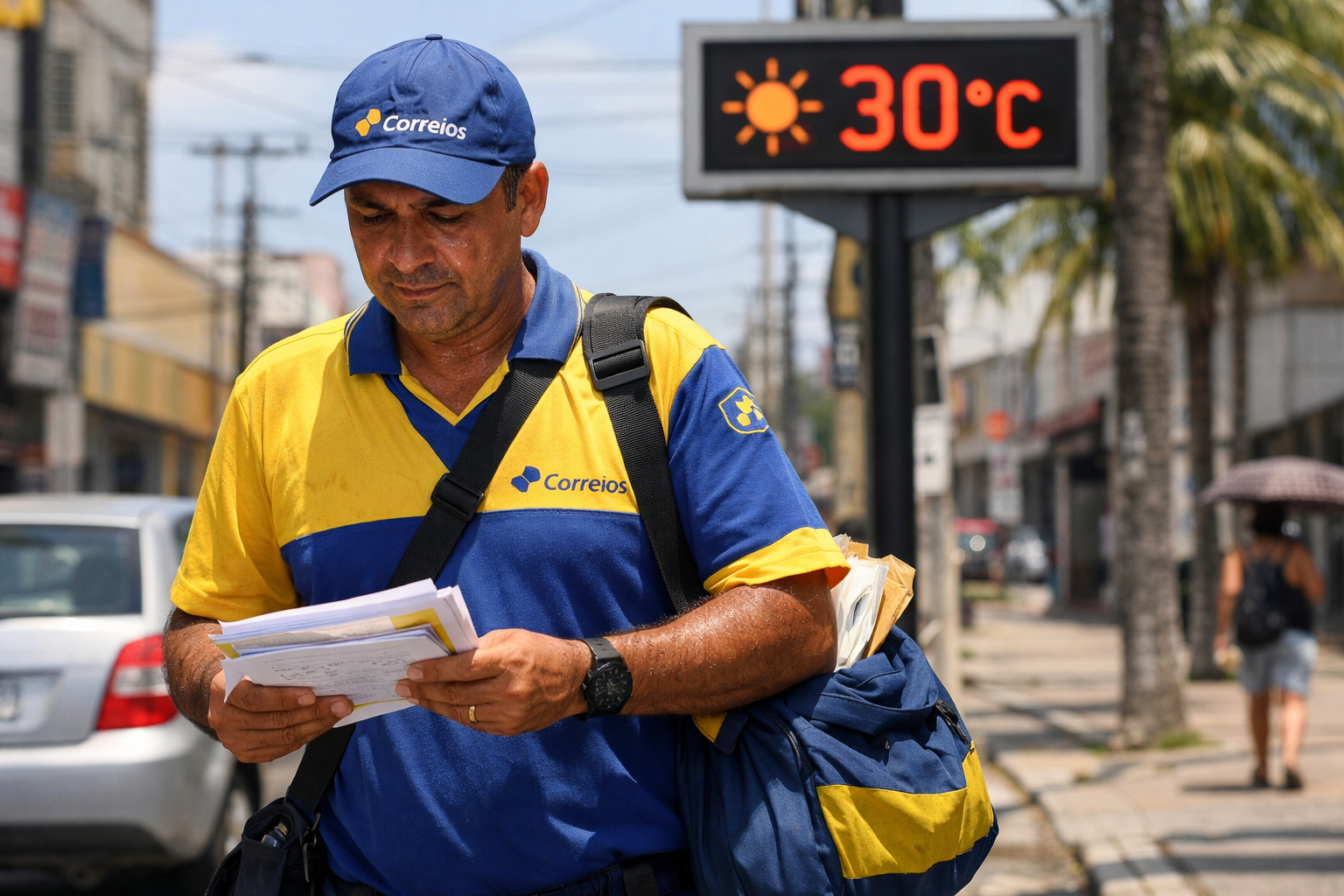
Decision of the 17th Panel of the Regional Labor Court of the 2nd Region Sets Deadline of 60 Days, Creates Automatic Rule Based on Weather Forecast and Strengthens Health Protection in Activities Conducted Under Extreme Heat
The Labor Court determined that the Postal Service anticipates the external working hours of its workers whenever the weather forecast indicates a temperature equal to or greater than 30°C. The decision creates an immediate “climate trigger,” compelling the company to organize deliveries in the morning as a means of protecting the health of mail carriers and other professionals who perform outdoor activities, especially during periods of intense heat and increasingly frequent heat waves in the country.
The measure was defined by the 17th Panel of the Regional Labor Court of the 2nd Region, which overturned a previous ruling and established a deadline of 60 days for the Postal Service to implement or definitively resume morning deliveries at the distribution centers where external service is performed on foot. Until this occurs, the decision imposes the automatic anticipation of working hours whenever the thermal limit of 30°C is reached, functioning as a provisional guardianship to reduce immediate risks to workers.
The information was disclosed by the Regional Labor Court of the 2nd Region, according to the ruling made in case No. 1000334-91.2024.5.02.0067, which ruled in favor of a Public Civil Action filed by the Union of Workers of the Brazilian Postal and Telegraph Company and Similar Entities of São Paulo, Greater São Paulo Region, and Sorocaba Postal Zone.
-
Countries may be required to pay up to R$150,000 for emotional abandonment: new law changes rules and expands parental responsibility in Brazil.

-
New vaccination and mandatory testing rules in Brazil raise alarms, redefine public health regulations, and spark debate on sanitary control and individual rights.
-
The noise ban in Germany will no longer be at 10 PM starting in June with a new rule valid during the 2026 World Cup.

-
New vaccination rules and mandatory exams in Brazil raise alarms, redefine public health regulations, and spark debate on sanitary control and individual rights.
Decision Requires Postal Service to Present Plan with Goals and Timelines
In addition to anticipating working hours on days of extreme heat, the court ruling requires the Postal Service to present a national plan with clear timelines and goals for the universalization of morning deliveries at the distribution centers where work is performed on foot. The requirement demonstrates that the Justice does not treat the measure as temporary but as a permanent policy for protecting worker health.
According to the panel’s understanding, the company violated a collective labor agreement previously made, in which it committed to prioritizing morning deliveries. However, in several units, this practice was not implemented or ended up being interrupted, which prompted judicial action.
The Postal Service claimed that it would not be possible to adopt morning working hours because the units would need to cover all postal districts, which, according to the company, would contradict the Operations and Clients Manual. However, this argument was not accepted by the judges.
The rapporteur of the ruling, Judge Maria de Lourdes Antonio, highlighted that the collective agreement itself provided for the continuous improvement of the logistical flow. For her, the commitment made by the company requires practical progress, not stagnation. “The verb ‘improve’ implies evolution, not regression,” she stated, emphasizing that the conduct of the Postal Service frustrated the legitimate expectations of the category and violated the principle of trust protection.
Understanding of the Supreme Court Validates Judicial Intervention in Public Policies
As a legal basis, the 17th Panel applied the understanding established by the Supreme Federal Court in General Repercussion Theme 698. This precedent recognizes that the intervention of the Judiciary in public policies is legitimate when there is a serious deficiency in service delivery or insufficient protection of fundamental rights, such as health and the physical integrity of workers.
In this context, the Judiciary does not replace public management in defining administrative means, but can require that the Administration presents a concrete plan to achieve the desired outcome. This was precisely the logic adopted in the case of the Postal Service, with the imposition of goals, deadlines, and provisional measures to ensure immediate protection.
The ruling also adopted the technique of what is called a “structural” or “structuring” decision, which recognizes the complexity of the case and requires a multifaceted solution rather than a simple and isolated order. This model has increasingly been used in cases involving fundamental rights.
The topic gained even more strength with the issuance of CNJ Recommendation No. 163/2025, from the National Justice Council, which establishes specific guidelines for the identification and conduct of Structural Processes in the Brazilian Judiciary, reinforcing the legitimacy of this type of action.
Extreme Heat, Thermal Stress, and the December Orange Campaign
The court ruling directly engages with the context of the December Orange campaign, a national initiative that marks the onset of summer in the Southern Hemisphere and raises awareness about the risks of excessive exposure to ultraviolet radiation. In Brazil, the month is dedicated to raising awareness about daily preventive measures and the importance of regular dermatological monitoring.
In the work environment, the alert is even more relevant. Various professional categories perform outdoor activities, being exposed to intense heat for long periods. This condition favors what is called thermal stress, which can cause dehydration, exhaustion, reduced performance, worsening of illnesses, and, in extreme cases, lead to death.
To mitigate these risks, Regulatory Standards seek to promote safer and healthier work environments, using technical indices to assess occupational exposure to heat. As a reference, the Ministry of Labor and Employment and Fundacentro published, in 2024, the material “Heat Exposure in Outdoor Work – General Guidelines,” which guides employers and workers on preventive practices.
Attentive to the campaign, the Regional Labor Court of the 2nd Region illuminated the Ruy Barbosa Labor Forum, located in Barra Funda, in orange this month. In addition, the court has been disseminating alerts and guidance on self-care and health preservation through its digital media, reinforcing the importance of the subject in the face of rising temperatures in the country.







-

Uma pessoa reagiu a isso.