





 English
  4 min of reading
  0 comments


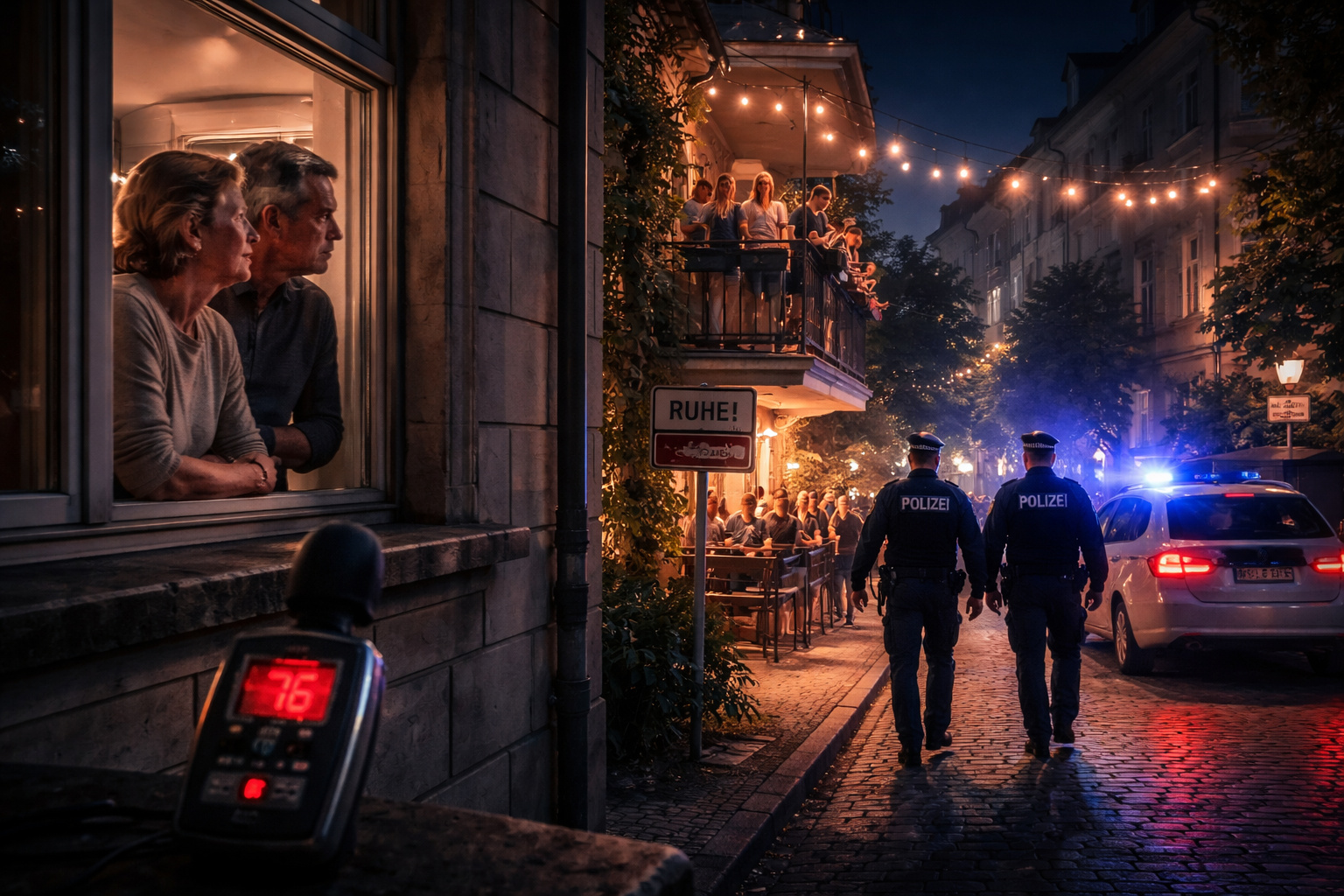
The relaxation of Nachtruhe redefines silence rules, allows public displays, and reorganizes the balance between rest and collective events
An important regulatory change has been established in Germany, bringing the topic of Noise Law back to the center of public debate.
The traditional sound restriction period, starting at 10 PM, remains as the general rule, but will still undergo temporary adjustments during the 2026 World Cup.
This change is defined for the period between June 11 and July 19, 2026, when matches held in America will take place at night in Central Europe.
As a result, public broadcasts and collective events will require a reorganization of noise regulations.
This movement demonstrates that German authorities sought to balance the right to rest with the collective interest in following the games.
At the same time, the adaptation maintains limits and controls, avoiding unrestricted noise release.
-
Chamber approves constitutional amendment reducing the age of criminal responsibility from 18 to 16 years; what now?

-
Justice confirms that old debts in tax executions that have been stalled for more than 15 years can no longer be collected through judicial or administrative means.
-
Churches may gain a new exemption in the tax reform, but the Treasury warns that Brazilians may pay more taxes to compensate for the loss of revenue.

-
Consumer was awarded R$ 10,000 after being led to believe that the apartment had a private yard, but discovered that the external area was common to the condominium.


Rules of the noise law and noise limits
The Noise Law, known as Nachtruhe, establishes that the noise level must be reduced starting at 10 PM.
This protected period varies according to the type of urban area and, therefore, requires specific attention in each region.
In residential areas and zones near hospitals or nursing homes, the limits usually vary between 35 and 65 decibels.
These parameters are applied to protect residents and sensitive groups, ensuring minimum rest conditions.
Additionally, bars, parties, and outdoor events must adjust music and sound to these limits.
Sports broadcasts in public spaces also follow these rules, which would naturally complicate games starting at late hours.
Temporary relaxation during the 2026 World Cup
The new federal regulation created temporary exceptions for the World Cup period.
Thus, cities gain autonomy to authorize public displays after 10 PM, provided they meet technical criteria.
Even with this relaxation, acoustic protection is not completely suspended.
Sound volumes must be adjusted, ensuring that the impact is minimized.
Without this measure, many outdoor broadcasts would have limited sound or would not be authorized.
Thus, the relaxation enables events but maintains the foundation of noise legislation.
Event authorization and municipal analysis
Despite federal permission, there is no automatic authorization for events after 10 PM.
The final decision is attributed to municipalities, which analyze each request individually.
Organizers must submit formal requests to city halls or environmental agencies.
These requests are evaluated based on the local context and safety conditions.
Among the main criteria observed are the location of the event, proximity to sensitive areas, and crowd management.
Additionally, acoustic mitigation measures and frequency control are also considered.
Balance between rest and collective experience
The regulation follows the model adopted in previous major events, such as the 2006 World Cup.
At that time, similar adjustments were implemented temporarily.
Instead of allowing unrestricted noise, the exceptions are specific and controlled.
Organizers remain responsible for reducing impacts and ending sound shortly after the matches conclude.
Additionally, the rapid dispersal of the audience is encouraged to avoid prolonged noise.
This set of measures seeks to reconcile residents’ rest with the collective experience of fans.
Impacts for residents and organizers
In practice, residents maintain the Noise Law as the predominant rule.
The exceptions are communicated in advance, which reduces conflicts and increases predictability.
On the other hand, organizers gain legal security to plan events.
Still, they must comply with technical requirements and safety regulations established by the authorities.
The central reference remains respect for noise regulations.
Even with temporary adaptations, control remains the foundation of the legislation.
The impact of the change in the context of the World Cup
The adaptation of the Noise Law highlights how major international events influence local rules.
This type of adjustment allows public broadcasts to occur without completely compromising collective rest.
At the same time, maintaining limits reinforces the concern for urban balance.
Thus, the 2026 World Cup becomes part of a context in which regulations are adjusted in a controlled manner.
How to reconcile the right to silence with the growing demand for collective experiences at global events?







Be the first to react!