





 Portuguese
  English
  Spanish
  4 min of reading
  3 comments


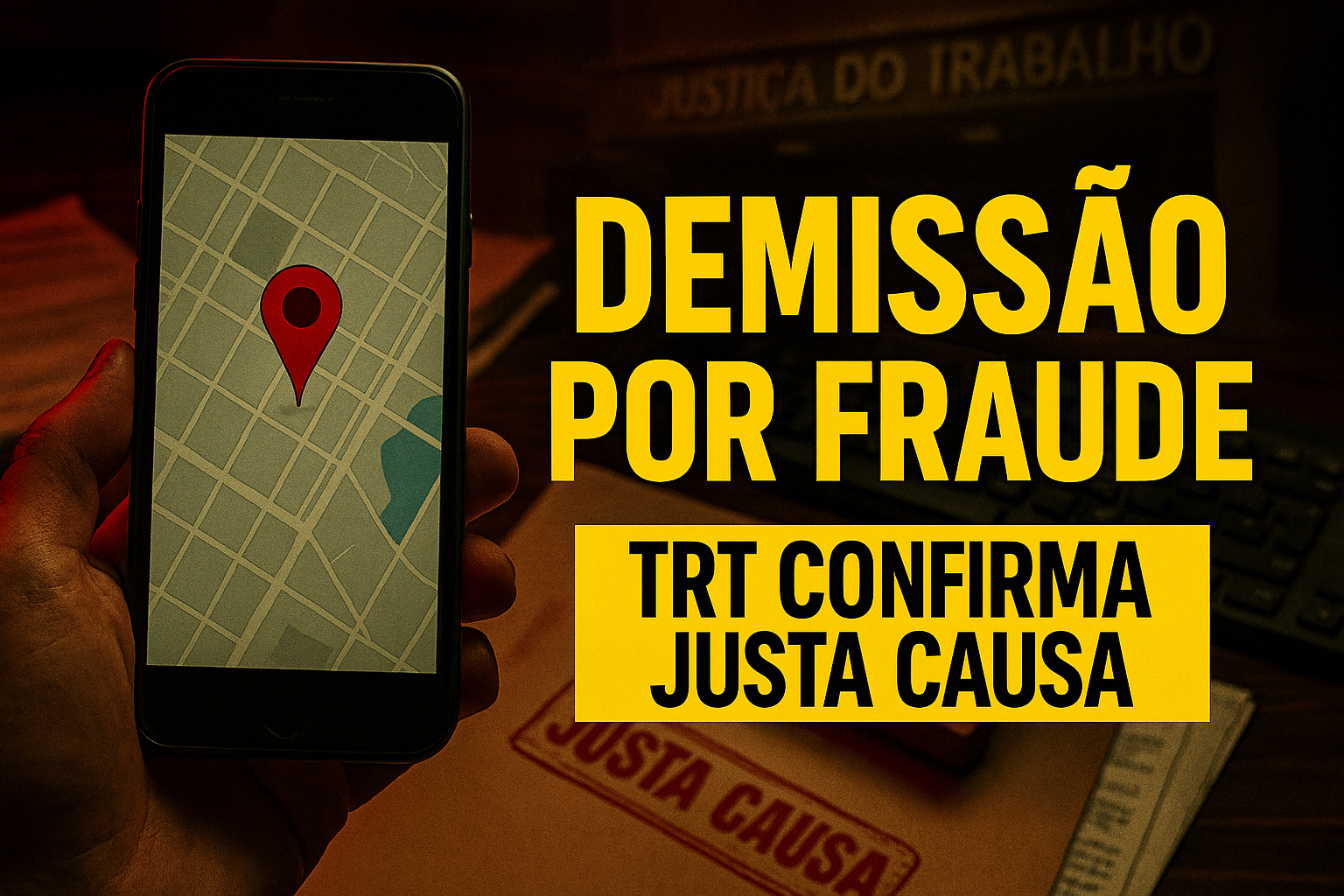


TRT-4 Upheld Just Cause Dismissal of Stock Clerk Who Falsified Time Records via App with GPS and Photos. Ruling Reinforces the Importance of Digital Evidence in Employment.
The 1st Panel of the Regional Labor Court of the 4th Region (TRT-4) upheld the dismissal for just cause of a supermarket stock clerk accused of falsifying time records through a mobile application. The decision was published by the Migalhas portal and was based on article 482, item “b”, of the CLT, which addresses misconduct. The case drew attention for involving digital fraud in timekeeping, a practice increasingly common with the use of geolocation applications in companies. According to the court, the worker manipulated the location to simulate presence at the workplace, even when at home or in transit.
The information comes from the TRT of the 4th Region, which had national repercussions after its publication by Migalhas.
Fraud in Timekeeping by App Was Proven by Images and Geolocation
According to the proceedings, the company used a mobile application to control working hours, which required:
-
Government enacts new law: paternity leave increases from 5 to 20 days with gradual increases until 2029, and Social Security pays the paternity salary; companies no longer bear the absence cost, estimated at R$ 5.4 billion.

-
End of the 1-hour lunch break in the CLT? Current labor law maintains the break, allows for negotiated reductions, and defines rules for working hours and home office in Brazil.

-
Employee Fired After Accumulating 114 Days of Medical Leave in One Year, Labor Court Upholds Company’s Decision

-
Employee Fired While Treating Depression Wins in Court and Vale Is Required to Rehire Him Following Decision Based on the CLT and INSS Benefits

- GPS location logging,
- and capturing a photograph at the time of clocking in.
Upon analyzing the records, the company identified that the worker altered the geolocation to simulate presence at the supermarket, when, in fact, the images showed:
- the employee at his residence,
- in casual attire,
- or inside means of transportation.
Another serious point was that the clock-ins initially appeared at the worker’s address and were later manually adjusted to the company address, indicating intentional manipulation of the system.
Defense Claimed Authorization for Remote Clocking, but Recurring Practices Undermined the Argument
In an attempt to reverse the punishment, the stock clerk asserted that there was authorization to clock in outside the company under certain circumstances, such as when employees left early. A witness confirmed that, occasionally, this type of practice was tolerated.
However, both the first instance and the TRT-4 understood that the issue was not an isolated incident, but rather a repeated pattern of fraud.
The court itself emphasized that the worker even clocked in without actually working on some days, which completely negates any claim of a momentary error.
Judge Acknowledged Total Breach of Trust in the Employment Relationship
The Labor Judge Cristiano Fraga, from the 3rd Labor Court of Canoas (RS), was straightforward in characterizing the serious misconduct:
“There is no doubt that the complainant’s action of falsifying the timekeeping controls represents a break in the trust necessary for maintaining the employment relationship.”
For the Court, the fraud irreversibly compromised the trust, an essential element of the employment relationship.
TRT Upheld Just Cause and Limited Severance Pay
In the second instance, the reporting judge, judge Raul Zoratto Sanvicente, emphasized that, although there might be some occasional permission for remote clocking, the reiteration of the fraud transforms the conduct into a serious offense.
According to him:
“Clocking in at home was an absolutely recurring practice of the worker, who even sometimes clocked in without ever going to work.”
Consequently, the dismissal for just cause was upheld, with payment only of:
- proportional 13th salary,
- proportional vacation,
in accordance with the Summaries 93 and 139 of TRT-4.
Digital Evidence Gains Traction in Dismissals for Just Cause
The case consolidates a clear movement within Labor Justice:
digital evidence has taken on decisive weight in cases of fraud.
Among the elements that supported the decision were:
- GPS records,
- images captured by the application,
- discrepancies between actual location and recorded location,
- repetitive pattern of manipulation.
In practice, this shows that:
- frauds in applications leave traces,
- control systems are increasingly auditable,
- and the margin for claiming technical errors is getting smaller.
Direct Impact for Workers and Companies
The decision of TRT-4 serves as a national alert for:
- employees who use timekeeping applications,
- companies in logistics, retail, and supermarkets,
- operations with external teams,
- and any activity that relies on geolocation for time tracking.
The understanding makes it clear that digital time falsification is treated with the same severity as falsifying a physical document, and typically leads to immediate job loss without the right to full compensation.
Final Reflection to the Reader
The decision shows how technology, which facilitates time tracking, also drastically reduces the margin for fraud. When location, images, and digital data come into play, the intention to deceive ceases to be mere supposition and becomes technically provable.
The case also reinforces that trust remains the foundation of the employment contract and when it is repeatedly broken, the punishment tends to be the maximum.
And you, reader: do you believe that digital time fraud should always lead automatically to just cause, or should there be room for warnings even in the face of technical evidence?










TEM CERTAS COISAS QUE NÃO TEM COMO
NÃO DAR EM **** !!!
Eu acho que a empregada teria que colocar ponto fixo pois não somos obrigado a ter o ponto no nosso próprio celular a empresa que tem obrigação de registrar o ponto como o funcionário exemplo se o funcionário não tem telefone como ficaria
Compra um telefone.