





 Portuguese
  English
  Spanish
  4 min of reading
  0 comments



Volcanic Lake Accumulates Over 1.6 Billion m³ of CO₂ for Decades, Remains Chemically Unstable Since the 1980s and May Release Lethal Cloud Within Minutes Without Warning.
The scenario is the Nyos Lake, a volcanic lake located in the northwest of Cameroon that acts as a natural trap for carbon dioxide. Over decades, the lake has accumulated more than 1.6 billion cubic meters of dissolved CO₂ in its deep waters, remaining chemically unstable since the 1980s. Unlike explosive volcanoes or visible tsunamis, here the risk is silent: a sudden release of gas can create an invisible, heavy, and suffocating cloud capable of asphyxiating everything nearby within minutes, with no warning.
A Lake That Acts Like a Pressurized Bottle
Nyos occupies a deep volcanic crater, with steep walls and stable thermal stratification. The deeper waters are cold, dense, and do not mix with the surface. This arrangement creates the perfect environment for gas accumulation.

Below the lake, the mantle continuously releases magma-derived CO₂. This gas rises slowly, dissolves in the deep waters, and remains trapped by hydrostatic pressure—a mechanism similar to that which keeps gas dissolved in a sealed beverage. As long as nothing disturbs the system, the lake appears calm.
-
He started running at 66 years old, broke records at 82, and is now a subject of study for having a metabolic age comparable to that of a 20-year-old, in a case that is intriguing scientists and inspiring the world.

-
Oldest tree on the planet reappears after 130 years of searches: Wattieza, 385 million years old, was 10 meters tall and had no leaves or seeds; Gilboa fossils in New York solved the mystery in 2007.

-
A 48-square-meter house assembled in hours with 4,000 bricks made of recycled plastic that does not absorb moisture, has natural thermal insulation, and costs less than 90,000 reais in a complete kit.

-
Luciano Hang revealed that Havan’s air fleet has already accumulated more than 20,000 landings, 10,000 flight hours, and 6 million kilometers traveled, and he says that without the planes, the company would never have grown so quickly.


The Physics Behind the Danger: Solubility, Pressure, and Collapse
The solubility of CO₂ increases with pressure. At depth, the gas remains dissolved; if there is any trigger that reduces the pressure or mixes the layers—a landslide, an earthquake, a phreatic eruption, extreme winds—the balance can break.
When this happens, the CO₂ exsolves (comes out of solution) explosively, rising in a column and dragging even more gas with it.
The process is self-amplifying: the more gas rises, the more the pressure drops, releasing even more CO₂. Within minutes, a dense cloud forms, heavier than air, which spreads close to the ground.
The Event That Proved the Risk Is Real
On the night of August 21, 1986, this mechanism manifested on a catastrophic scale. A sudden release of CO₂ came from the lake and descended into the valleys around it. The gas displaced oxygen in the air and asphyxiated people and animals while they slept. More than 1,700 people died, in addition to thousands of livestock.
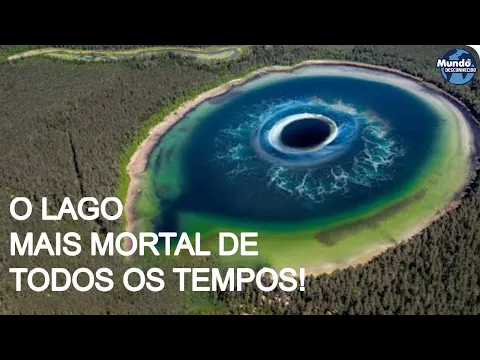
There was no explosion, fire, smell, or noise. The danger was invisible and silent. The episode turned Nyos into the most extreme case of limnic eruption ever recorded.
Subsequent measurements showed that the lake did not completely empty of CO₂ during the 1986 event. On the contrary: the magmatic input continued. Technical estimates indicate that the system has resumed gas accumulation over the years, reaching again volumes on the order of billions of cubic meters dissolved.
This accumulation sustained for decades is what keeps the lake chemically unstable. In other words: without intervention, the risk does not disappear over time.
The Engineering That Tries to Contain a Natural Disaster from the Volcanic Lake
After the tragedy, scientists implemented a controlled degassing system. Vertical tubes were installed down to the deep waters; upon initiating the flow, the CO₂ release itself creates a siphon effect that gradually removes the gas, reducing the lake’s internal pressure.
The system works, but requires continuous maintenance. If the tubes fail, if the operation is interrupted, or if the magmatic input increases, the risk begins to grow again. It is a permanent race against a deep natural process.
Why Nyos Lake Is Unique
Nyos encompasses rare factors at the same time: suitable depth, constant magmatic input, stable stratification, and terrain that channels gas into populated areas. This combination makes it exceptionally dangerous.
But it is not the only lake capable of storing CO₂. Other deep volcanic lakes, in different parts of the world, exhibit signs of gas accumulation, although on smaller scales. Nyos serves as a global alert to a little-known natural risk.
A Danger That Cannot Be Seen, Heard, or Felt

The most disturbing aspect of Nyos Lake is the nature of the risk. Unlike earthquakes, eruptions, or storms, there are no sensory signals. CO₂ is colorless, odorless, and non-irritating. The victim loses consciousness quickly due to hypoxia, without realizing what is happening.
This factor makes prevention depend solely on science, monitoring, and engineering.
What the Case of the Volcanic Lake Teaches About Natural Limits
Lake Nyos exposes an uncomfortable limit: there are natural systems that safely store lethal energy in silence, outside our everyday perception. They do not fit the classical image of disaster, but can be equally devastating.
With over 1.6 billion m³ of dissolved CO₂ accumulated over decades and a proven history of fatal release, Nyos remains a reminder that apparent stability can be illusory and that deep technical understanding is the only barrier between a fragile balance and a new tragedy.








-

-

2 pessoas reagiram a isso.