





 Portuguese
  English
  Spanish
  6 min of reading
  30 comments


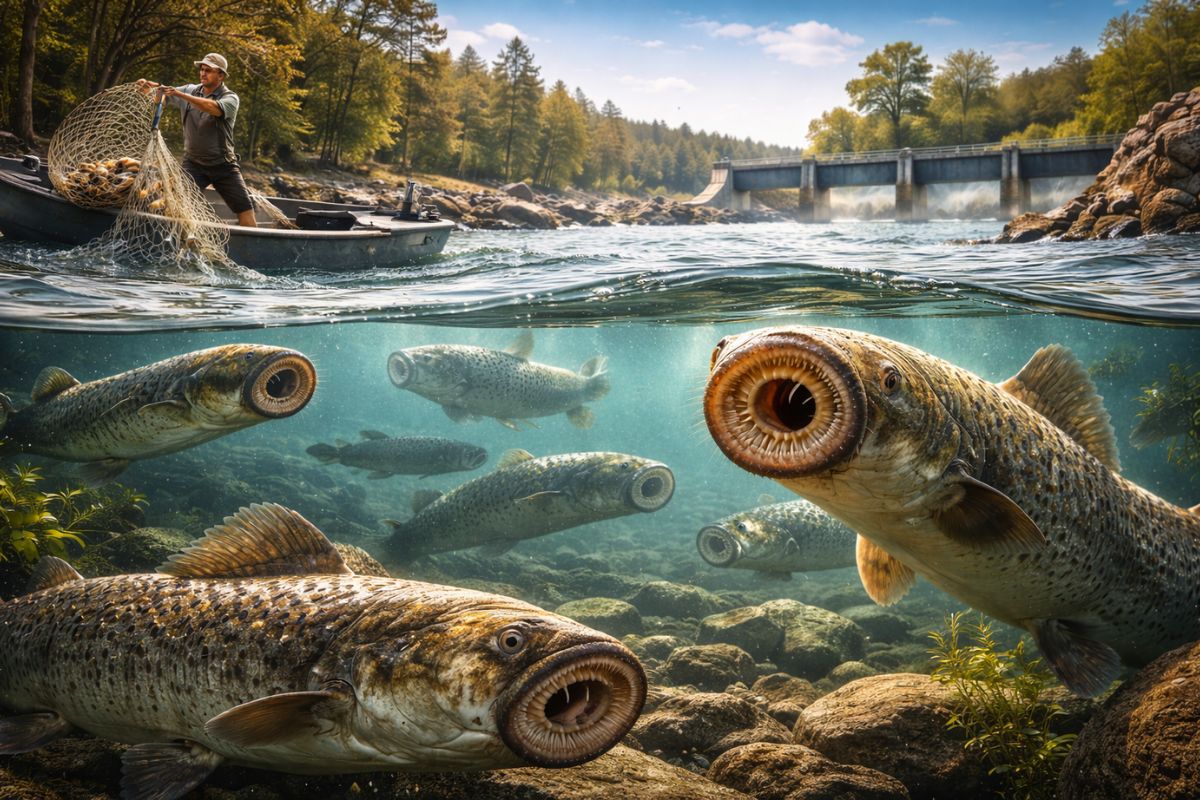


In The Great Lakes, The Invasive Sea Lamprey Has Caused A Fishing Crisis And Continues To Require Ongoing Control
The sea lamprey that arrived in the Great Lakes has put significant pressure on fish populations and has contributed to the decline of commercial and recreational fishing in parts of the system. Under typical parasitic conditions, an individual can destroy the equivalent of up to about 40 lbs of fish over its feeding period, which helps explain the scale of the problem when the population expands.
After decades of research and management, the control program has reduced invasive populations by about 90% in most areas of the Great Lakes, opening up space for ecosystem recovery and fishing activity.
The fishery in the Great Lakes is often estimated at more than US$ 7 billion per year, which reinforces why management of the species continues to be treated as a priority.
-
Trip to Mars getting closer: Pulsar Fusion, from the UK, advances with plasma ignition in fusion engine and could drastically reduce space travel time, making crewed missions faster, safer, and economically viable.

-
Made with recycled plastic, a Lego-inspired brick builds a 180 m² house in 15 days, providing thermal comfort, preventing moisture, and turning waste into income, kits, and accelerated construction in the country.

-
A robot with a silicone face and 26 facial motors learns to move its lips accurately by observing its own reflection like a child, then analyzes hours of videos on YouTube to reproduce how humans speak and sing, now articulating words in several languages, has already recorded a music album generated by AI, and is beginning to cross the uncanny valley that causes people to reject almost human robots.

-
Iron foundry in Senegal reveals a pile of 100 tons of slag, 35 furnace bases, and a rare technique that has remained stable for centuries.


Even with advances in control, the species remains present in rivers and tributaries, so the story is not over yet.
What Is The Invasive Sea Lamprey

The invasive sea lampreys belong to an ancient family of jawless fish that have existed since before the dinosaurs.
They have an elongated body, similar to an eel, can exceed 30 centimeters in length, and are noted for their circular mouth filled with rows of teeth.
This anatomy allows them to attach to fish with a sucker-shaped mouth and feed primarily on bodily fluids, weakening the host and potentially leading to death, especially in species that have not evolved with this type of pressure.
In closed systems like the Great Lakes, where native fauna did not evolve with this type of predator, the impact is devastating.
Originally, the sea lamprey lived in the Atlantic Ocean. For a long time, the Niagara Falls acted as a natural barrier that prevented this species from moving upstream into the Great Lakes.
The situation changed when new navigation routes were built to bypass the falls, paving the way for the sea lamprey to invade new basins.
How The Sea Lamprey Invaded The Great Lakes And Destroyed The Fishing
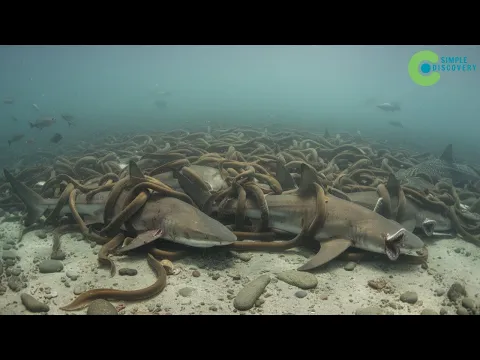

Beginning in the late 19th century, the species invaded the Great Lakes and began to spread throughout the system quietly.
By the 1930s, records already showed that the invasive fish had infested all of the Upper Great Lakes, establishing populations at a rate that was difficult to control.
The damage went far beyond isolated dead fish. The sea lamprey severely disrupts native fish populations and competes for resources in an environment that is unprepared for its presence.
Before the invasion, lakes like Huron, Michigan, and Superior were famous for their large, high-quality cold-water fish, sustaining a highly profitable commercial fishery.
By the 1940s, the lake trout alone accounted for an average commercial catch of 7,000 tons per year. With the advance of the sea lamprey that invaded the Great Lakes, those populations began to collapse.
The predatory pressure led to such a drastic decline that the fishing season had to be closed in 1962, after the complete collapse of lake trout populations in several areas.
This sequence of events shows how a single invasive species that invaded the Great Lakes was able to topple an entire economy based on fishing, affecting jobs, riverside communities, and the entire ecological balance of the region.
The Turning Point With Lampricides And The Recovery Of Fish
In the face of the crisis caused by the species that invaded the Great Lakes, authorities and scientists organized a coordinated response.
Under the leadership of the Great Lakes Fishery Commission, a major chemical control effort focused on the most vulnerable stages of the sea lamprey was launched in the 1950s.
Researchers tested nearly 6,000 chemical compounds in search of a substance capable of targeting the larvae of the sea lamprey without causing significant harm to other species.
The result of this work was the identification of 3-trifluoromethyl-4-nitrophenol, a lampricide known as TFM, which became the main product used in control.
Biologists apply TFM in infested streams around the Great Lakes, locations where larvae develop before migrating to open waters.
The effects were rapid and profound. By the early 1960s, TFM treatments reduced sea lamprey populations by about 90% in many areas and allowed for the recovery of self-sustaining populations of native lake trout in the upper region.
This outcome was crucial in preventing the system where the sea lamprey invaded the Great Lakes from remaining in permanent collapse.
With fewer invasive predators, native fish had the chance to reestablish, and the fishing economy began to recover to its current level of billions of dollars annually.
Why You Don’t See The Species, But The Risk Remains

Many people who live in or visit the area today may not even imagine that a species that invaded the Great Lakes was once at the center of such a serious crisis.
One reason is the effectiveness of control. Lampricides like TFM are selectively toxic to the sea lamprey, allowing for a reduction in their populations without causing widespread impact on the ecosystem.
Although some fish, insects, and broadleaf plants are also sensitive, TFM has been used for over 60 years and degrades naturally in the environment, preventing bioaccumulation.
The Environmental Protection Agency (EPA) considers that the product, when used correctly, does not pose an unacceptable risk to the general population or the environment.
Still, scientists and managers know that the complete elimination of the species that invaded the Great Lakes is unlikely. Current strategies combine:
- continuous treatment with lampricides in infested streams
- use of mechanical and electrical barriers to prevent the migration of lampreys
- constant monitoring of invasive populations and native fish
As efforts to restore lake trout expand, control of the sea lamprey remains a priority.
The Great Lakes Fishery Commission coordinates and funds management across the region, while the Department of Fisheries and Oceans Canada oversees the Canadian side of the waters.
The goal is to keep the species that invaded the Great Lakes under control and prevent another ecological collapse.
Invasive vs Natives: Not All Lampreys Are Villains
An important point in this story is that the invasive sea lamprey is not the only lamprey present in the region. There are native lampreys that are part of the local ecosystem and do not cause the same devastating effects on fish populations.
While the focus of control is the species that invaded the Great Lakes, these native species need to continue existing to maintain the natural balance.
Additionally, there is ongoing work to restore the native Pacific lamprey on the West Coast, showing how management is always specific to each species and each ecosystem. In one place, a lamprey may be a villain; in another, it is an important piece of biodiversity.
This difference helps explain why the case of the sea lamprey that invaded the Great Lakes has become a symbol of the challenges posed by invasive species.
Once they cross natural barriers and find an environment with no adapted defenses, they can cause chain damage, from fishing to the economy and the culture of communities that depend on the water.
In the end, the story of the sea lamprey that invaded the Great Lakes is also a warning about how human decisions, such as opening channels and navigation routes, can create unexpected pathways for invaders that forever alter an entire ecosystem.
Want to know more? The Biological Stations of Marquette and Ludington, in Michigan, carry out the Sea Lamprey Control Program; explore the official pages to see how monitoring and field actions are conducted.
Do you think that the experience with the sea lamprey that invaded the Great Lakes should serve as a lesson for other regions of the world that still underestimate the impact of invasive species on fishing and rivers?





Sim porque isso ajuda na prevenção!
Como um peixe de 30 cm come 18 kg de peixe ?
Parece que o texto foi escrito por uma criança de 10 anos. Precisa repetir o msm texto (lampreia-marina que invadiu os Grandes Lagos) 50x??
São importantes e necessárias as informações, porém as repetições, tornou-se um pouco cansativa de se ouvir…