





 Portuguese
  English
  Spanish
  4 min of reading
  0 comments


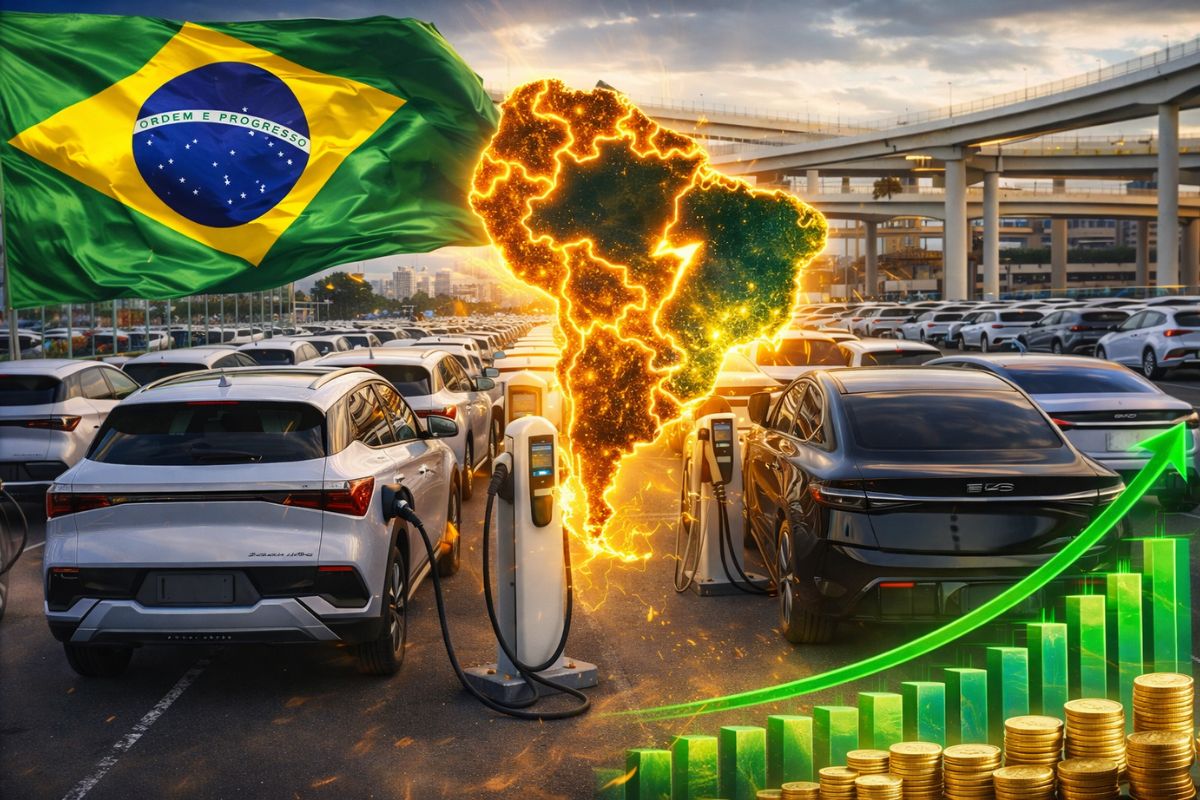
In Latin America, electrified vehicles already represent 14.5% of all sales in the region, with Brazil leading in all categories, followed by Mexico, Colombia, Argentina, and Chile, while the charging infrastructure grows and consumers weigh the costs between gasoline and electricity.
Latin America sold 136,575 electrified vehicles in the first two months of 2026, a significant jump from 80,635 units in the same period of 2025. The data comes from the Colombian Automotive Dealers Professional Association, a member of the Latin American Automobile Distributors Association, and shows that electrified vehicles already account for 14.5% of the entire automotive market in the region. Brazil leads uncontested, with 55,713 units registered, almost half of the total in Latin America.
According to the portal bloomberglinea, the numbers reveal a change that goes beyond a trend: it is a reconfiguration of the regional automotive market. In Latin America, 100% electric vehicles reached 33,772 units and 3.6% market share; hybrids totaled 77,039 units with 8.2% market share; and plug-in hybrids recorded 25,664 units with 2.7%. Each of these categories grew significantly compared to the previous year, signaling that electrification in the region has ceased to be a niche and has become a relevant part of the market.
Why Brazil Dominates Electrified Vehicle Sales in Latin America
Brazil registered 55,713 electrified vehicles in the first two months of 2026, a 69% increase compared to the same period the previous year. There are 17,129 100% electric vehicles, a growth of 103.4%, plus 22,160 hybrids and 16,424 plug-in hybrids.
-
Switzerland will get a chocolate park worth R$ 2.5 billion: Cailler’s megaproject in Broc will feature hotels, restaurants, and a pre-opening scheduled for between 2027 and 2028.

-
The government eliminates the tax on kerosene to try to curb the rise in airfares and includes a billion-dollar credit to airlines in a package against fuel prices, while diesel and cooking gas are also included in the crisis equation.
-
Buying a car may suspend Bolsa Família in 2026 and trigger automatic government oversight.

-
Contactless payments in 2026 soar in Brazil, exposing new invisible fraud gaps and forcing users to double their security precautions with contactless cards.

The share of electrified vehicles in the Brazilian market has already reached 15.7% of total sales, above the Latin American average.
Brazil’s leadership is supported by three pillars. First, the largest network of public charging stations in the region: 14,827 units, according to the Latin American Energy Organization.
Second, the aggressive presence of Chinese automakers like BYD, which have brought competitively priced models. Third, the growth rate of the economy, which, despite challenges, keeps the automotive market vibrant.
For Latin America as a whole, Brazil acts as a locomotive: where the Brazilian market goes, the regional trend follows.
Mexico, Colombia, and Argentina Accelerate in Brazil’s Wake
Mexico is the second-largest market in Latin America for electrified vehicles, with 27,840 units sold in the two-month period, a growth of 31.7% and a 10.9% share of the domestic market. Colombia ranks third with an impressive figure: 16,410 units and a 36% share of the total market, the highest percentage in Latin America.
Colombians are partly motivated by the vehicle rotation system in cities, which exempts electric cars.
But the most explosive growth came from Argentina. The country recorded 12,583 electrified vehicles, with a growth of 263.4% over the previous year. In the 100% electric segment, the increase was 862.3%; in plug-in hybrids, the advance reached 3,958.7%, numbers that reflect a very small previous base but indicate a drastic acceleration in adoption.
Chile completed the picture of the top five markets in Latin America with 6,017 units and a 60% increase.
The Role of Infrastructure in the Speed of Transition in Latin America
The electrification of the fleet in Latin America faces a bottleneck that still limits consumer choice: the charging infrastructure. Brazil leads by a wide margin, but the second place, Mexico, has only 3,212 public stations, less than a quarter of the total in Brazil.
Chile has 1,133, Colombia 300, and Uruguay 202. The difference between countries is vast and explains why many consumers in Latin America prefer hybrids over purely electric cars.
Pedro Nel Quijano, president of the Latin American Automobile Distributors Association, confirmed this dynamic.
The still nascent charging infrastructure in Latin America is leading consumers to opt for intermediate technologies, conventional hybrids, and mild hybrids instead of vehicles that rely entirely on the electric grid.
It is a step-by-step transition: consumers want the savings of electric vehicles but need the security of knowing they won’t run out of battery on the way.
What is Driving the Shift from Gasoline to Electricity in Latin America
Motivations vary from country to country. In the Southern Cone—Brazil, Argentina, Chile, and Uruguay—environmental awareness weighs in the decision. In Colombia, the exemption from vehicle rotation in cities is a direct and immediate incentive.
But across Latin America, the economic calculation is becoming the dominant factor: with the cost of gasoline rising and the price of electrified vehicles falling due to competitive pressure from Chinese automakers, the math increasingly favors electricity.
The 69% growth in Brazilian sales and 263% in Argentine sales is not the result of environmental campaigns; it is the result of consumers doing the math on paper. Latin America is proving that fleet electrification does not depend solely on public policy or ecological awareness: it depends on competitive pricing, minimal infrastructure, and a supply of models that make sense for consumers’ wallets.
With 136,000 electrified vehicles sold in just two months, the region is closer than ever to a turning point—one where the question is no longer “why buy an electric vehicle?” but “why still buy gasoline?”.
Has electrification in Latin America come to stay, or is it still too early to say? Would you trade your gasoline car for an electric one? Share in the comments.










Seja o primeiro a reagir!