





 Portuguese
  English
  Spanish
  4 min of reading
  0 comments


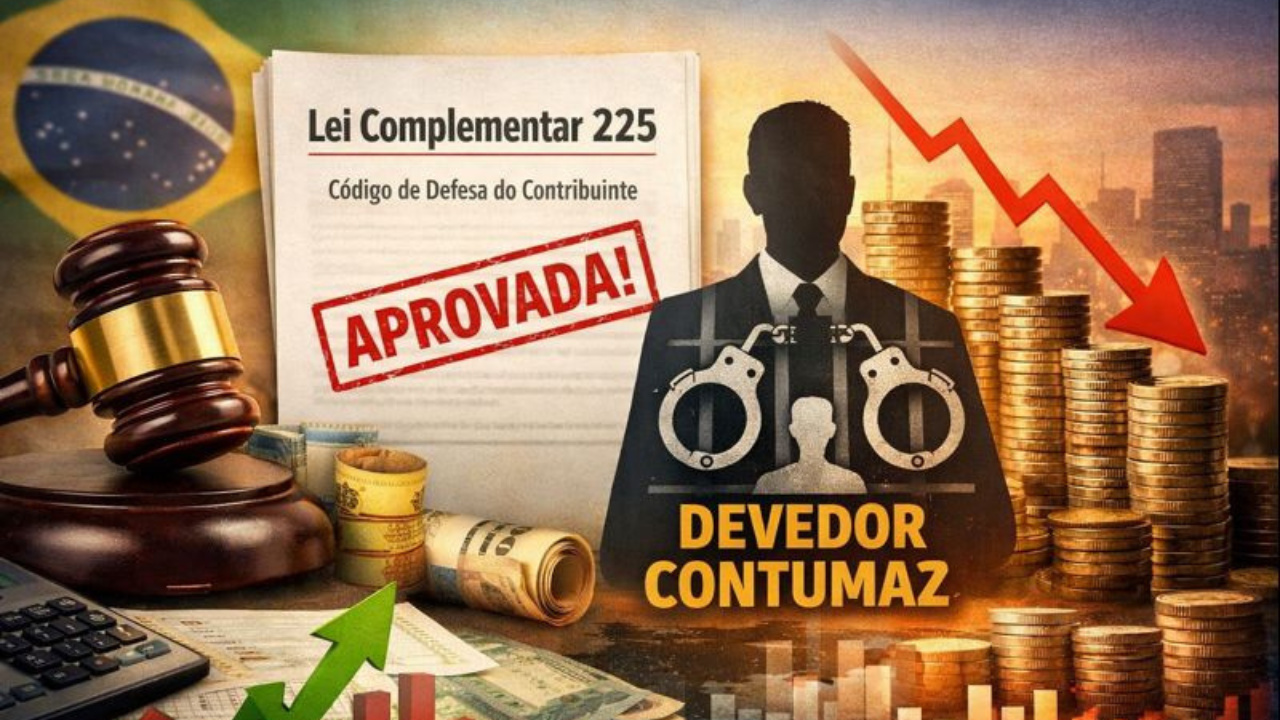
Complementary Law 225 Comes into Effect with Presidential Vetoes and Imposes Severe Restrictions on Companies Classified as Chronic Debtors.
The federal government officially established a new framework in the relationship between the State and companies in Brazil.
President Luiz Inácio Lula da Silva signed the Complementary Law 225, published in the Official Gazette of the Union, which establishes the Taxpayer Defense Code.
The sanction occurred with five presidential vetoes, considered strategic by the economic team, with the aim of protecting public accounts and reinforcing tax compliance.
-
“No one will make us change the Pix,” says Lula after the US report.

-
Lula responds directly to Trump and says that Pix is from Brazil and will not change under pressure from anyone, after a report from the United States pointed out the Brazilian payment system as an American trade barrier.

-
Amazon has just announced a new fee on all deliveries, and your online purchases will become more expensive starting April 17, including for those buying from the United States here in Brazil.

-
He sold his share for R$ 4 thousand, saw the company become a giant worth R$ 19 trillion, and missed the opportunity of a lifetime.


Approved by the National Congress in December, the new legislation seeks to combat recurring tax evasion practices, reduce tax litigation, and at the same time, create incentives for companies that maintain a good history of tax payments.
Who is Considered a Chronic Debtor under the New Law
The Complementary Law 225 establishes clear criteria for classifying a company as a chronic debtor.
According to the legal text, the taxpayer presents fiscal behavior marked by substantial, repeated, and unjustified delinquency of taxes, whether as a principal debtor or jointly responsible.
Before any sanctions are applied, the company must be formally notified.
From that point on, it will have 30 days to settle the debts or present a defense, guaranteeing the right to a fair trial and ample defense, central principles of the Taxpayer Defense Code.
Sanctions Provided for Companies Classified as Chronic Debtors
The law applies strict consequences to taxpayers classified as chronic debtors.
The text authorizes the cancellation of the CNPJ in specific situations, such as in cases where the company creates or manages its activities for fraudulent purposes, collusion, or tax evasion, including through the use of “straw men.”
Additionally, these companies are prohibited from:
Using tax benefits;
Participating in public tenders;
Maintaining ties with public administration;
Requesting judicial recovery.
Meanwhile, the ineptitude of the taxpayer registration severely limits market operations and complicates commercial activities.
Criminal Liability is Not Extinguished by Payment of the Debt
Therefore, one of the toughest points of the Complementary Law 225 lies in the criminal sphere.
The text stipulates that the chronic debtor will not be able to extinguish their liability merely by settling the tax debt.
Thus, in practice, this means that payment of the owed tax does not automatically terminate criminal proceedings related to tax evasion, reinforcing the punitive nature of the rule and signaling greater state rigor against structured tax fraud.
Tax Compliance Gains Incentives for Good Payers
In spite of the crackdown on bad payers, the new law also invests in tax compliance as a public policy.
Programs aimed at companies with a good fiscal history have been formalized, such as:
The Cooperative Tax Compliance Program (Confia);
Tax Compliance Incentive Program (Sintonia);
Brazilian Authorized Economic Operator Program (OEA).
Benefits include differentiated treatment, reduced interest, greater predictability, and the possibility of self-regulation in times of temporary financial difficulty.
Rights and Duties Reinforced in the Taxpayer Defense Code
Thus, the Taxpayer Defense Code also expands guarantees for citizens and companies.
Among the rights is the possibility of facilitated treatment when the taxpayer lacks resources to cover fees and administrative costs.
On the other hand, the law reinforces duties, such as declaration of relevant operations and retention of fiscal documents for the legal period, seeking greater transparency and legal security.
Presidential Vetoes Reduce the Fiscal Impact of the New Law
The government justified the presidential vetoes as necessary measures to preserve public interest. One of them blocked broad flexibility of tax guarantees.
According to the Planalto, “the provision contradicts the public interest, by providing a rule for the flexibility of guarantees without precise legal definition, which poses a risk to the Union.”
In the Sintonia Program, Lula vetoed the discount of up to 70% on fines and interest, in addition to the possibility of using negative tax credits and CSLL negative bases to settle part of the debts.
According to the government, “the legislative proposal contradicts the public interest, by instituting benefits that would increase the Union’s tax expenditure.”
The president also vetoed the possibility of splitting the debts into up to 120 months.
The Planalto argued that the term exceeded the limits established by the Fiscal Responsibility Law.
New Balance between Punishment and Incentive
With the Complementary Law 225, the federal government establishes a new balance between repressing the chronic debtor and encouraging tax compliance.
The expectation is to reduce unfair competition, strengthen revenue collection, and make the relationship between the tax authority and the taxpayer more transparent and predictable.
In practice, the Taxpayer Defense Code inaugurates a phase of greater rigor, but also of greater dialogue, for those who fulfill their tax obligations.









Seja o primeiro a reagir!