





 Portuguese
  English
  Spanish
  3 min of reading
  0 comments


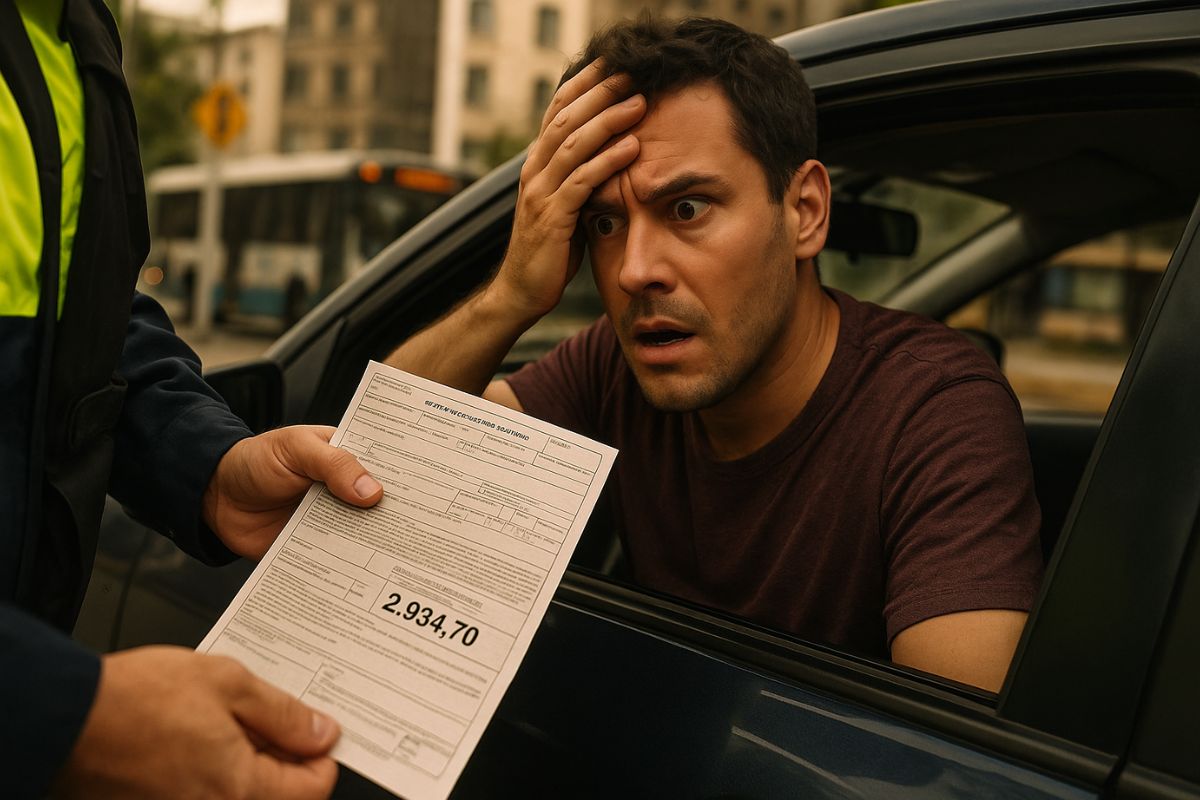
A Single Infraction Can Take Away a Driver’s License and Weigh on the Wallet with Maximum Penalty Provided for in the Brazilian Traffic Code
The traffic law in Brazil establishes severe penalties for dangerous conduct behind the wheel — and a single act can be costly. According to Article 175 of the Brazilian Traffic Code (CTB), engaging in dangerous maneuvers is a serious infraction, with a fine of R$ 2,934.70 and immediate suspension of the driver’s license.
More than a common infraction, it is a self-suspending conduct, meaning it automatically removes the right to drive, in addition to adding 7 points to the driving record. The penalty does not depend on recidivism or accumulation of infractions: it is enough to commit this single act to face the strictest consequences of the legislation.
Traffic Law Punishes Dangerous Maneuver with Extreme Rigidity
Article 175 of the CTB describes as a serious infraction the act of “using a vehicle to demonstrate or exhibit a dangerous maneuver.” This includes actions such as abrupt starts, skids, and braking with tire sliding or dragging. The intent to show off turns the car into a risk instrument, and the punishment comes without delay.
-
Oil surged to $115 a barrel due to the war in the Middle East, and diesel in Brazil has already risen to R$ 7.45 per liter, while the United States…

-
Brazilian city bets on the business environment to generate jobs and attract investments in the energy sector — secretary reveals strategy at Macaé Energy 2026.

-
50 viaducts, 4 tunnels, 28 bridges, and 40 kilometers of bike paths: BR-262 in Espírito Santo will receive 8.6 billion reais for the largest engineering project in the state’s history, inspired by the Immigrant Highway in São Paulo.

-
Brazil produces too much clean energy and doesn’t know what to do with it: over 20% of solar and wind capacity was wasted in 2025 while investors flee and 509 renewable generation projects were abandoned in the last year.


The traffic law treats these behaviors with zero tolerance. The driver can have their license suspended for a period of 2 to 8 months, a time that can be extended to up to 18 months in case of recidivism within one year. The legislation tightens the grip on actions that put lives at risk.
Traffic Law Considers Dangerous Driving More Than It Seems
Contrary to what many believe, dangerous maneuvers are not limited to cinematic chase scenes. Any act involving reckless driving, aimed at showcasing skill or impressing others, falls under the infraction. And the cost goes beyond the financial.
Driving aggressively or making maneuvers that challenge the safety of others can lead to serious accidents, injuries, and fatalities. For this reason, the traffic law is emphatic in treating these actions as potential crimes — even when there are no victims involved.
Traffic Law Establishes Values According to the Severity of the Infraction
The CTB organizes infractions into four categories: light, moderate, severe, and very serious. The financial penalty varies from R$ 88.38 to R$ 293.47 in common situations. However, very serious infractions with a multiplying factor, such as dangerous maneuvers, escalate the values exponentially.
In this case, the amount of R$ 293.47 is multiplied by ten, resulting in a fine of R$ 2,934.70. This mechanism is used to curb extreme behaviors and reinforce the seriousness of the act. It is the way the traffic law finds to create an effective brake on recklessness.
Traffic Law Allows Contesting but Requires Attention to Deadlines
Although the penalties are strict, the driver has the right to appeal. The process begins with the presentation of a preliminary defense, which must be submitted within 30 days after receiving the notification. At this stage, it is still possible to avoid the definitive penalty.
If the defense is rejected, there is the possibility of appeal to the Administrative Board of Traffic Violation Appeals (JARI). If the denial persists, there is still a second instance to contest the fine. However, all deadlines are limited to 30 days, requiring attention and agility from the driver.
Do you believe that this type of punishment is proportional to the risk involved?









-

-

-

-

-

-

79 pessoas reagiram a isso.