





 Portuguese
  English
  Spanish
  5 min of reading
  1 comment


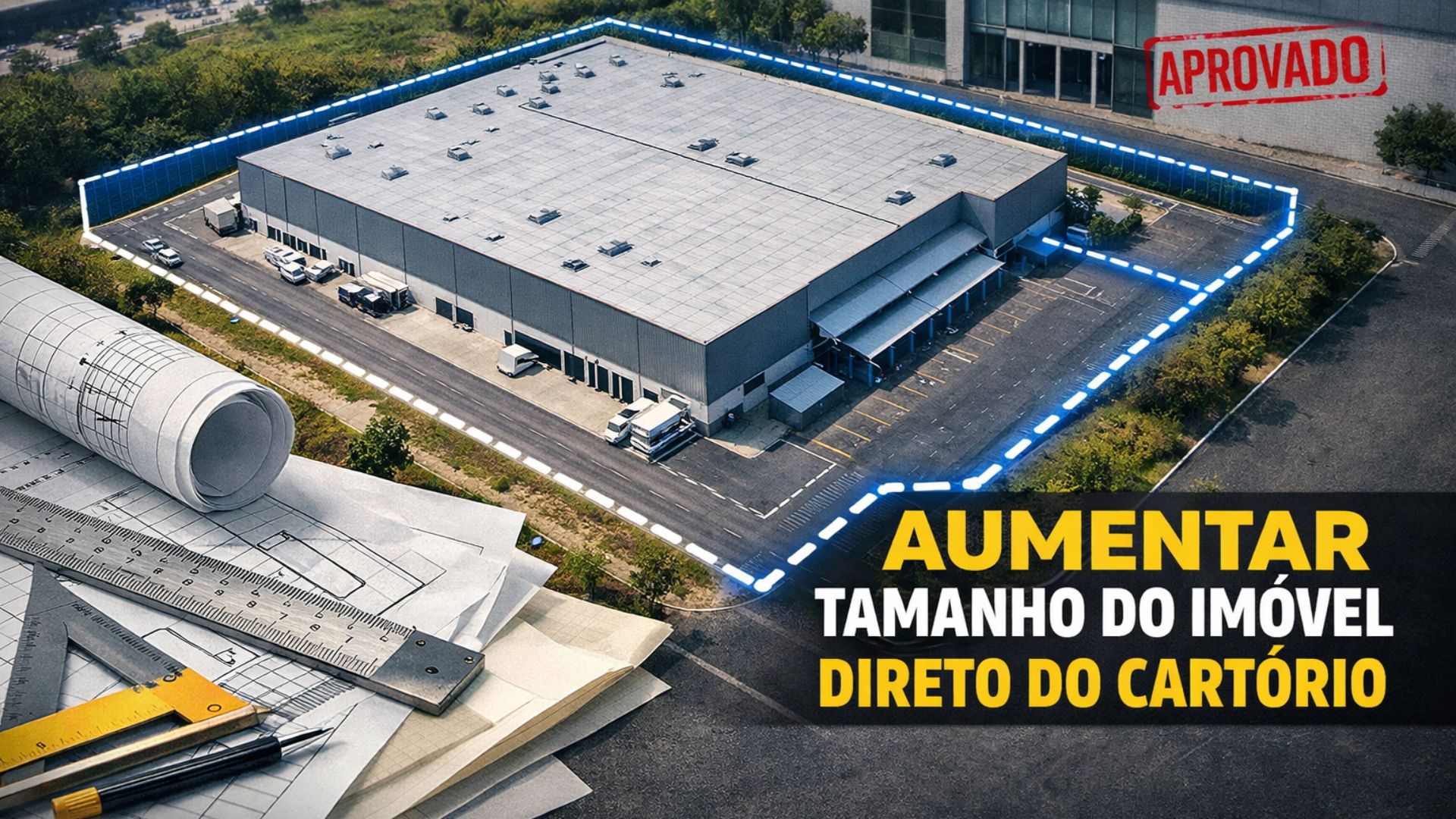


Rectification of Registration Can Unlock Investments, Financing, and Expansion of Warehouses, Logistical Bases, and Industrial Areas by Correcting Measures and Limits in the Land Registry, with Formal Notification to Adjoining Owners and Presumption of Consent When There Is No Challenge Within the Legal Period, Provided That Technical Plans Support the Change.
Measurement, boundary, and description errors that remain for years in registrations of industrial warehouses, logistical areas, operational bases, and lands linked to the energy sector can block investments, contracts, and high-value financing.
In many of these cases, the correction can be made directly at the Land Registry through an administrative procedure, even when a signature from an adjoining neighbor is missing on the plan, provided that they are formally notified and do not present a challenge within the legally established time frame.
This possibility exists because public registration legislation establishes a specific procedure for rectification, with technical verification, precise identification of the property, and communication to the involved adjoining owners.
-
He started running at 66 years old, broke records at 82, and is now a subject of study for having a metabolic age comparable to that of a 20-year-old, in a case that is intriguing scientists and inspiring the world.

-
Oldest tree on the planet reappears after 130 years of searches: Wattieza, 385 million years old, was 10 meters tall and had no leaves or seeds; Gilboa fossils in New York solved the mystery in 2007.

-
A 48-square-meter house assembled in hours with 4,000 bricks made of recycled plastic that does not absorb moisture, has natural thermal insulation, and costs less than 90,000 reais in a complete kit.

-
Luciano Hang revealed that Havan’s air fleet has already accumulated more than 20,000 landings, 10,000 flight hours, and 6 million kilometers traveled, and he says that without the planes, the company would never have grown so quickly.


If the notified person remains silent after proper notification, consent may be presumed, which prevents the absence of a signature from halting industrial or energy projects when there is no formal contestation.
Warehouses and Industrial Areas with Incorrect Measurements Halt Expansion and Credit
The point that usually draws attention is the idea of “increasing” the area.
In practice, the procedure does not create land where there is none, nor does it regularize illegal occupations.
The rectification serves to align the registration with the physical reality, correcting common flaws in old registrations of open industrial areas when the region was not yet fully urbanized or zoned.
When the registration presents inaccurate measurements or is incompatible with current technical surveys, the registered area can be adjusted after correction, including an increase, if the original error is proven by a plan and descriptive memorial.
Administrative Rectification in the Land Registry Applied to the Industrial Sector
The administrative pathway follows the rules of the Public Registration Law, which guides how the official should analyze requests involving large-properties, with significant economic impact.
The norm authorizes the correction of boundaries, confrontations, directions, and perimeter measurements, provided that the alteration is technical, documented, and does not conceal a domain conflict, a situation particularly sensitive in industrial hubs and energy zones.
In practice, this type of problem arises when companies try to expand warehouses, install new production lines, contract structured financing, or formalize real guarantees, and discover that the registration does not reflect the property effectively used for years.
It is also common in areas where old farms have been divided for industrial use, with registrations based on generic descriptions or physical references that no longer exist.
Technical Plan and Descriptive Memorial Are Decisive in the Notary
To initiate the procedure, the holder presents a request to the competent Land Registry, accompanied by technical documentation capable of precisely individualizing the real estate asset.
Generally, the rectification depends on plans and descriptive memorials signed by a qualified professional, in addition to documents demonstrating the chain of title and the correspondence between the registered property and the property effectively used by the company.
The registrant evaluates the technical consistency, compatibility with the existing registration, and the legal framing of the request, and may formulate requirements before authorizing the proceeding.
Lack of Signature from the Adjoining Owner Does Not Prevent Automatic Advancement
This is where the participation of adjoining owners comes in.
The law stipulates that, when there is a change in area or boundaries, neighbors must be notified to express their opinions.
A direct signature on the plan is the simplest form of consent.
When this does not occur, the procedure does not automatically conclude.
The adjoining owner may be formally notified to agree or contest the request within the legal period.
The notification has a clear function: to ensure transparency and avoid future disputes, especially in areas where industrial properties share boundaries with other productive assets.
The official must demonstrate that the communication was valid and that there was a real opportunity for response.
If, after proper notification, there is no contestation within the time limit, the legislation allows for the presumption of consent, permitting the procedure to proceed without the physical signature of the neighbor.
When the Notary Interrupts the Rectification
The administrative procedure does not substitute for the Judiciary in cases of actual conflict.
If there is a substantiated challenge, the Land Registry does not decide the dispute like a judge.
The administrative rectification has clear limits and is not intended to resolve complex disagreements regarding ownership or possession.
In these situations, the legislation itself provides for referral to the competent court.
There is also a rigorous technical filter.
The rectification requires unequivocal identification of the property, which may require additional adjustments in old industrial areas, where urban layouts have changed or physical landmarks have been removed over time.
Correct Registration Directly Impacts Energy and Industrial Projects
Another relevant aspect is the coherence between the registration history and the operational reality of the property.
If the intended alteration appears to exceed a simple correction of error, the procedure tends to become more rigorous, with additional requirements.
The purpose of registration is to preserve legal security, essential for long-term contracts, financing, partnerships, and structured operations in the energy and industrial sectors.
In practice, rectification is sought to unlock strategic acts.
Bank financing, lease contracts, area assignments, sale and leaseback operations, and industrial expansions depend on accurate registration.
Corporate inventories and asset reorganizations also often stumble upon old descriptions that do not reflect the real asset.
Despite the economic impact, the procedure does not dispense with robust documentation.
The registrar analyzes technical and formal evidence, and the quality of the material presented often determines the speed of the process.
Accurate plans, coherent memorials, provenance documents, and well-conducted notifications reduce risks and increase predictability.
The decisive factor tends to be the combination of engineering, documentation, and adequate legal communication.
When these steps are aligned, the silence of the adjoining owner, after valid notification, can produce the expected legal effect and permit the registration to accurately reflect the property used in industrial or energy activity.
In expansion or financing projects, what detail of your property’s registration could be preventing the asset from being used to its full potential?








Pode ser em imóvel rural?