





 Portuguese
  English
  Spanish
  4 min of reading
  3 comments


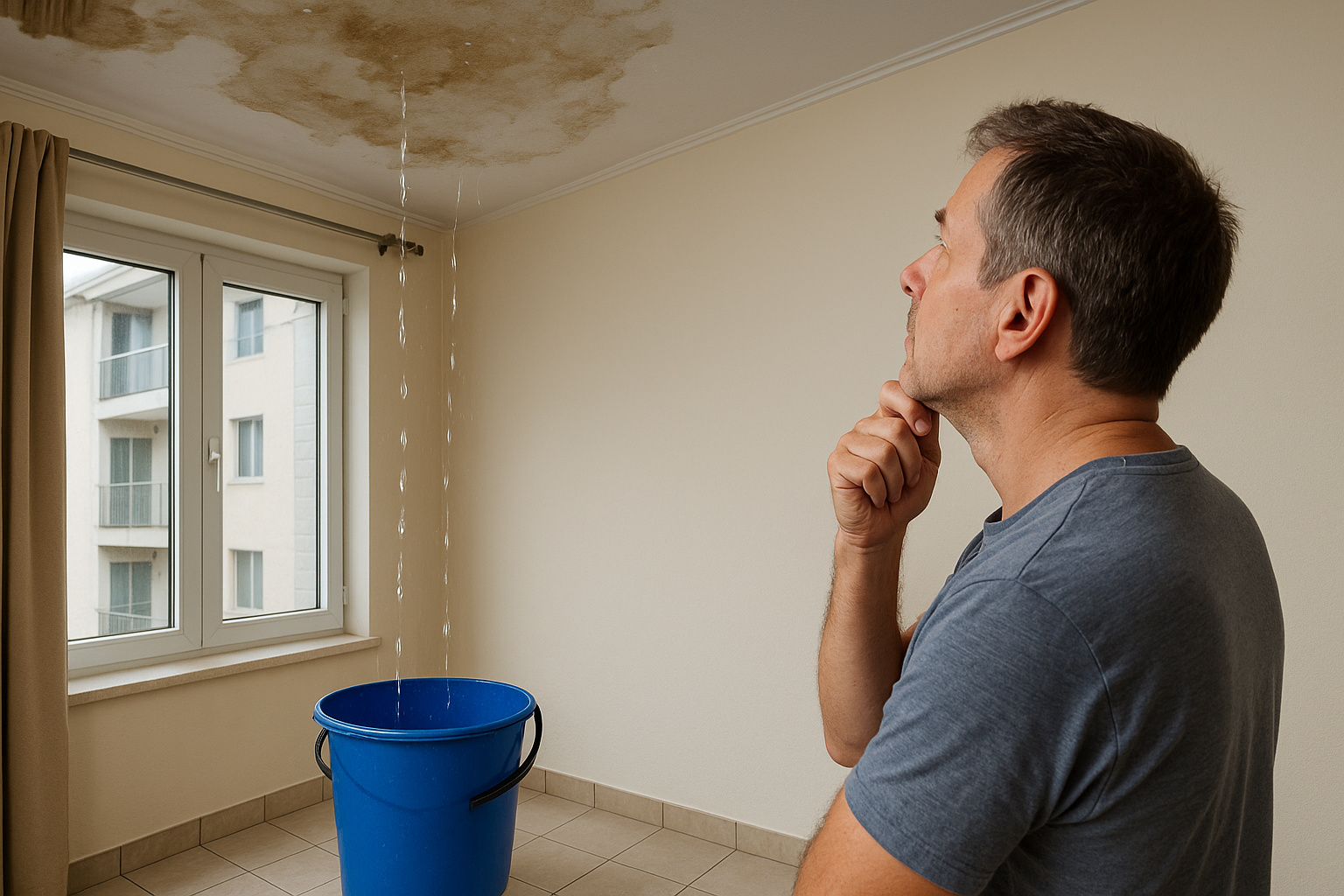


Leaks From the Apartment Above Cause Compensation: Civil Code and STJ Confirm That the Owner Is Responsible for Damages, Even Without Direct Fault.
Few coexistence problems cause as much trouble as the leaks and dripping water from the apartment above. The scene is common: moisture stains on the ceiling, damaged paint, ruined furniture, and neighbors arguing about who is responsible.
What many don’t know is that the Brazilian law and the jurisprudence of the Superior Court of Justice (STJ) have already settled this understanding: the owner of the upper property is responsible for the damages caused to the neighbor below, even without direct fault. This means that it does not matter whether the problem arose from a broken pipe, maintenance failure, or builder error — the resident of the upper floor must bear the losses.
What the Civil Code Says About Responsibility Between Neighbors
The article 1,277 of the Civil Code establishes that the owner or possessor of a property has the right to demand that the neighbor cease interferences that harm their safety, peace, and health. The article 1,336, IV, imposes as a duty of the condominium resident not to harm the safety, health, and peace of other residents.
-
The Chamber opens a debate on driver’s licenses at 16 years old as part of a reform that includes around 270 proposals to change the Brazilian Traffic Code and may redesign rules for licensing, enforcement, and circulation in the country.

-
The new Civil Code could revolutionize marriages in Brazil with “express divorce” and changes that could exclude spouses from inheritance.

-
Banco do Brasil sues famous influencer for million-dollar debt and intensifies debate on delinquency, risks of seizure, and direct impact on Gkay’s credibility.

-
The Senate approves a bill that criminalizes misogyny, hatred, or aversion towards women, and includes the crime in the Racism Law with a penalty of up to 5 years.



In practice, this means that leaks, drips, and spills coming from an apartment constitute a violation of neighborhood rights, creating an obligation to repair the damage.
Furthermore, article 927 of the Civil Code enshrines the theory of civil liability: anyone who causes harm to another is obligated to repair it, regardless of fault, whenever the law so determines.
STJ Confirms: The Neighbor Above Pays for Damages, Even Without Direct Fault
In recent rulings, the STJ reinforced that the resident of the upper floor is responsible for damages caused to the lower apartment. The court has applied the rule of strict liability, where fault is not investigated, but only the fact that the damage originated from the neighboring property.
In a case judged by the Third Panel, the court ruled that an owner must compensate the neighbor below for leaks in the ceiling, even if the problem originated from structural failures in the building. For the court, the responsibility arises from the simple fact that the damage came from the property of the owner.
Practical Examples: When the Neighbor Must Compensate
Situations that usually generate judicial compensation include:
- Leaks in internal piping from the apartment above;
- Infiltrations in bathrooms and wet areas, such as laundries;
- Clogs that result in overflow to the lower apartment;
- Maintenance failures, such as deteriorated grouts or poor sealing in wet areas.
In these cases, the affected neighbor may demand full repair of material damages, such as painting, furniture, appliances, and even hotel expenses if the residence becomes temporarily uninhabitable. In some cases, judges have also recognized the right to compensation for moral damages when the inconvenience is prolonged and affects the dignity of the resident.

Role of the Condominium and Joint Responsibility
There are situations where responsibility may also fall on the condominium, especially when the leak results from failures in the common areas of the building, such as slabs, water columns, and shared drains.
The STJ has already determined that, in these cases, the condominium must bear the compensation, but can later charge the resident if it is proven that they contributed to the problem. Thus, each situation needs to be analyzed according to the origin of the leak: if it is from internal piping, the responsibility lies with the owner; if it is from common areas, the responsibility lies with the condominium.
Experts Highlight the Importance of Prevention
According to condominium lawyer Marcelo Borges, “prevention is always the best path. Small ignored leaks lead to larger lawsuits. The duty to keep the property in good condition falls on the owner, who is responsible in front of the neighbors.”
Civil engineer Patrícia Reis adds that “leaks almost always start as small stains, but can quickly compromise structures and electrical installations. The cost of preventive maintenance is much lower than that of a lawsuit.”
Conclusion: Responsibility and Balanced Coexistence Between Neighbors
The message from the law and justice is clear: those who live in apartments cannot ignore the impacts of their unit on that of their neighbors. The right of neighbors seeks to balance coexistence in shared spaces and protect the dignity of all.
Thus, leaks and drips from the upper floor require the owner to compensate for the damages, even without direct fault. Strict liability ensures that the problem is resolved quickly, preventing the resident below from being left unprotected.
More than imposing fines and compensation, this understanding reinforces a basic principle of condominium life: one person’s rights end where another’s begin.









Olá. Estava lendo a matéria sobre vazamentos. Me enquadro nela. Apto ao lado do meu, vaza da área de serviço dele ( são diferentes na planta ) para a parede de meu quarto. Do meu quarto vaza para o apto debaixo. Dono do apto causador, diz que é problema dos canos condomínio e que profissional foi no apto dele, juntamente com o síndico e constataram ser coisa de condomínio. O dono disse que só autoriza quebrar paredes e piso, se o condomínio pagar. TODAS ALEGAÇÕES ESTÃO EM MSGS WHATSAPP NO MEU CELJLAR, ATÉ FOTOS DOS ESTRAGOS. 27/08/25 FEZ UM ANO DESSA LENGA LENGA EMPURRA EMPURRA, TENHO DESDE O AVISO EM 27/08/24. MONTEI TUDO E VOU ENTRAR NAS PEQUENAS CAUSAS. PERGUNTO : POR PREUCACAO, DEVO COLOCAR OS DOIS COMO RÉUS/CAUSADORES OU SÓ O CONDOMÍNIO ?
Não entre no JEC, é caso que depende de prova pericial. Acaba tenho competência declinada para a justiça comum e vai perder o tempo vom esse processamento
Abre a sua parede, acha o vazamento, abre um **** perto e injeta espuma poliuretano expansiva dentro do cano. .
Problema resolvido e nao gasta dinheiro com zdvogado.