





 Portuguese
  English
  Spanish
  7 min of reading
  9 comments


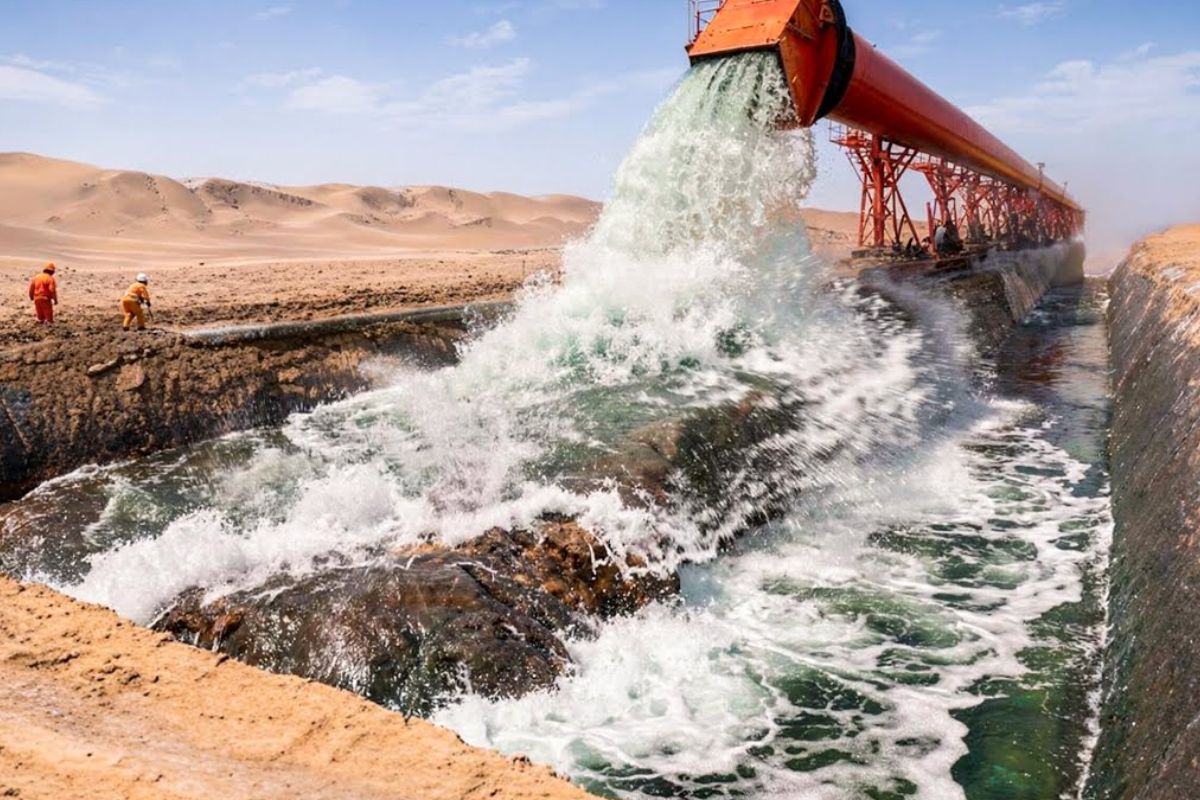


In Libya, almost the entire territory is desert without permanent rivers and rain disappears for months. To survive, the country explores the Nubian sandstone aquifer, fossil water of up to millions of years, and sends it through underground pipelines to Tripoli and Benghazi in a high-risk continuous bet.
Libya is one of the driest nations on the planet and yet holds one of the largest water treasures ever found under the Sahara: ancient fresh water, trapped in deep layers of rock, which became the basis for a giant project to sustain entire cities on the Mediterranean coast.
However, this solution has a dark side: it is fossil water that does not regenerate, and the country has become dependent on a colossal, expensive and vulnerable infrastructure, which can be disrupted by failures, political disputes, and war, in addition to leaving deep environmental and social marks.
A Country Almost Without Rain and Without Permanent Rivers

Libya is located on the Mediterranean coast, but this is misleading. More than 90% of the territory is within the Sahara Desert, one of the most extreme arid regions on Earth, marked by intense heat and constant wind.
-
Expedition 501: Scientists drill into the ocean floor and discover a giant reserve of fresh water hidden beneath the sea, extracting nearly 50,000 liters and revealing an invisible system that could reshape the map of water scarcity.
-
Archaeologists find an intact tomb over 2,500 years old, with more than 100 preserved objects, weapons, jewelry, and human remains never touched.
-
Volcanic lava transforms into threads as fine as human hair that travel over 30 kilometers by wind and fall like cutting rain on roofs and backyards in Hawaii and Iceland.
-
NASA issues a warning for the feared Godzilla El Niño that could change the planet’s climate in 2026 with extreme warming of the Pacific capable of causing devastating droughts in some regions and historic floods in others simultaneously.
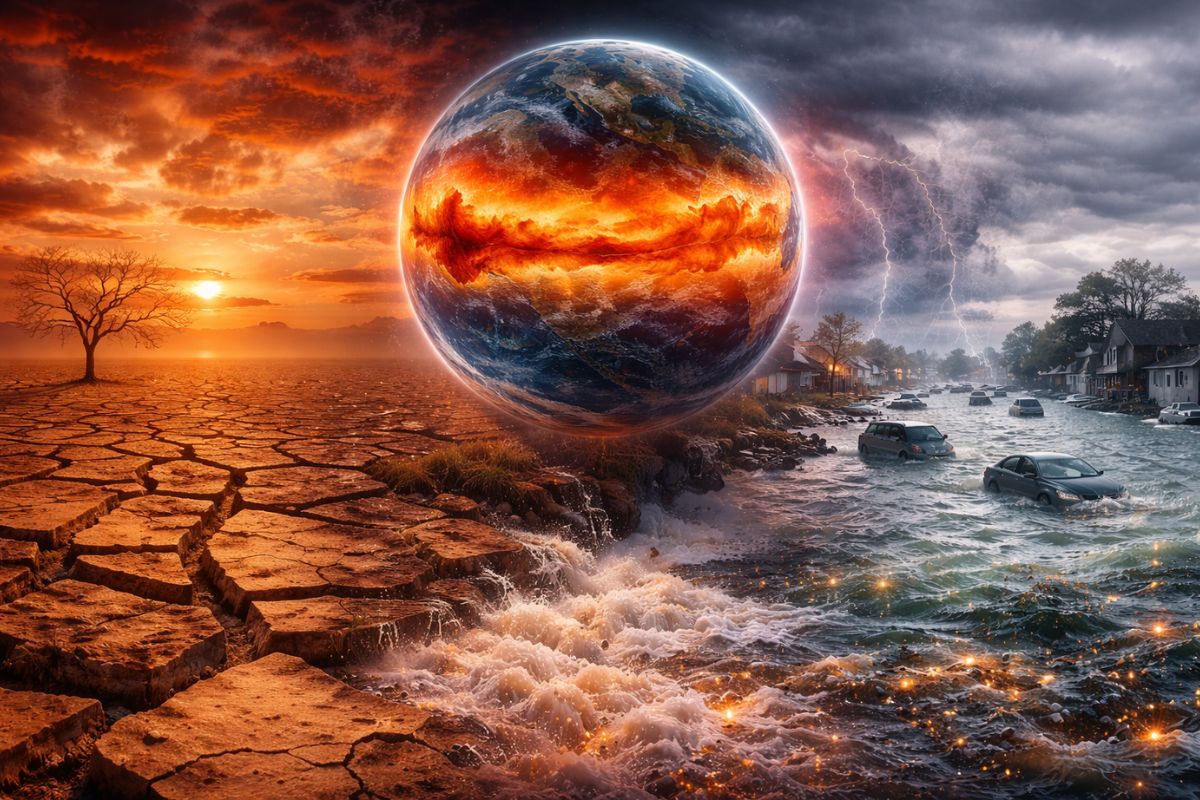

What exists are dry riverbeds that only carry water for a few hours after a rare rainfall. In much of the country, the average annual precipitation is almost zero. The exception is a narrow coastal strip, comprising less than 5% of the national area, which manages to receive more than 100 mm of rain per year.
This geography has pushed the population to the coast, where the supply is more stable. Meanwhile, the interior survives as best it can, in oases and small irrigated areas. In practice, water defines where Libya can exist.
The Nubian Sand Aquifer and Prehistoric Water from the Sahara

The turning point came when deep drilling in the southern part of the country, initially linked to the search for oil, found something even more valuable: large volumes of fresh water.
These were not small pockets. It was a gigantic reservoir stored in layers of sandstone: the Nubian Sand Aquifer, which extends beneath Libya, Egypt, Sudan, and Chad, covering an area of over 2 million square kilometers.
Estimates indicate a monumental amount, in the order of 39 million trillion gallons of water. And the detail that changes everything is the age: this water accumulated between 10,000 and over 1 million years, during a time when the Sahara was greener, wetter, and full of life.
That’s why it is called fossil water. And here comes the catch: it is not a renewable resource. The country is not “using an endless underground river”; it is drawing from an ancient stock that decreases with each pumping.
The Great Artificial River and the Choice to Take Water from the Sahara to the Coast

With this reality exposed, Libya faced a paradox: almost no water on the surface, but an enormous reserve hidden underground. The discussion shifted from “Is there water?” to “How to use this water?”.
The decision was to take water from the desert interior to the coastal cities, rather than bring seawater inland. Thus the Great Artificial River was born, which is not a natural river, but a subterranean network of wells and pipelines.
The system was conceived as an unprecedented scale water management project: wells drilled hundreds of meters deep, connected by kilometers and kilometers of pipes buried under the sand, aimed at maintaining continuous flow to urban centers like Tripoli, Benghazi, and Misrata.
The bet was clear: sustain urban life with deep subterranean water, without relying on a country with rain.
The Engineering Behind the “River” That Does Not Appear on the Surface
To get this water across the Sahara, Libya had to face a challenge that few countries would even attempt: transporting water for thousands of kilometers through desert reliably for decades.
The project described includes more than 13,000 drilled wells in desert areas, with depths around 500 meters, in locations where surface temperatures can exceed 45°C.
The water from these wells enters a network of reinforced concrete pipes with steel, buried to reduce losses and protect the system from the extreme environment. Each pipe is described as extremely heavy, weighing dozens of tons, and the connections use components such as rubber seals and high-strength mortar to minimize leaks.
The total length of the system is estimated at over 4,000 km, comparable to linking cities separated by continental distances. The volume of materials is also impressive: the cement used to make the pipes is cited as equivalent to 5 million tons.
All this helps to understand why the project is seen as an engineering marvel and, at the same time, as something fragile. The larger and more complex the system, the more critical points it creates.
Why Libya Avoided Desalination of the Mediterranean
The inevitable question is: why did a country with a coastline not choose to desalinate seawater on a national scale?
The explanation revolves around cost, energy, and control. Desalination requires significant electricity consumption, a network of plants operating continuously, heavy maintenance, and reliable logistics, in addition to fuel and infrastructure.
In a scenario of sanctions, instability, and fragile security, this was seen as a strategic risk. Additionally, there is an environmental factor pointed out: desalination returns to the sea highly concentrated brine, which pressures coastal ecosystems.
Thus, the Great Artificial River was treated as a cheaper, faster, and more self-sufficient path. However, this choice came with a hidden cost: growing dependence on ancient, finite water that is slowly depleting.
Who Receives the Water and Who is Left Behind in the Interior
When the water began to flow, the problem ceased to be merely engineering and turned into politics. Who benefits from the water decides who gains power.
The coastal cities gained priority due to their concentration of population, infrastructure, economy, and power. Meanwhile, in rural and nomadic communities, access has always been described as unstable. When underground levels dropped or supply was redirected, the impacts came in a chain: livestock without water, dry pastures, gradual collapse of traditional lifestyles, and silent migration toward the coast.
In this scenario, water becomes a dividing line between staying and leaving. It is survival, but it is also a distribution of power.
Oases, Date Palms, and the Domino Effect of Water Instability
The impact in the interior appears strongly when looking at the oases. For thousands of years, the date palm has been presented as a pillar of local life: it maintains humidity, creates shade, supports microecosystems, and enables the cultivation of other plants.
Without water, date palms cannot survive. And without date palms, the oasis ceases to exist as a system. When water becomes uncertain, the decline is progressive: wilting, reduced production, dried soil, and ecological collapse around.
The promise of agricultural rebirth in the interior depended on consistent flow. When that flow fails, hope also becomes fragile.
When Water Becomes a Weapon in a War-Torn Libya
After 2011, with the advance of civil war, water gained an even more dangerous role. In a country dependent on underground water and an artificial pumping system, controlling stations and pipelines becomes real power.
The text describes pumping stations as strategic targets, sections of pipeline taken or sabotaged, and supply interruptions used as political pressure against rival cities and communities.
For civilians, the effect is immediate: dry faucets, disrupted routines, interrupted agriculture, and a new wave of migration. In Libya, water ceased to be neutral and became a tool of conflict.
The Bitter Paradox: Drought, Management Failure, and Disaster in Derna
The Libyan water crisis does not only appear as scarcity. There is also the reverse: excess and destruction.
In coastal cities, mismanagement and infrastructure deterioration have been described as capable of unnaturally raising groundwater levels, bringing contaminated water to the surface and turning streets and homes into flooded, muddy areas, even without heavy rain.
And then came the shock of 2023: Storm Daniel brought an extremely rare amount of rain, causing the breaking of dams upstream of Derna.
The result was a torrent of water and mud that devastated the city, cited as responsible for more than 4,000 deaths and leaving tens of thousands of people homeless.
In Libya, lack slowly kills, and excess destroys in minutes.
Public Health in the Post-Disaster: Stagnant Water and Explosion of Mosquitoes
After flooding and abnormal elevation of groundwater, another threat described as persistent arises: stagnant water in homes, ditches, and gardens, creating an ideal environment for mosquito proliferation.
In a country with weakened infrastructure due to conflict, containment, and drainage becomes more difficult.
The text points to the reappearance of mosquito-borne diseases, citing malaria, dengue, and other illnesses, in addition to the impact on cramped and unsanitary temporary shelters.
The water crisis ceases to be only infrastructure and becomes a direct risk to public health.
The Lesson Libya Imposes: Monumental Work, Finite Future
The Great Artificial River is described as both a wonder and a warning. It proves that humanity can carry water through the desert, but also shows that natural limits and governance cannot be ignored.
Libya avoided costly desalination and gained supply on a gigantic scale, but placed its future in a non-renewable resource, sustained by a massive and vulnerable system subject to failures and conflicts.
In your view, is Libya making a smart choice to survive now or a dangerous bet that may explode in the future?





Use it all. Enjoy. Create another forest.
ALLAH IS GREATEST JUST NO ONE OTHER so AESE BT NI KARTE delete it
Some context needed here. 39 million trillion gallons of water, if correct, is not running out any time soon. I mean even if they’re using 40 billion gallons of water a day, and I’m guessing they’re probably not, that would last over two million years. It’s more about the logistics of distribution, and, more importantly, political stability. It’s not scarce. Probably, almost as important, is establishing a sustainable solar power infrastructure to have the energy needed to keep it all running.