





 Portuguese
  English
  Spanish
  3 min of reading
  0 comments


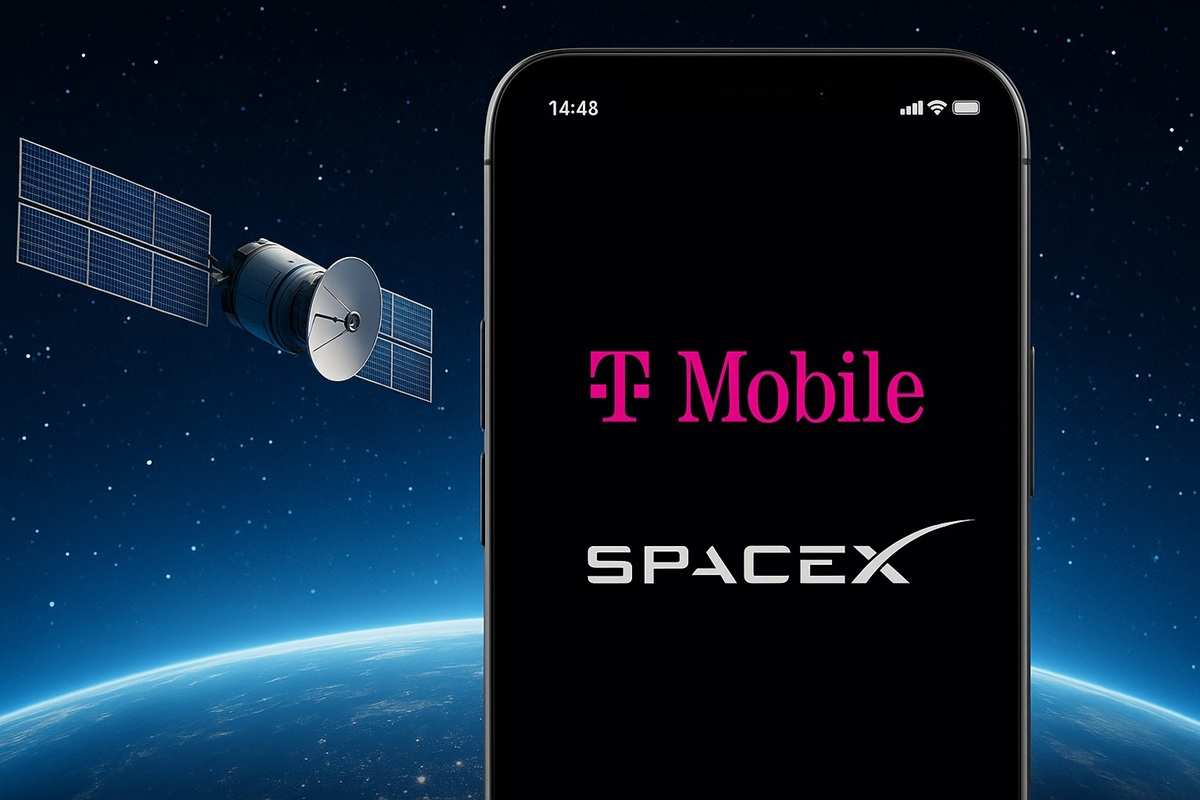
New T-Mobile and SpaceX Service Allows Sending Messages Via Satellite on Modern Cell Phones, But Internet and Calls Are Not Yet Available.
Starting July 23, 2025, a new era in satellite connectivity officially begins. Elon Musk and his company SpaceX, in partnership with carrier T-Mobile, will launch a service that promises to change the way we communicate in areas without cellular coverage.
This is the “T-Satellite,” a system that allows sending and receiving messages directly via Starlink satellite, without the need for additional equipment.
The service represents a milestone for travelers, adventurers, and residents of rural areas.
-
How the terraforming of Mars can transform the planet: artificial aerosols can increase the temperature by up to 35°C in 15 years, creating conditions for liquid water.

-
Scientists drilled nearly 8,000 meters into the ocean floor above the fault that caused the 2011 tsunami in Japan and discovered that a layer of clay 130 million years old was responsible for making the wave much worse than any model had predicted.

-
Thousands of years after causing the largest eruption of the Holocene, one of the world’s largest supervolcanoes is rebuilding itself beneath the sea south of Japan, receiving new magma and alarming scientists with its transformation.

-
China has activated a magnet 700,000 times more powerful than the Earth’s magnetic field that operates for over 200 consecutive hours while consuming little energy, and now the world wants to know what Beijing plans to do with this technology in 2026.


With it, it will be possible to share location and send messages even in regions where there is no signal from conventional towers.
During the beta period, the connection will be free for anyone with a compatible smartphone, and after the commercial launch, it will remain free for customers on special plans from T-Mobile. Users of other carriers will be able to subscribe to the service for a monthly fee of $10.
How The Starlink Connection Works
What makes this technology especially revolutionary is its ease of use.
As soon as the phone loses conventional cellular signal, it automatically tries to connect to the Starlink satellite constellation.
Once the connection is established, the device’s screen displays the message “T-Mobile SpaceX,” indicating that communication is now taking place directly with space.
No type of antenna, adapter, or additional accessories are required. Just ensure that the phone is updated and compatible with the system.
Initially, the service will be limited to sending text messages, sharing location GPS , and emergency calls.
Features such as voice calls and internet access are expected to be activated only starting in October 2025, according to T-Mobile’s official schedule.
The priority is to ensure basic and secure communications in remote locations.
Which Cell Phones Are Compatible
T-Mobile claims that the service will work on “modern phones released in the last four years,” but has not yet released an official list of all models.
There are speculations about support for models such as iPhone 14 and later, Galaxy S21 or newer, and new Pixel and Motorola devices, but this has not yet been officially confirmed by the carrier.
For now, the system is limited to the territory of the United States.
Contrary to some reports, there is no confirmation that the free satellite connectivity is available in Latin American countries. T-Mobile and SpaceX have not yet announced plans for expansion to other regions.
– Apple: all iPhone 14 models and future generations
– Samsung: Galaxy A series from A14 to A54, plus the flagship Galaxy S21 and more recent
– Google: Pixel 9 and Pixel 9 Pro
– Motorola: models released in 2024 or later
Starlink Mini Is Not Part of This Service
It is important to highlight that the “Starlink Mini,” another popular product from the company, has no direct relation to the new mobile messaging service.
The Mini is a portable physical device that provides high-speed internet via satellite, ideal for those who need more comprehensive connectivity in remote locations.
However, it is a separately sold product with a monthly cost. A Promising Change, But Still in Initial Phase
The satellite messaging system marks an important advancement in access to communication, especially in emergency situations.
However, its operation is currently limited to the United States, with limited functions and an undefined list of devices. The promise is great, but the actual reach is still under construction.










-

-

-

-

-

16 pessoas reagiram a isso.