






 Portuguese
  Spanish
  4 min of reading
  1 comment


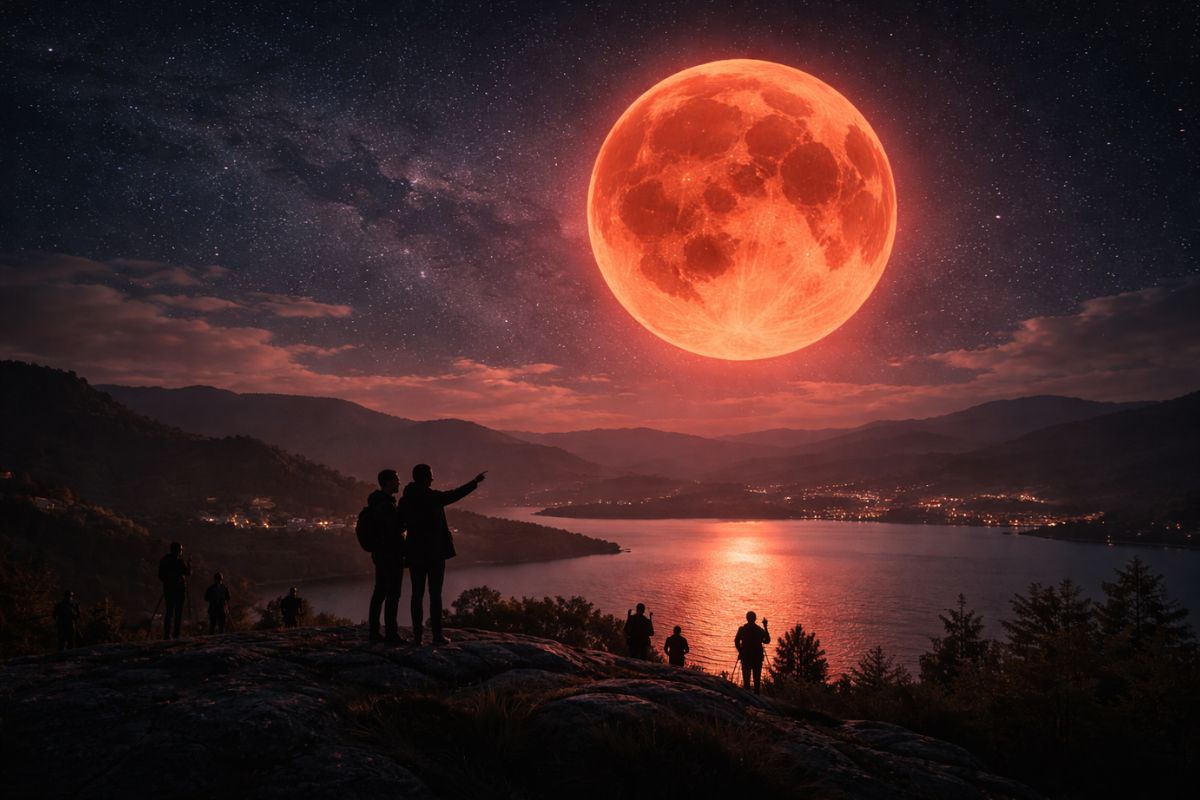


Red Moon Rises in the Early Morning of March 3, 2026 During a Total Lunar Eclipse, with Totality Between 6:04 AM and 7:03 AM in Brazil Time, Visible in Regions of the Americas, Asia, and Australia, and Observable with the Naked Eye if the Sky Allows, Without Special Equipment and with Marked Phases
The Red Moon has a time to start drawing attention, and this time it appears on the clock. In the early morning of 03/03/2026, a total lunar eclipse places the entire Moon inside the darkest shadow of the Earth, and the totality phase lasts between 6:04 AM and 7:03 AM in Brazil time.
The phenomenon is simple to follow and hard to forget. In several parts of the world, the Red Moon can be seen with the naked eye, as long as the sky is clear and the Moon is visible on the horizon, without buildings or hills blocking the view.
What Makes the Red Moon and Why Does It Happen
A total lunar eclipse happens when Earth, Sun, and Moon align, with the planet between the two stars.
-
Survivor of 1966 SS Daniel J. Morrell Shipwreck in Lake Huron Recounts 38-Hour Ordeal in Extreme Cold

-
The Greatest Hoax in World Cup History? The Film That Denied Brazil’s 1958 Victory and Exposed How Fake Evidence Can Seem Convincing on TV
-
Fake South Korean Online Stores Offer Shopping Thrill Without Spending Money or Receiving Products
-
The War of Jenkins’ Ear: How a Severed Ear Sparked One of the 18th Century’s Most Unusual Conflicts


In this alignment, the Moon enters the umbra, the darkest part of the Earth’s shadow, and it is precisely there that the Red Moon appears most strongly.
The red color does not come from a light of its own from the Moon, but rather from the path that sunlight takes as it passes through the Earth’s atmosphere.
Solar light scatters, and the reddish tones manage to continue on to the lunar surface.
It is an effect that resembles many sunsets projected at the same time on the Moon, and for this reason, the color can vary between dark red and copper during totality.
The Times That Organize the Early Morning and the Most Anticipated Minute
The Red Moon does not “turn on” all at once; it builds up in stages.
First comes the penumbral eclipse at 3:44 AM Brazil time, when the softest shadow begins to touch the Moon, and the change may still seem discreet to someone looking quickly.
Then, the eclipse enters a mode that becomes easy to notice. The partial eclipse starts at 4:50 AM, and the most awaited phase arrives at 6:04 AM, when totality begins and the Red Moon occupies the entire disk.
The end of totality occurs at 7:03 AM. Afterwards, the partial eclipse ends at 8:17 AM, and the phenomenon concludes at 9:23 AM.
In practice, the rare window lasts 59 minutes, a long enough interval to observe calmly, adjust your vision, and understand the color change.
Where the Red Moon Appears Entire and Where It Only Appears Partial
The visibility of the eclipse changes according to the position of each region on the planet at the moment of alignment.
Totality can be seen during the early morning in North America and Central America.
In East Asia and Australia, the eclipse appears at the start of the night, and regions of the Pacific Ocean follow along throughout the night.
In parts of South America and Central Asia, the event may appear only as a partial eclipse, without full totality. Africa and Europe will be outside the visibility of the phenomenon.
In other words, the question is not only whether there will be a Moon, but from which point in the world it is possible to see the entire Moon turn red, and from what angle it will appear in the sky at that time.
How to Observe Without Equipment and What Really Improves the Experience
To see the Red Moon, no special equipment is required. Observation can be done with the naked eye, with a clear sky and unobstructed view.
This places the eclipse in a rare category of phenomena that do not require technical knowledge to enjoy, they just require presence at the right time.
Those who want to go further may use binoculars or a telescope to enhance details and perceive color variations during totality, but this is a complement, not a requirement.
The detail that changes everything is the location: reducing artificial lighting helps, so it’s worth looking for a darker spot with a good line of sight to the Moon.
For photography, the recommendation is to use a tripod and exposures of a few seconds, because the Moon during the eclipse is less bright than on a regular night.
The Red Moon of 03/03/2026 combines a clear plan with a strong visual impact.
The alignment places the Moon in the Earth’s shadow, the atmosphere filters the light, and delivers that unreal copper hue, but it happens without trickery and without equipment.
Now I want to know from you, without generic answers. Do you intend to wake up to see the Red Moon between 6:04 AM and 7:03 AM, or will you try to follow along from 3:44 AM to see the full transformation? And from where will you observe, city and exact point, street, backyard, window, or darker spot?





Vou tentar acompanhar todo processo de minha casa em ibipora _PR quintal de casa