





 Portuguese
  English
  Spanish
  5 min of reading
  0 comments


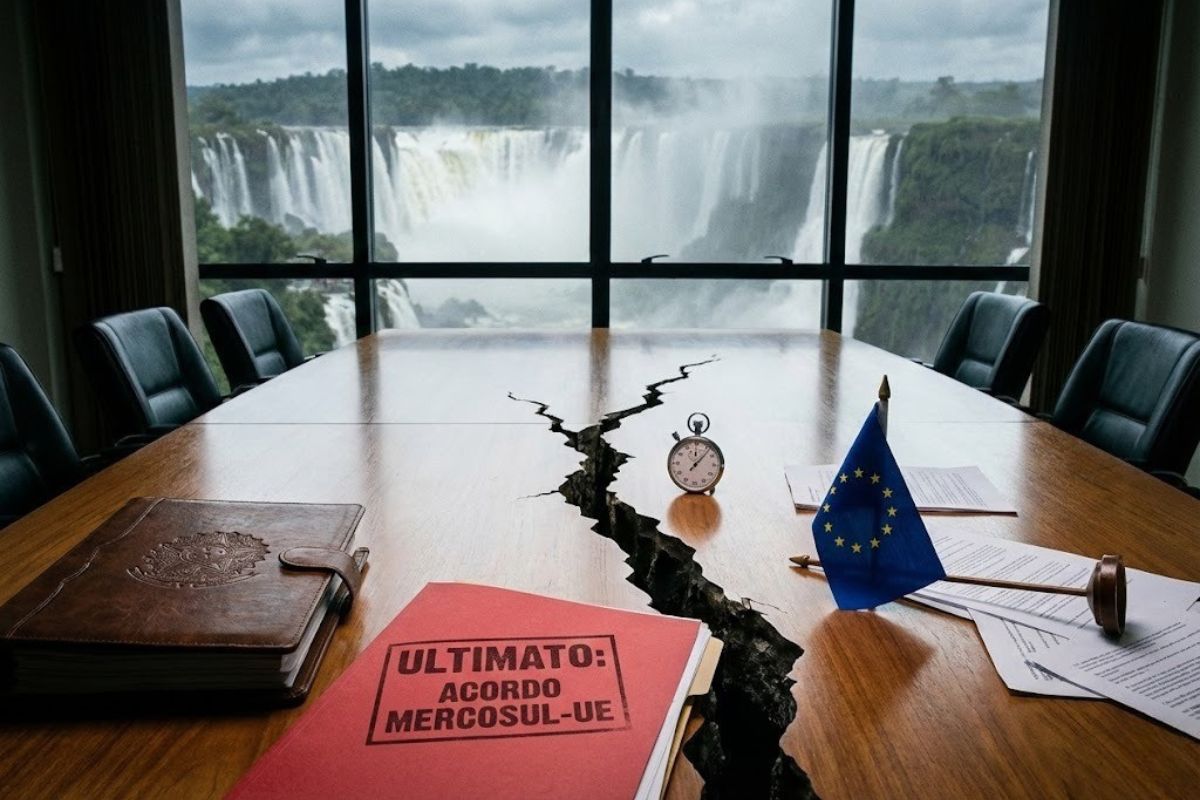
In Ministerial Meeting in Brasília, This Wednesday, 17, Lula Warned That the Mercosur-EU Agreement Will Only Come If Signed at the Summit This Weekend in Foz do Iguaçu and Promised a Much Tougher Stance from Brazil If the European Union Says No Again in Negotiations Between the Two Blocs.
This Wednesday, 17, in Brasília, President Luiz Inácio Lula da Silva issued a public ultimatum to the European Union and stated that if the Mercosur-EU agreement is not signed at the next Mercosur summit this weekend, Brazil will not sign the pact while he is in office, increasing pressure on European partners.
Lula declared that he will travel to the summit in Foz do Iguaçu, Paraná, hoping to hear a “yes” from the Europeans after more than two decades of negotiations between the blocs and warned that if he receives another “no,” Brazil will adopt a much tougher stance in talks with the European Union.
Ultimatum Changes the Tone of Talks with the European Union
In a speech to ministers in Brasília, Lula reinforced that he had already warned the Europeans about the limit of Brazilian patience.
-
Oil surged to $115 a barrel due to the war in the Middle East, and diesel in Brazil has already risen to R$ 7.45 per liter, while the United States…
-
Brazilian city bets on the business environment to generate jobs and attract investments in the energy sector — secretary reveals strategy at Macaé Energy 2026.

-
50 viaducts, 4 tunnels, 28 bridges, and 40 kilometers of bike paths: BR-262 in Espírito Santo will receive 8.6 billion reais for the largest engineering project in the state’s history, inspired by the Immigrant Highway in São Paulo.

-
Brazil produces too much clean energy and doesn’t know what to do with it: over 20% of solar and wind capacity was wasted in 2025 while investors flee and 509 renewable generation projects were abandoned in the last year.


According to the president, there will be no new round of concessions if the text is not finalized now, during the current negotiation phase.
He summarized the message with a direct phrase aimed at the European Union: if the agreement is not finalized at this moment, “Brazil will not make more agreements while I am president.”
By repeating this alert publicly, Lula sought to draw a red line around the Mercosur-EU agreement and send a signal of political pressure to the European capitals.
The president also stated that he does not intend to go to the summit “to hear a no,” making it clear that he expects a positive outcome.
If the European response is negative, Lula promised that Brazil will be tough “from now on” in commercial and political discussions with the European bloc.
Summit in Foz do Iguaçu Becomes a Decisive Moment
The summit of Mercosur heads of state, scheduled for this Saturday in Foz do Iguaçu, has been elevated by the Brazilian government to the status of a decisive moment for the Mercosur-EU agreement.
It is at this meeting that a clear definition is expected regarding the signing or not of the treaty.
Before the presidents’ meeting, a gathering of foreign ministers and the economy is set for the day before, also in Foz do Iguaçu, in the region of the triple border between Brazil, Paraguay, and Argentina.
It will be a diplomatic marathon to try to finally unlock the text of the bi-regional pact.
The full members of the South American bloc – Argentina, Brazil, Paraguay, and Uruguay – have already declared themselves ready to sign the agreement.
On the European side, the European Commission intends to complete the internal ratification process before Saturday, attempting to align the different interests of member countries around the same text.
Negotiation Drags On for More Than Two Decades
The Mercosur-EU agreement has been negotiated for over two decades, in a process marked by occasional advances and long periods of deadlock.
Even after political announcements of understanding, the text has been contested again, especially by European governments concerned about impacts on their agricultural sectors.
Some countries in the European Union are reluctant to ratify the pact for fear of competitive losses for their farmers, given the entry of South American products like meat and grains under more favorable tariff conditions.
This sensitive point is one of the main sources of resistance within the European bloc.
The pressure from governments such as France and Italy has cooled expectations for a quick signing.
The central criticism is that European producers could lose ground to Mercosur agribusiness, which is considered more competitive in various food supply chains.
What Is at Stake in the Mercosur-EU Agreement
If approved, the Mercosur-EU agreement will create a common market estimated at 722 million inhabitants, connecting the economies of South America and Europe in a zone of broader trade exchanges of goods.
The treaty provides for gradual market opening and tariff reduction for different sectors.
On the European side, the text will allow for expanding exports of vehicles, machinery, wines, and liquors to Mercosur countries, with tariff cuts over time.
In exchange, there will be facilitation of the entry of South American meat, sugar, rice, honey, and soybeans into European Union markets, increasing opportunities for agribusiness in the region.
For Mercosur countries, the expectation is that the opening of the European market will generate scale gains, diversification of buyers, and strengthening of production chains linked to the export of food and agricultural commodities, which is currently one of the pillars of the South American economy.
Agriculture, Pesticides, and European Environmental Requirements
France stands out among the countries that demand additional measures before endorsing the Mercosur-EU agreement. Paris seeks guarantees that all pesticides banned in the European Union will also be prohibited in Mercosur countries, as a way to avoid what it considers unfair competition.
In practice, this demand links trade liberalization to stricter environmental and sanitary commitments.
European governments fear internal criticism if they approve a pact seen as permissive towards production standards considered less rigorous than those applied within the EU itself.
Meanwhile, Mercosur countries argue that the treaty should be balanced and that additional requirements should not turn into disguised trade barriers.
In this clash, the environmental agenda and protection of European farmers have become central elements of the discussions.
Expanded Market and Political Dilemma for Brazil
While the Mercosur-EU agreement promises to open a market of 722 million consumers, it also creates a political dilemma for Brazil.
Lula’s signal is that the country will not accept to negotiate indefinitely without obtaining a concrete response from the Europeans.
By stating that if he receives another “no” in Foz do Iguaçu, Brazil will be tough from now on, the president indicates that he may close the door on reopening the issue and adjusting the text of the agreement whenever new European demands arise.
The message is both internal and external: for the domestic audience, it aims to show firmness and defense of national interests; for the European Union, it serves as pressure for decisions to be made now, without pushing the outcome of negotiations for more years.
In your opinion, should Brazil really toughen its stance and leave the Mercosur-EU agreement for later if the European Union says no again at the summit in Foz do Iguaçu?









-

-

-

3 pessoas reagiram a isso.