





 Portuguese
  English
  Spanish
  5 min of reading
  0 comments


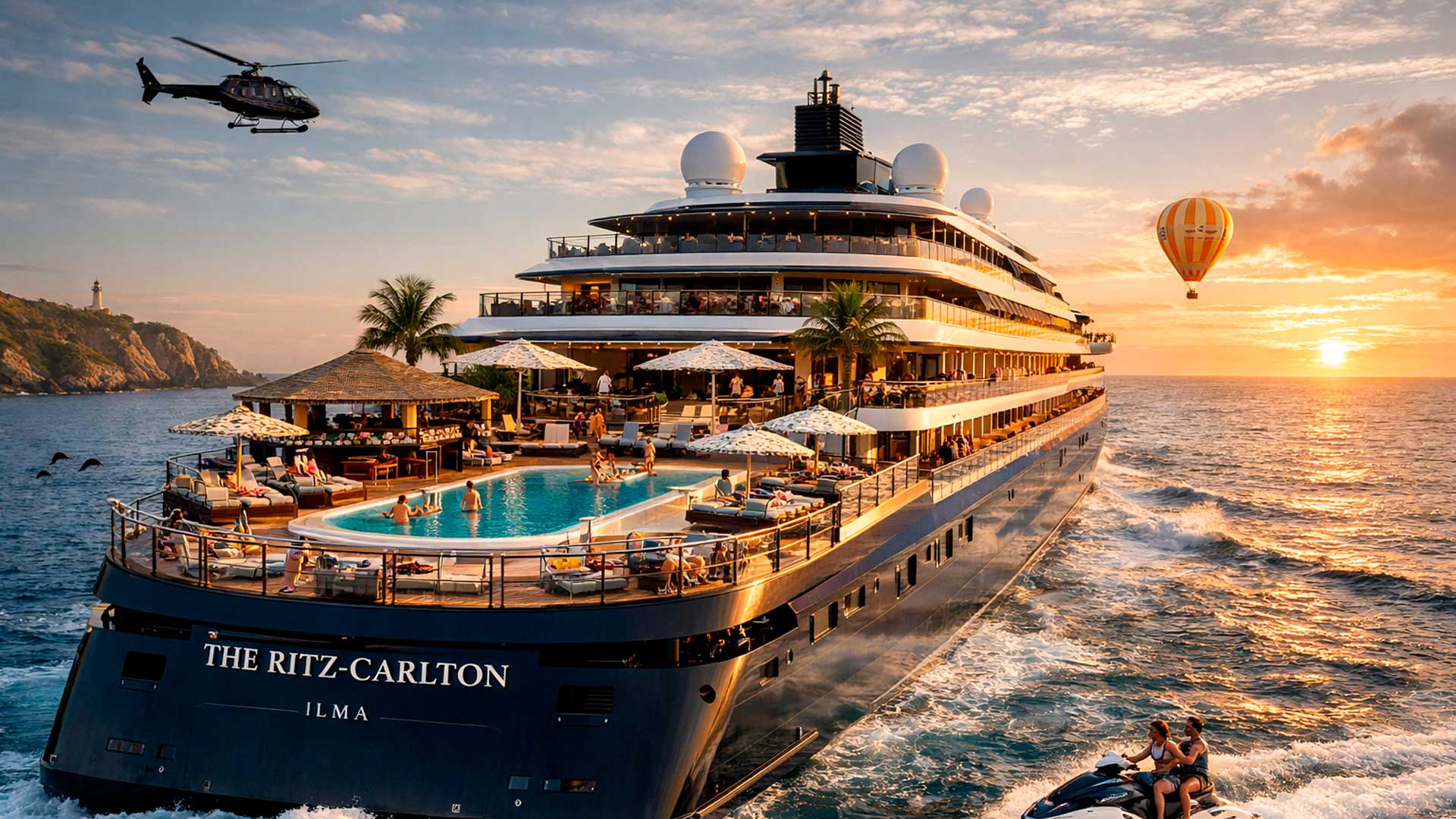
Traditional luxury hotel brands are trading part of the dispute on land for a strategic race at sea, with yachts promising more exclusive service, fewer passengers, and high rates
The market for luxury hospitality at sea gained momentum in 2026 with a clear strategy: to transform yachts into floating extensions of established hotels. The idea is to offer an experience closer to the standard of resorts and five-star properties than to the classic model of traditional cruises.
This movement brings together heavyweight names such as Four Seasons, Ritz-Carlton, Orient Express, and Aman. The bet combines original design, high-level gastronomy, personalized wellness, and routes designed for an audience willing to pay more for exclusivity.
Among the most visible examples is the Ritz-Carlton Yacht Collection, which expanded this concept with three vessels in operation. The most recent update occurred on the Ilma, a yacht launched in 2024 and valued at around US$ 600 million, which received a new tropical ambiance designed by Colombian stylist Johanna Ortiz.
-
A Brazilian city produces 120,000 pairs of shoes per day and dominates the footwear industry, accounting for 16.5% of national production and helping Ceará capture 24.3% of the Brazilian market even under external pressure.

-
A millionaire wanted a mansion in Florida, found a protected bird, and is now trying to overturn environmental protection, impacting more than 1,200 species, to avoid a fine of $118,000.
-
Brazilian city next to Natal holds the massacre of 1645, gathers the first saints of Brazil, and concentrates a cultural, religious, and popular heritage that many people still ignore.

-
Few people know, but no one lives in this place, as it is considered the hottest on the planet; still, it surprises with unreal landscapes and extreme temperatures. Discover Dallol, in Ethiopia.

The renovation reinforces a trend that unites high-end tourism, fashion, and interior design. More than just decorating the ship, the goal is to create a visual identity connected to the destinations and lifestyle that these brands want to sell.
Four Seasons, Ritz-Carlton, Aman, and Orient Express accelerate the race for a space in luxury tourism at sea
The advance of luxury networks over the ocean became more evident in March 2026, when Four Seasons launched its first yacht. The vessel arrived with 95 suites and a capacity for 200 passengers, a much smaller size than large cruises, precisely to preserve the feeling of exclusivity.
The Four Seasons project was inspired by the brand’s land properties, such as the Palazzo Donà Giovannelli in Venice. The proposal includes spas with personalized treatments, Michelin-experienced chefs, configurable suites, and a cross marina aimed at water sports.
In the same movement, Orient Express and Aman are also advancing with their own projects. The repositioning shows that the sector sees space for a traveler who wants to sail without giving up the aesthetic standard, service, and privacy found in the best hotels in the world.
Ilma, Ritz-Carlton yacht of US$ 600 million, receives new tropical ambiance to connect the ship to the routes of the Caribbean and the Mediterranean
Ritz-Carlton was one of the pioneers in this segment and already operates three vessels. The Evrima was launched in 2022, with 149 suites, the Luminara entered the scene in 2025, with 226 suites, and the Ilma began sailing in 2024.
In recent days, the Ilma received a visual update signed by Johanna Ortiz. The change began in February, during the season in the Caribbean, and continues throughout the summer in the Mediterranean, following the vessel’s route calendar.
The project focused mainly on the decks 9 and 10, two important social areas of the yacht. Ortiz created exclusive prints for loungers, sofas, chairs, and umbrellas, with a visual language connected to the nautical and tropical environment.
On deck 10, where the main pool and the outdoor bar are located, the dominant print is La Rumba, marked by maritime references and tropical elements. Meanwhile, deck 9, more private and closer to the cabins, received the La Siesta print, in green with botanical design.
The proposal was born from the original architecture of the ship and the destinations traveled by the Ilma. The result attempts to translate an atmosphere of tropical elegance, without breaking with the sophistication expected from a brand like Ritz-Carlton.
Johanna Ortiz joins the project due to affinity with guests and reinforces the mixture of fashion, decoration, and premium experience on board
The choice of Johanna Ortiz was not by chance. The stylist’s pieces are already sold in the ship’s boutique, which brings the brand closer to the consumer profile of some guests embarking on Ritz-Carlton Yacht Collection trips.
Gaby Aiguesvives, marketing director of the Ritz-Carlton Yacht Collection, explained that the collaboration arose precisely from this connection with the audience. The company’s internal reading was simple: many passengers already knew Johanna Ortiz’s aesthetic and identified with it.
The stylist herself followed the implementation of the project on board during a trip through the Virgin Islands. It was the first time she saw the prints integrated into the yacht’s spaces, with the sea and sky functioning as part of the visual composition.
This type of partnership shows how luxury tourism at sea has been moving away from selling just cabins, routes, and gastronomy. Now, the package also includes a more sophisticated aesthetic curation, capable of transforming the ship into a showcase of style and desire.
How much does it cost to travel on Ilma and why the prices help explain the new positioning of luxury on the waters
The prices charged on the Ilma make it clear that the proposal targets a very high-income audience. In the Caribbean, the weekly package starts at US$ 7,500 per person, while the route from Barcelona to Monte Carlo has an initial rate of US$ 9,820 per person.
For those seeking more spacious accommodation, the Grand Suite for 7 nights ranges between US$ 18,000 and US$ 25,000 per person, depending on the season and the chosen route. It is a price range that brings the trip closer to an ultra-luxury experience and distances any direct comparison with mass cruises.
This positioning helps explain why famous hotels are entering this market. The sea has become a new frontier to increase revenue, strengthen brand, and cater to a traveler who wants to move between destinations as they do in a boutique hotel, but with the comfort of a vessel designed for few.
In practice, the sector bets on a very clear combination: fewer people, more personalization, and higher rates. It is this model that sustains the new competition among hospitality giants, now also far from the coast.
Luxury tourism at sea is still likely to generate much discussion, especially regarding prices and the type of exclusivity that these brands are selling. Do you think hotel yachts represent a natural evolution of premium hospitality or a luxury increasingly distant from reality? Leave your comment and join this debate.







Seja o primeiro a reagir!