Portuguese
  Spanish


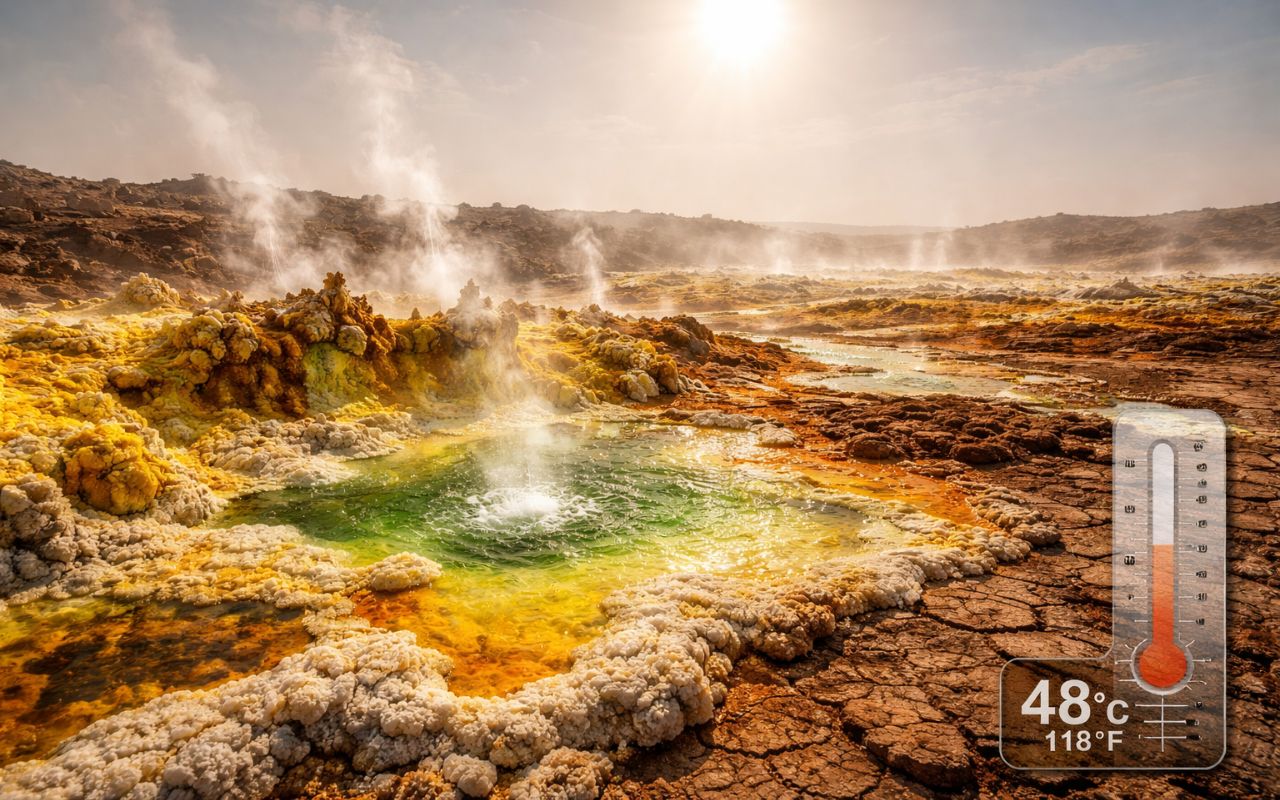

Discover Dallol, considered the hottest place in the world, with extreme temperatures, colorful landscapes, and an inhospitable climate in Ethiopia.
In one of the most inhospitable regions on the planet, Dallol, located in Ethiopia, is considered the hottest place on Earth, with temperatures that can exceed 47 °C and an even higher heat index. Situated in the Danakil Depression, about 120 meters below sea level, the location draws attention not only for its extreme heat but also for its colorful landscapes and unique geological features. The combination of volcanic activity, high salinity, and severe climate explains why the region is often referred to as the “gateway to hell.”
Despite the adverse conditions, Dallol continues to spark scientific and tourist curiosity. The scenery, which looks like something out of a science fiction movie, attracts researchers and adventurers interested in understanding how life and minerals behave in such a hot and hostile environment.
Dallol is the hottest place on the planet
The title of the hottest region in the world is not by chance. Dallol records impressive average annual temperatures, hovering around 41 °C, with even higher peaks during the most intense months.
-
Entrepreneur Turns Rio Cemetery Canteen into a Successful Snack Chain Generating $4.9 Million Annually and Expanding to Metro Stations

-
Rare fox feared “extinct” found alive on Caribbean island after over two decades without official sightings

-
21-Year-Old Brazilian Student Turns Homemade Popsicle Hobby into $100,000-a-Month Business

-
Australia Dumps Hundreds of Thousands of Tons of Gravel into Rivers to Restore Natural Barriers and Reverse 150 Years of Erosion




Moreover, historical records indicate that between 1960 and 1966, the annual average was 34.6 °C — one of the highest rates ever documented for an inhabited area. Meanwhile, the hottest months can reach averages of up to 46.7 °C.
Therefore, the constant heat throughout the year makes the environment practically uninhabitable for humans.
Extreme hot climate and unbearable heat index
The climate of Dallol is classified as extreme hot desert, which means not only high temperatures but also very low rainfall.
On the other hand, one factor further exacerbates the situation: the relative humidity, which can reach around 60%. This makes the heat index even hotter and harder to bear.
Thus, even temperatures that would already be considered extreme become practically unbearable for the human body.
Dallol’s landscapes look like another planet
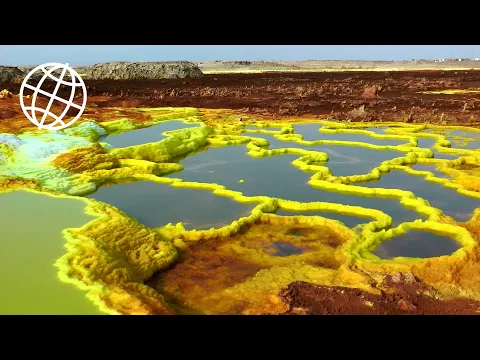
If on one hand the heat drives most people away, on the other, the natural beauty of Dallol impresses. The location is known for its vibrant colors and unusual geological formations.
The yellow, orange, and green tones are a result of the presence of sulfur, iron, and other minerals. These elements have been deposited over thousands of years by intense volcanic activity.

Additionally, there are hot springs that can reach up to 60 °C, where the water constantly bubbles. This contributes to the formation of landscapes that seem unreal.
Main characteristics of Dallol
To better understand why Dallol is considered so extreme, here are some key points:
- Average annual temperature of around 41 °C
- Records of up to 47 °C during the hottest periods
- Altitude of approximately 120 meters below sea level
- Presence of hot springs and volcanic activity
- Soil rich in salt, iron, and sulfur
These combined factors make the environment unique on the planet.
Salt extraction marked the history of the region
Despite the severe conditions, Dallol had significant economic importance throughout history. The region was known for salt extraction, considered a valuable resource.
For centuries, the so-called “white gold” was used as currency in Ethiopia. Even in extremely hot environments, workers ventured to extract the mineral.
Over time, many of these activities were abandoned. Still, there are records of exploration until the mid-20th century.
Old infrastructure and mineral exploration
In the early 20th century, a railway was built to facilitate the transport of salt from the region. The line connected areas near Dallol to the port of Mersa Fatma in Eritrea.
This structure, built between 1917 and 1918, used a simple system that allowed for quick assembly. However, after World War II, it was dismantled.
Additionally, international companies explored minerals such as potassium. At times, production reached tens of thousands of tons.
Dallol is now a ghost town
Currently, Dallol has no permanent population. The extreme heat and environmental conditions make human habitation practically unviable.
Therefore, the location is considered a ghost town. Still, researchers and tourists continue to visit the region sporadically.

Meanwhile, its proximity to politically tense areas, such as the border between Ethiopia and Eritrea, also contributes to its isolation.
Tourism and scientific curiosity grow
Even being one of the hottest places on the planet, Dallol gained international notoriety. In 2004, for example, it was featured in a documentary aired by international channels.
Since then, interest in the location has increased. Scientists study its extreme conditions to better understand similar environments on other planets.
Additionally, adventurous tourists seek to experience this unique setting up close. However, visits require rigorous planning due to the risks involved.
Climatic data of Dallol
| Indicator | Approximate Value |
| Average annual temperature | 41 °C |
| Average maximum temperature | 46.7 °C |
| Relative humidity | 60% |
| Altitude | -120 meters |
| Type of climate | Extreme hot desert |
By combining intense heat, volcanic activity, and unique mineral composition, Dallol establishes itself as one of the most extreme environments on the planet.
Therefore, even being an extremely hot and hostile place, its scientific importance and natural beauty continue to attract global attention.
Thus, Dallol remains an impressive example of how Earth can host scenarios that are as challenging as they are fascinating.
With information from Mega Curioso.