





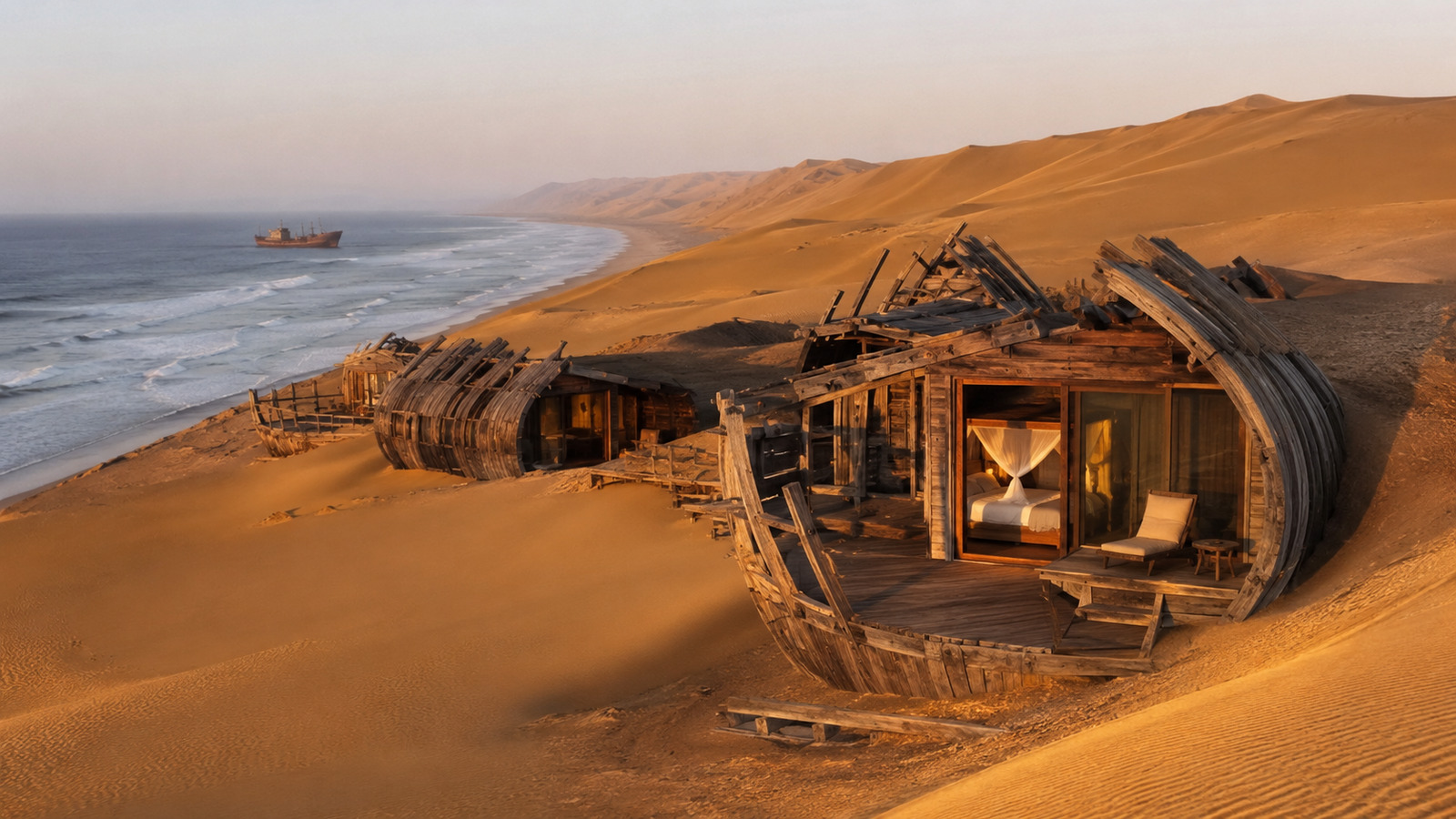

Projects like Shipwreck Lodge and Onduli Enclave combine local materials, discreet forms, and extreme isolation to create high-standard accommodations that almost disappear among dunes, shipwrecks, mountains, and rocky outcrops of Namibia
Invisible architecture is transforming high-standard accommodations in Namibia by placing the landscape at the center of the projects. On the Skeleton Coast and in Damaraland, cabins and villas use shapes, colors, and local materials to reduce visual impact and offer isolation in some of the most remote regions of the country.


Invisible architecture accompanies shipwrecks on the Skeleton Coast
The Skeleton Coast occupies a coastal strip of almost 500 kilometers, marked by dunes up to one hundred meters and shipwrecks scattered across the sand.
Locally known as the “Gates of Hell,” the region features extreme conditions and wildlife that includes lions, elephants, and sharks circling near the rusty wrecks.
-
China did not imagine that by constructing a mega-structure capable of holding back 39 billion m³ of water, it would end up altering the Earth’s rotation, shifting its axis, flooding cities, and forcing the relocation of more than 1.3 million people.

-
Excavating 4.5 meters under an avenue in Los Angeles, workers halted the subway construction upon finding tusks, mastodon teeth, and the skull of a young mammoth preserved since the last Ice Age.

-
He sold empty bottles at the junkyard, coxinha, sacolé, and kites to earn some change, abandoned the dream of living off surfing due to lack of money, started by unloading trucks at construction sites, and today he runs the largest construction company on the southern coast of São Paulo, is among the 100 largest in Brazil, and sponsors international athletes.
-
At 101 years old, an American woman was still driving and changing the oil of her own car, a 1930 Packard, bought in 1949 and kept in impeccable condition for over six decades.


In this setting, Namibian architect Nina Maritz designed the Shipwreck Lodge. Opened in 2018, the set of cabins visually replicates the hulls of ships stranded along the coast.
The structures were built with weathered wood and positioned not to interrupt the horizon when viewed from afar. The proposal is to make the accommodation remain subordinate to the landscape.
The material can also be removed if the concession granted by the Namibian government for the use of the area is terminated, allowing the removal of the facilities.

Luxury villa blends with the rocks of Damaraland
In the interior of Namibia, invisible architecture also guided the construction of the Onduli Enclave, installed on a granite outcrop in the rocky plains of Damaraland.
The villa overlooks Brandberg, the highest mountain in the country, and is located in the Doro Nawas Conservancy. The area covers nearly 4,000 square kilometers and is home to about 1,500 people.
The region is also inhabited by black rhinos, leopards, and cheetahs. To integrate with the environment, the construction features reddish roofs that match the tones of the rock formations.
Built on stilts, the complex seems to float above the ground. The accommodation includes interconnected spaces, a pool, a campfire, an outdoor pizza oven, and three suites with glass doors fully open to the landscape.

Construction only appears in the last meters of the path
Access to the Onduli Enclave was designed to hide the villa for almost the entire journey. The construction only becomes visible in the final meters of the approach.
The proximity is indicated by metal-sculpted giraffes installed on a granite block. The name Onduli means giraffe in the local language.
The project was conceived by Trevor Nott, a former ecologist from Etosha National Park who became a self-taught designer. The inauguration took place in 2024.
The construction used biodegradable materials found in the region, including calcrete extracted from nearby deposits and wood from dead trees in the surrounding forests. The components were gradually assembled to form the final structure.
This article was prepared based on the information provided in the material about the Shipwreck Lodge and the Onduli Enclave, with data, numbers, and characteristics of the projects preserved as per the consulted content.


