





 English
  Francês
  Alemão
  Italiano
  Japonês
  Norueguês
  Portuguese
  Spanish
  4 min of reading


Metallic Wood Is Here to Revolutionize the Industry! Discover the Material Used as Membranes to Separate Biomaterials in Cancer Diagnostics, Protective Coatings, and Flexible Sensors
Yes, there is already a wood harder than steel and titanium, but James Pikul from the University of Pennsylvania in the U.S. wanted to flip the equation. So instead of making wood that looks like metal, he made a metal that looks like wood. The researchers have finally managed to solve the biggest problem that had prevented this highly promising metallic foam from being produced on a large scale: They have successfully eliminated the so-called “inverted cracks,” a type of defect that has plagued similar materials for decades.
Also Read
- Macaé Has Many Functions Called for Job Vacancies in Offshore Construction and Assembly Contracts, Today July 8
- Job Openings for Elementary, High School, and Higher Education Are Open Today (08/07) for Work in an Ethanol Plant
- ExxonMobil, the Largest Oil Company in the U.S. and Operator of Nine Oil Blocks in Sergipe, Donates Over 287 Thousand Reais to Combat Hunger for 3,600 Families in Sergipe
- Brand Loyalty at Fuel Stations Will End and Fuel Delivery Sales Will Be Allowed; Measure Promises to Reduce Gas Prices by Stimulating Competition
- Brazilian Multinational, World Leader in Foundry and Metallurgical Machining, in Partnership with Other Global Giants, Develops the Most Efficient Hydrogen Internal Combustion Engine in the World
Despite Technological Advances in Construction, Wood Remains a Ubiquitous Building Material Thanks to Its High Strength-to-Density Ratio
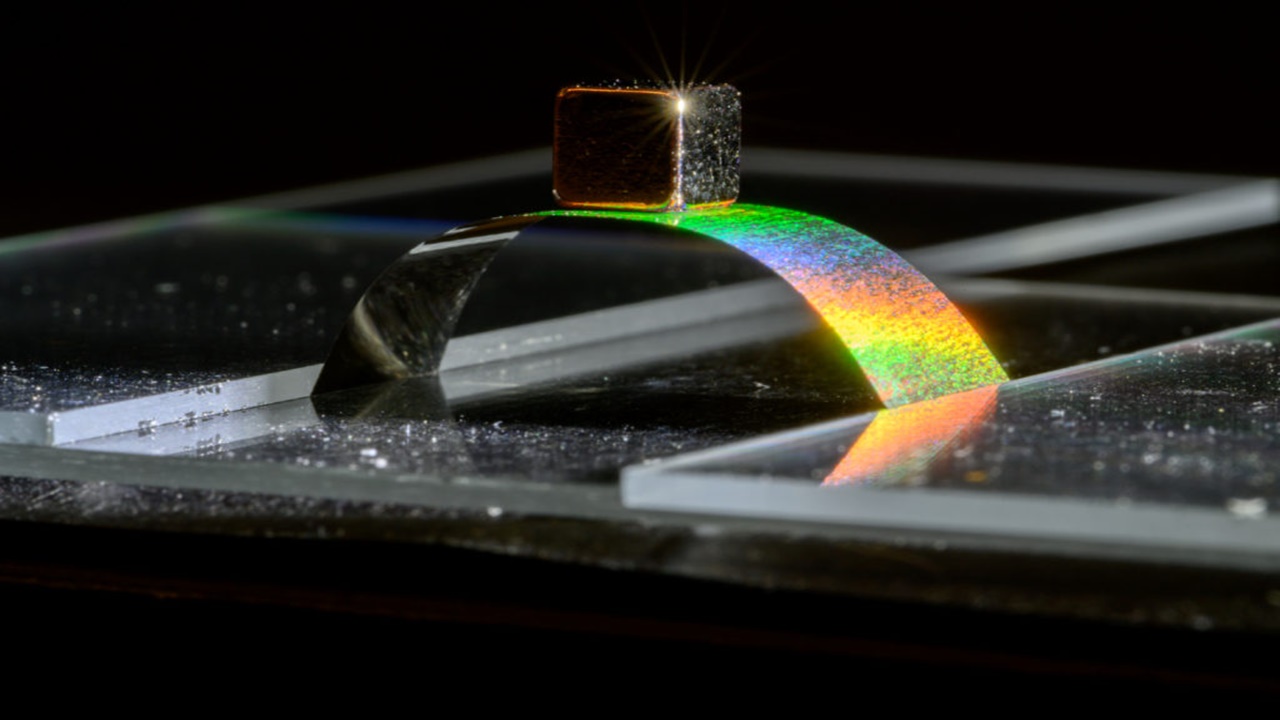
The precise spacing of these pores also gives the material some unique optical properties. The spaces between the gaps are the same size as the wavelengths of visible light, meaning that light reflected from the wood interferes, resulting in specific colors – depending on the angle of reflection – being enhanced. This gives the material a bright and attractive rainbow appearance, with potential for incorporation into sensing devices.
Although the material has been in development for several years, engineers have resolved a serious issue that prevented them from producing metallic wood in useful sizes: eliminating the inverted cracks that form as the material is grown from nanoparticles in metal films. Preventing these defects allows strips of the material to be grown in areas 20,000 times larger than before. The solution was detailed in a paper in Nature Materials.
-
‘Interlocking brick’ made of earth arrives in the construction industry with cost reductions of up to 40% on the project.
-
Espírito Santo will receive the largest engineering project in its history with the duplication of BR 262, which will have 50 viaducts, 28 bridges, and 2-kilometer tunnels cutting through the most challenging mountainous region of the entire state.

-
A project of nearly 9 million reais already has the first kilometer paved in Santa Catarina and promises to completely transform the access between Jaraguá do Sul and Rio dos Cedros in an area where tourism is growing at a rapid pace.

-
A couple builds a system to bring water from the spring to their land, climbs a hill with materials on their backs, and creates a simple, cheap, and sustainable solution to ensure their own water supply.


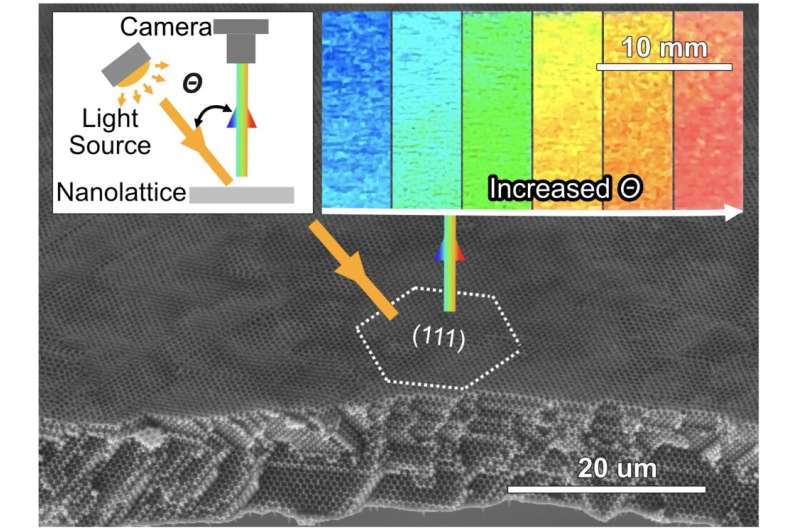
When a crack forms in conventional material, the bonds between the atoms break, eventually causing the material to separate. An inverted crack, however, is an excess of atoms. In the case of metallic wood, these are extra nickel atoms filling the nanopores that give it its unique properties.
“Inverted cracks have been a problem since the first synthesis of similar materials in the late 1990s,” said graduate student Zhimin Jiang, who worked on the project. “Finding a simple way to eliminate them has been a long-standing hurdle in the field.”
Porous Metal Like Wood and Inverted Cracks
Inverted cracks emerge from the way metallic wood is grown. It starts as a “template” of stacked nanospheric shapes. When nickel is deposited through the template, it forms a network around the spheres, which are then dissolved to leave behind the nickel pore structure. However, the researchers discovered that if there is any place where the regular pattern of stacking of the nanospheres is disrupted, nickel will fill those gaps and produce an inverted crack when the template is dissolved.
“The standard way to construct these materials is to start with a nanoparticle solution and evaporate the water until the particles are dry and regularly stacked. The challenge is that the surface forces of the water are so strong that they tear the particles and create cracks, just like cracks that form in dry sand,” explained Professor James Pikul. “These cracks are very difficult to prevent in the structures we are trying to build, so we developed a new strategy that allows us to self-assemble the particles while keeping the template wet.
“This prevents the films from breaking, but since the particles are wet, we have to lock them in place using electrostatic forces so that we can fill them with metal.”

Metallic Wood Is Three Times Stronger than Porous Metals
Now that it is possible to create larger and more consistent strips of metallic wood, Pikul and his colleagues are particularly interested in using it to build new devices. He said: “Our new manufacturing approach allows us to make porous metals that are three times stronger than previous porous metals at similar relative densities and 1,000 times greater than other nanolattices.
“We plan to use these materials to make a range of previously impossible devices, which we are already using as membranes to separate biomaterials in cancer diagnostics, protective coatings, and flexible sensors,” says Pikul.
This work was partially funded by the pilot grant program of the Center for Innovation & Precision Dentistry at the University of Pennsylvania and by the National Science Foundation under CAREER Grant No. 1943243.









Seja o primeiro a reagir!