





 Portuguese
  English
  Spanish
  3 min of reading
  0 comments


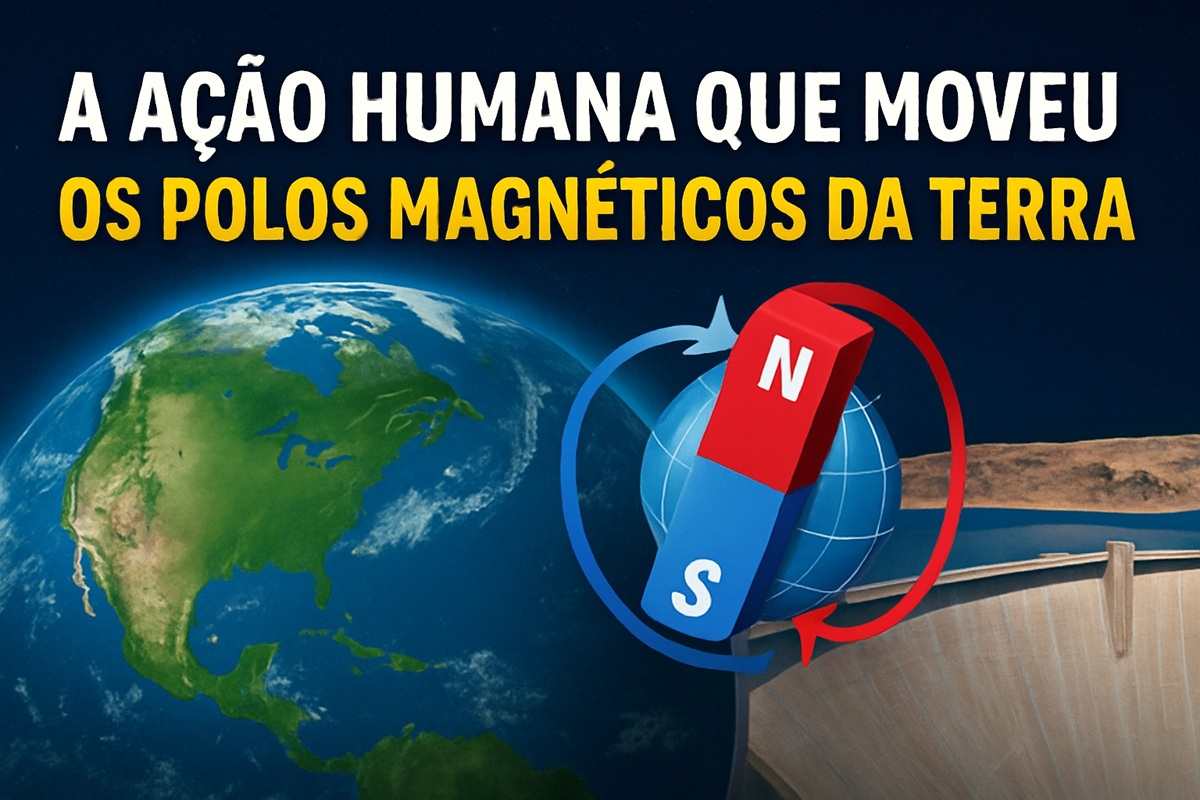
Humanity Has Changed The Planet So Intensely That Even The Magnetic Poles Felt It. A New Study Reveals That The Reservoirs of Water in Thousands of Dams Have Already Displaced The Earth’s Axis of Rotation and Caused Significant Changes in Sea Level.
The construction of dams around the world has had an unexpected effect on the planet. Researchers from Harvard have discovered that large-scale water reservoirs are altering the Earth’s axis of rotation and contributing to changes in the magnetic poles.
The Weight of Dams
The study led by geophysicist Natasha Valencic from Harvard University revealed that nearly 7,000 of the largest dams in the world have already displaced the Earth’s crust by about one meter.
This occurs because the accumulation of water behind the dams redistributes weight on the planet’s surface.
-
With a cost per shot close to zero, the DragonFire laser could change naval warfare in 2027 and provide British ships with nearly unlimited defense against drones.

-
A British startup creates tires that generate electricity in electric vehicles when passing over potholes, speed bumps, and cracks.

-
Scientists have created robots made with living cells that have their own nervous system, swim on their own, explore the environment, and self-organize without any genetic engineering, and now they want to do the same with human cells.

-
Students create a solar-powered ambulance that operates without a plug, without fuel, and still keeps medical equipment running in remote areas.


According to Valencic, this displacement does not directly affect the planet’s core, which is responsible for the magnetic field, but rather the Earth’s crust that floats above it. “When we hold water behind dams, it removes water from the oceans and redistributes mass differently on the planet,” she explains.
Displacement of the Poles
The study showed that this mass redistribution was sufficient to alter the position of the magnetic North Pole in two distinct phases.
Between 1835 and 1954, the pole moved about 20 centimeters toward Russia, coinciding with the construction of dams in Europe and North America.
From 1954 to 2011, with the expansion of dam construction in Asia and the Eastern Africa, the displacement was 57 centimeters toward North America. In total, the magnetic North Pole moved about one meter during this period.
This phenomenon is known as “true polar wander,” occurring when the Earth’s crust moves around the fixed magnetic axis, causing the surface to reposition over the inner poles.
Impacts on Sea Level
Another finding revealed by the research is the drop in global sea level. With so much water held back, there was a reduction of 21 millimeters in ocean levels. Researchers estimate that this represents about a quarter of the expected rise for this century, which is directly linked to climate change.
Even though it is an unexpected consequence, this reduction may temporarily help mitigate the effects of rising sea levels.
However, Valencic warns that this is not enough to curb the impacts of climate change. “We are not going into a new glacial age just because the pole moved one meter, but this has implications for sea level,” she stated.
Planning and Future Consequences
The team highlights the importance of considering the location of dams and reservoirs in urban and climate planning. The way these structures are distributed can influence the geometry of sea level rise in different regions.
Valencic emphasizes: “Depending on where you position dams and reservoirs, the geometry of sea level rise will change. These changes can be quite large and significant.”
Human-Induced Changes
The alteration of the magnetic poles joins a growing list of planetary phenomena affected by human activity.
Among them are the shrinking of atmospheric layers, changes in ocean circulation, and even the activation of volcanoes.
This discovery reinforces the growing influence of human action on large-scale natural phenomena, many of which are still being studied.







Seja o primeiro a reagir!