





 Portuguese
  English
  Spanish
  5 min of reading
  28 comments


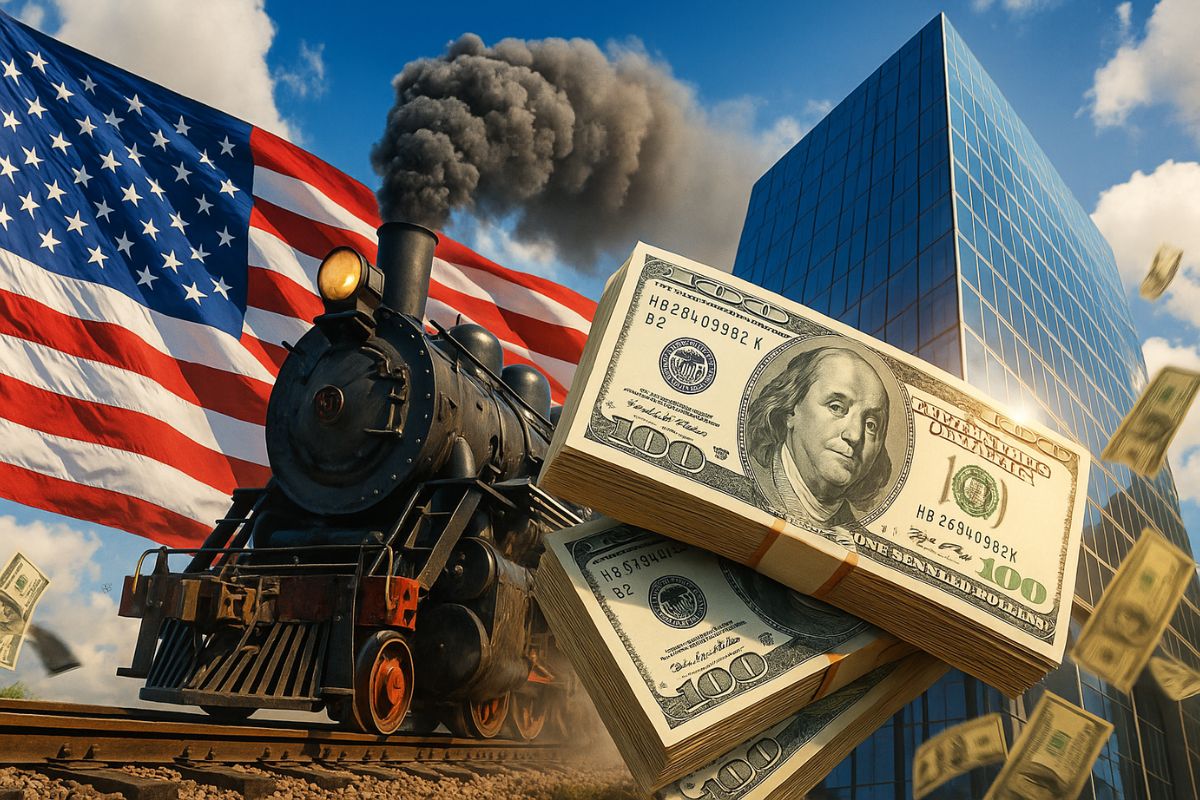


The History Of The Largest Economy In The World Crosses The Railroad Expansion Of The Gilded Age, The Post-War Period, And The Digital Revolution, With Nominal GDP Rising From US$ 542 Billion In 1960 To About US$ 29 Trillion And Consolidating An Ecosystem Of Services, Advanced Industry, And Technology
The largest economy in the world is the result of a cumulative journey, from the infrastructure built in the 19th century to the technological dominance of the 21st century. In numbers, the trajectory is eloquent, with the nominal GDP of the United States jumping from US$ 542 billion in 1960 to approximately US$ 29 trillion, a performance driven by the dynamism of the services sector, continuous innovation, and a continental-scale domestic market. This growth was not linear, but it sustained global leadership for decades, even as competition intensified.
In the short term, activity also fluctuated, with contraction in the first quarter of 2025 and annualized growth of 3.8 percent in the second quarter, a sign of a resilient economy in a higher interest rate environment and geopolitical uncertainties. The backdrop combines advances in finance and technology with sophisticated industry and highly productive agriculture, while the American currency remains central in global finance, even amid debates about de-dollarization.
From The Gilded Age To The Rails, The Base Of Productive Power
The foundation of growth traces back to the accelerated industrialization in the post-Civil War, when the railway network united coasts, lowered freight costs, and integrated markets.
-
The largest food company on the planet, JBS, has just opened a 4,000 square meter laboratory in Florianópolis to develop customized proteins that modulate muscle mass gain, immune response, and metabolic performance.

-
After nearly 30 bids and competition among industry giants, a Spanish company purchases one of the largest airports in Brazil for almost R$ 3 billion and takes over the management of Galeão in a concession that will last until 2039.

-
The Federal Revenue Service now automatically cross-references everything you declare with data from banks, credit cards, brokerage firms, and insurance companies, and any discrepancy between your income and your expenses triggers an alert in seconds.

-
Amid global tensions, Brazil blocks the United States’ proposal at the WTO and paves the way for a trade crisis and possible retaliations.
The transcontinental railroad completed in 1869 shortened distances, brought inputs to factories, and carried production to ports, creating a virtuous cycle of investment, productivity, and urbanization.
The abundance of coal, iron, oil, and fertile land ensured energy and raw materials at scale, allowing for industrial takeoff.
At the same time, mass immigration expanded the labor force and domestic demand. The constantly expanding domestic market reduced dependence on external shocks and generated a base for companies to grow before launching into the world.
It was in this wake that manufacturing surpassed agriculture around 1890, paving the way for conglomerates and the modernization of financial capital.
From The Post-War Period To The Hegemonic Dollar
In the 20th century, two vectors consolidated leadership, the position of supplier and financier after the World Wars and the monetary architecture of the post-1945 period.
With intact infrastructure and significant industrial capacity, the country funded European reconstruction and exported machinery, consumer goods, and managerial know-how.
The global financial arrangement gave prominence to the dollar, which began to back reserves and price international trade and finance.
This design reduced the cost of capital and attracted global savings, feeding domestic investment in science and technology.
Universities, laboratories, and venture capital formed a triangle of innovation that, decades later, would culminate in the Silicon Valley and digital platforms that redefined value chains around the world.
The Leap Of GDP, From US$ 542 Billion To US$ 29 Trillion
The historical snapshot shows a long climb, from US$ 542 billion in 1960 to about US$ 29 trillion in 2024, with accelerations and brakes dictated by credit cycles, energy shocks, and technological changes.
Still, the structural trend was one of expansion accompanied by productivity gains, especially in knowledge-intensive services.
In recent years, the pace combined a strong labor market, investment in technology, health, and data centers, and industrial recomposition in critical niches.
Quarterly fluctuations are the norm for any large economy, but the size of the market and the capacity to innovate have preserved the comparative advantage in high-value-added segments.
How The Machine Operates Today, Services On Top And Advanced Industry
The current GDP is primarily from services, with finance, technology, health, education, professional services, and real estate leading the charge.
It is in these sectors that the majority of incremental productivity resides, thanks to digitalization, automation, and large-scale data analysis.
The so-called big techs have become cornerstones of capitalization and R&D, defining technical standards and global platforms.
The industry remains relevant, especially in capital goods, aerospace, semiconductors, medical equipment, and automotive.
Agriculture, although smaller in GDP, is highly mechanized and competitive, supporting food chains, bioenergy, and grain exports.
The whole produces network effects, where sophisticated services support high-tech manufacturing.
Trade, Dollar, And Investment, The Global Channels
In trade, the country remains among the largest importers and exporters, with highlights on industrial supplies, capital goods, consumer goods, and vehicles.
The dollar continues to be the main currency for international pricing and settlement, which reduces financial friction and anchors capital flows.
Even with discussions about de-dollarization, the depth of markets and institutional confidence keep the currency at the center.
In investment, the legal environment, innovation, and consumer scale continue to attract foreign direct investment, while local companies lead mergers, acquisitions, and global expansion.
The primacy of the domestic capital market, with liquid exchanges and a broad base of investors, finances growth and accelerates technological diffusion.
Vulnerabilities And Dilemmas, From Deficit To Inequality
Not everything is record-breaking. The high budget deficit and rising debt require fiscal discipline and coordination with monetary policy.
Inflation has eased, but the cost of living continues to pressure families, with housing, health, and education weighing on budgets.
Income and wealth inequality has grown, which tempers the reading of aggregates and fuels political tensions.
On the external front, tariffs and technological disputes are reshaping supply chains, while partners seek to diversify currencies and suppliers.
The debate about de-dollarization makes headlines, but faces practical limitations of scale and trust.
The challenge is to preserve competitiveness, with investment in people, critical infrastructure, and applied science.
What Explains Leadership In One Sentence
Market scale, continuous innovation, and deep financial institutions.
These three pillars together explain why the largest economy in the world maintains relative advantage, despite cycles, shocks, and lurking competitors.
What Happens Next, Short And Medium Term Scenarios
In the short term, the picture combines moderate growth, vigilant monetary policy, and private investment concentrated in AI, cloud, and energy transition.
Industrial recomposition in strategic sectors should continue, with incentives for semiconductors, batteries, and digital infrastructure, in parallel with environmental regulations and productivity targets.
In the medium term, the continuity of leadership will depend on human capital and technological diffusion beyond already mature hubs.
If innovation spreads to more states and sectors, the economy is likely to dilute regional inequalities and sustain growth potential, maintaining the momentum that took it from US$ 542 billion to US$ 29 trillion.
The trajectory of the largest economy in the world unites rails, factories, and algorithms, from railroads and oil to cloud, AI, and advanced services.
The outcome is a growth machine that has already proven resilient, but now needs to address debt, cost of living, and inequality without losing the engine of innovation.
And for you, what else sustains leadership in the future, the dollar at the center of the financial system or the capability to scale technologies like AI and semiconductors? If you had to prioritize one policy axis, would you invest in innovation, in reducing the cost of living, or in green reindustrialization? Share your thoughts in the comments, we want to hear from those who entrepreneur, research, and work within this machinery.







Interessante constatar, que a participação desta super potência que chegou a quase 50% do PIB mundial, hoje é aproximadamente 25%, e cresceu se tornando o maior devedor do mundo, a algo de errado no país das maravilhas, ou seu entendimento em economia entre outros assuntos é muito ufanista !e misturando com meias verdades, comentários devem ter embasamento,e mostrando o porque o império está demorando!
America Way Life !!!
The Best Place of The World !!!
Uma narrativa totalmente fora da realidade. Não cita a desindustrialização nem o declínio do dólar.