





 Portuguese
  English
  Spanish
  4 min of reading
  0 comments


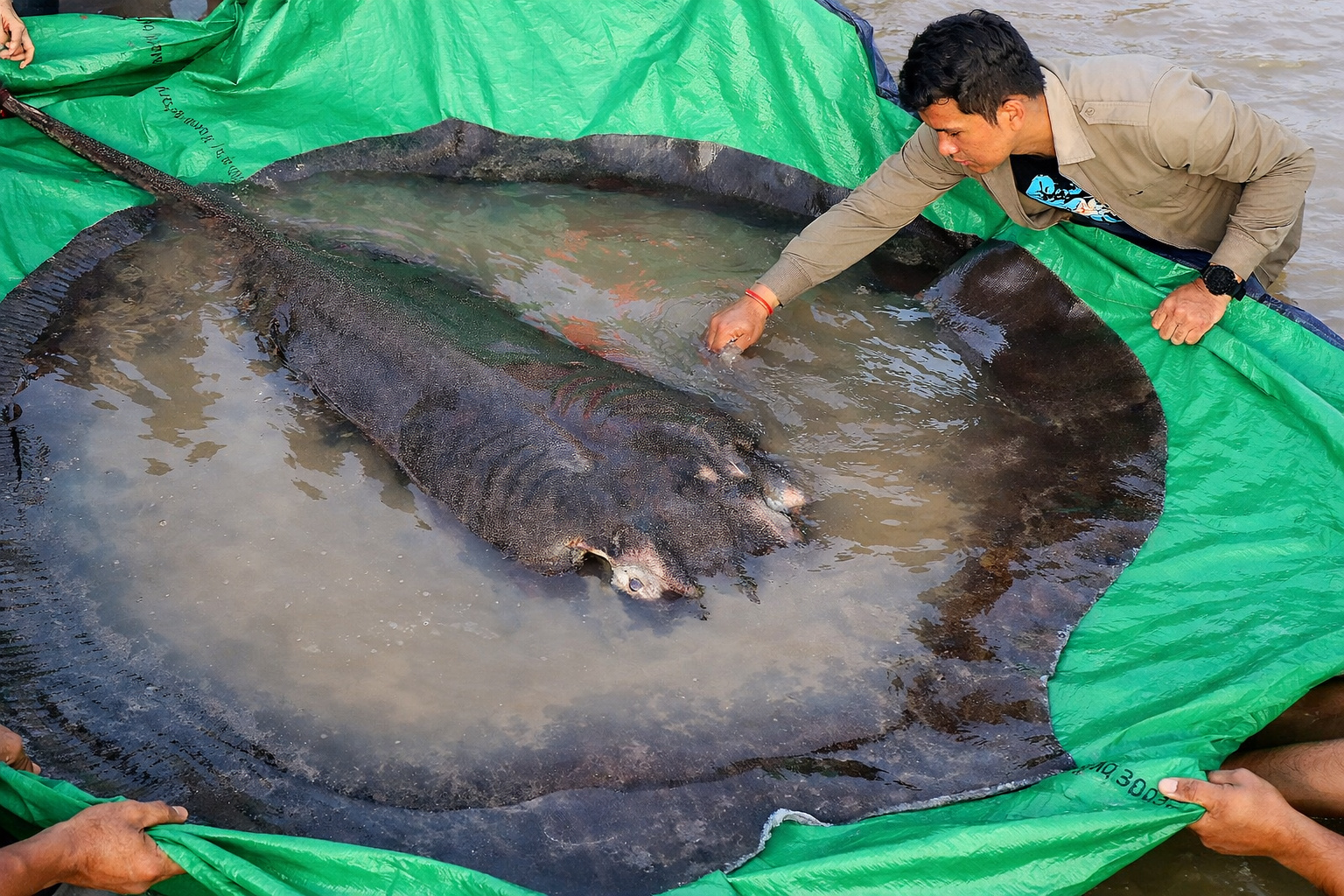
Scientific Record Made in Cambodia Reveals Details of the Largest Freshwater Fish Ever Documented and Highlights the Importance of Conservation in the Mekong River
An impressive discovery recorded in Southeast Asia has once again put large freshwater fish in the spotlight of the scientific community.
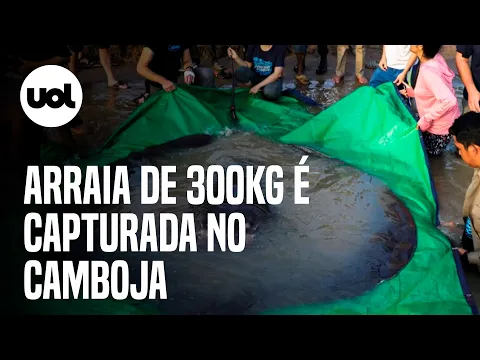
Researchers documented a giant Mekong ray (Urogymnus polylepis) weighing 300 kg and measuring 3.98 meters in length, establishing the new record for the largest river fish ever recorded.
The confirmation was made by Guinness World Records, which officially certified the animal’s weight.
With this, the record surpassed the previous title holder, a giant Mekong catfish weighing 293 kg caught in Thailand in 2005.
In addition to marking a historical achievement for ichthyology, the record drew attention to the conservation of giant freshwater species, many of which are threatened with extinction.
-
These living root bridges and ladders are over 700 years old and help indigenous people survive in one of the rainiest regions in the world.

-
From sertanejo star to international investor: Ana Castela invests millions in a mansion in the USA, creates a themed accommodation in Orlando, and shows that the “boiadeira” also wants to grow away from the stage.

-
The 10 most stunning motorhomes in the world: a $3 million trailer with a rooftop nightclub and garage for a Ferrari, “palaces on wheels” with Italian marble, private cinema, and five-star hotel luxury for billionaires.

-
Trump wanted to spend $400 million on the White House, but the courts prohibited the million-dollar construction.


Scientific Expedition Revealed the Largest River Fish Ever Recorded
The capture occurred during an expedition of the scientific project Wonders of the Mekong, coordinated by biologist Zeb Hogan.
At the time, local fishermen alerted the team about the presence of an unusual animal captured in the river.
As soon as the scientists arrived at the site, the animal was carefully measured and weighed.
Subsequently, the researchers installed a acoustic tag for scientific monitoring.
After data collection, the ray was released back into the Mekong River, a procedure considered essential to ensure the species’ preservation.
The incident was also highlighted by the scientific publication Discover Wildlife, which emphasized the value of the record for understanding the river’s biodiversity.

Species Monitoring Uses Acoustic Tracking Technology
After the animal’s record, researchers installed a tracking chip capable of monitoring its movements for about a year.
To enable this monitoring, a network of 36 acoustic receivers was used, distributed along the Mekong and 3S rivers.
These devices capture the signals emitted by the tag installed on the fish.
This way, scientists can track the ray’s movements in its natural environment.
The system allows for data collection on behavior, displacement, and habitat of the species, which is considered rare and little studied.
Thus, monitoring can help researchers better understand the habits of this animal that lives in the muddy bottom of the Mekong River.
Impressive Characteristics of the Giant Mekong Ray
The Urogymnus polylepis has unique characteristics that explain its adaptation to deep river environments.
Among the main aspects of this species are:
• Maximum Recorded Weight: 300 kg
• Total Length: up to 3.98 meters
• Habitat: muddy bottom of large Asian rivers
• Respiration: spiracles located behind the eyes
• Conservation Status: endangered species
Unlike many fish, the ray uses spiracles to breathe, an adaptation that allows it to remain partially buried in the mud.
Additionally, the animal has a long, thin tail capable of causing injuries, although it is not considered aggressive.
Comparison with the Arapaima, Giant of the Amazon Rivers
While the ray holds records in Southeast Asia, the Arapaima (Arapaima gigas) represents one of the largest freshwater fish in South America.
This fish is considered the largest scaleless freshwater fish on the planet.
Historical records indicate specimens that have reached up to 220 kg and 2.9 meters in length, such as the one recorded in 2021 in the Japurá River, in the Amazon.
However, in nature, adult individuals usually measure between 1.8 and 2.5 meters, weighing between 90 and 160 kg.
The main differences between the two giants include:
• Habitat: the ray lives on the bottom of the Mekong; the Arapaima inhabits Amazonian floodplains
• Respiration: the ray uses spiracles; the Arapaima breathes air with an adapted swim bladder
• Maximum Weight: 300 kg for the ray; about 220 kg for the Arapaima
• Conservation: both face threats, although the Arapaima has management programs in Brazil
The Scientific Importance of the Discovery in the Mekong River
The discovery of the giant ray represents more than a world record.
It also brings attention to the environmental challenges faced by the Mekong River.
Currently, the ecosystem is suffering from impacts caused by dams, pollution, and pressure on natural habitats.
As a consequence, several species of giant fish are threatened.
One example cited by researchers is the Chinese paddlefish, declared extinct in 2020.
Thus, monitoring the ray may provide essential information about the survival of these species in increasingly pressured environments.
The Wonders of the Mekong project hopes that the record will stimulate new conservation efforts.
How many giants of the planet’s rivers are still hidden in the deep waters?








-

-

-

-

-

-

14 pessoas reagiram a isso.