





 Portuguese
  English
  Spanish
  3 min of reading
  0 comments


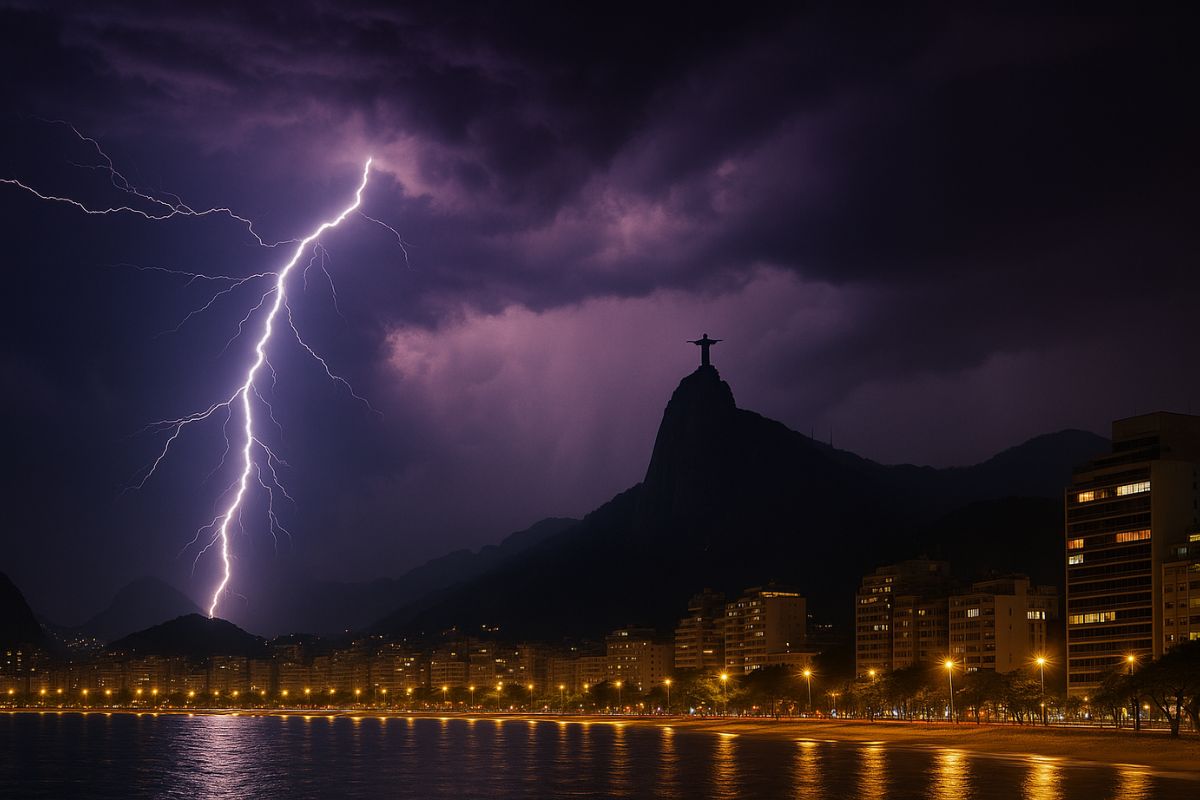
Lightning of 829 Km in the U.S. Sets World Record and Surpasses Phenomenon That Affected Brazil and Argentina
A study published this Thursday (31) confirmed that the longest lightning bolt recorded in history traveled an impressive 829 kilometers, almost the distance between Curitiba and Rio de Janeiro. The phenomenon was detected in 2017 during a storm in the Central-West region of the United States, but its length was only officially recognized now through analyses made with satellite images.
The lightning was recorded by the satellite GOES-16, from NOAA (National Oceanic and Atmospheric Administration), and lasted 7.39 seconds. The data was validated by the World Meteorological Organization and published in the Bulletin of the American Meteorological Society. Prior to this, the record was held by a lightning bolt measuring 709 km that crossed parts of Brazil and Argentina in 2018 — the latter still holds the title for the longest duration, at 17 seconds.
What Are Mega Lightning Strikes and Why Do They Impress
Unlike common lightning strikes, which last milliseconds and have short paths between clouds and the ground, the so-called mega-flashes (or mega lightning) can last several seconds and extend for hundreds of kilometers. According to researchers, these phenomena are rare: they occur in only 1 out of every 1,000 storms.
-
How the Egyptians erected giant structures like pyramids, temples, and obelisks without modern technology, cranes, or engines still amazes the world and reveals the power of engineering based on ramps, levers, ropes, and colossal organization.

-
The induction stove you know may be numbered: a new invisible technology hides the stove under the stone countertop, heats only the pot, and promises to cook up to 50% faster while using less energy.

-
Garlic with pure honey undergoes a natural fermentation that transforms the two ingredients into a versatile condiment for marinades, sauces, and roasted vegetables, and it can also be used as a natural treatment in your garden.

-
A woman in the United States hired six immigrants for a $10,000 job on her house, and when the work was almost done, she allegedly called ICE to avoid paying and to have the workers deported.

In the case of the record lightning bolt, it originated from a large convective storm, with powerful updrafts and large amounts of ice and water in the clouds. This combination creates extremely charged horizontal layers that, when collapsing, generate gigantic discharges.
Where These Extreme Lightning Strikes Typically Occur
The most frequent locations for mega lightning strikes are the Central-West region of the United States and the southeast of South America. It was precisely in this last region that the previous record in length occurred in 2018, crossing Paraguay, southern Brazil, and northern Argentina.
According to Michael Peterson, the researcher who led the analysis, mega-flashes “are like electrically charged sheets of paper that stretch for hundreds of kilometers, but have minimal thickness.” The phenomenon occurs in the troposphere, up to an altitude of 11 km, where particles can no longer rise — creating the ideal environment for a large-scale flash.
How the Phenomenon Was Measured with Unprecedented Accuracy
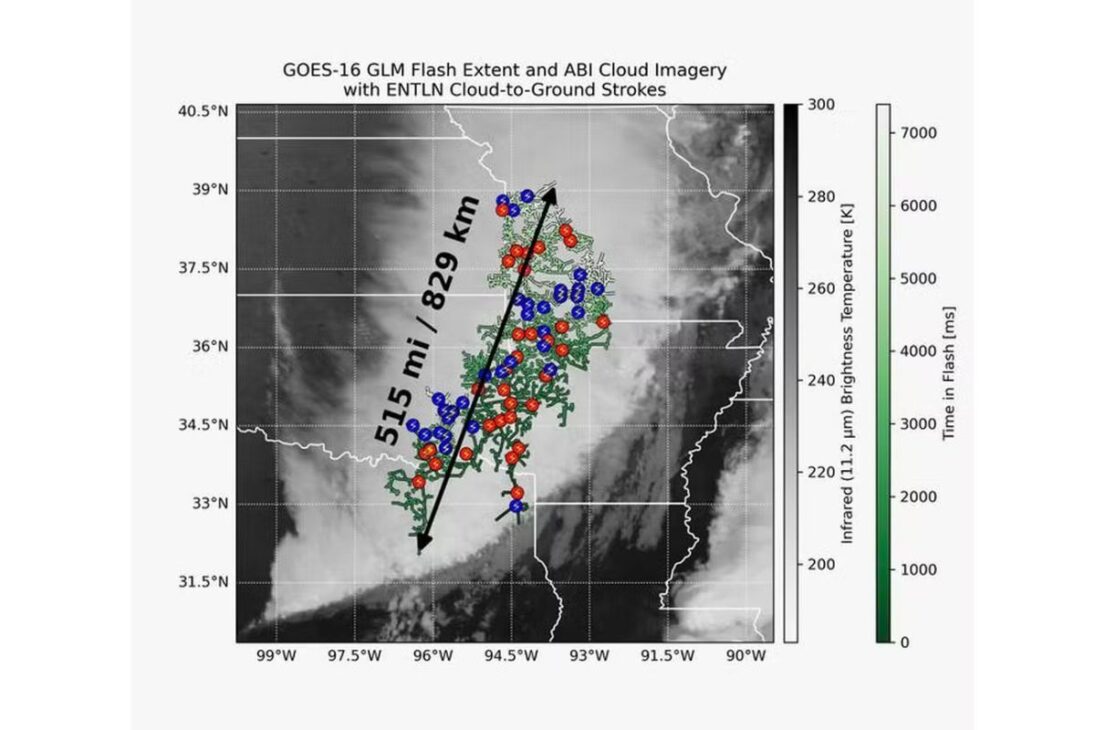
Until recently, measurements of this type of lightning were inaccurate, based on ground networks of antennas that detected radio signals emitted by the discharges. With the advancement of geostationary satellites like GOES-16, it has become possible to map, in milliseconds, the start, path, and exact duration of the lightning with continental range.
The GOES-16 mapped 116 discharge peaks along the trajectory of the record lightning bolt, capturing the phenomenon with unprecedented detail. This accuracy is essential for feeding databases and climate models that help predict and mitigate risks of wildfires, power outages, and fatal accidents.
Why Studying Mega Lightning Strikes Is So Important
According to Randy Cerveny, a climatologist involved in the study, “It is still likely that there are even larger lightning bolts” and that future measurements may break the current record. Analyzing these phenomena helps better understand how extreme storms form, contributing to the development of more efficient alerts and protection strategies for vulnerable urban and rural areas.
Additionally, mega lightning strikes have enough energy potential to ignite entire forests, affect electrical systems, and even interfere with commercial flights. Monitoring this type of discharge is, therefore, a matter of public and environmental safety.
Have you ever witnessed a large lightning strike? Do you think extreme events like this are becoming more frequent? Share your experience in the comments — we want to hear from those who have seen the sky turn to light.







-

-

3 pessoas reagiram a isso.