





 Portuguese
  English
  Spanish
  6 min of reading
  0 comments


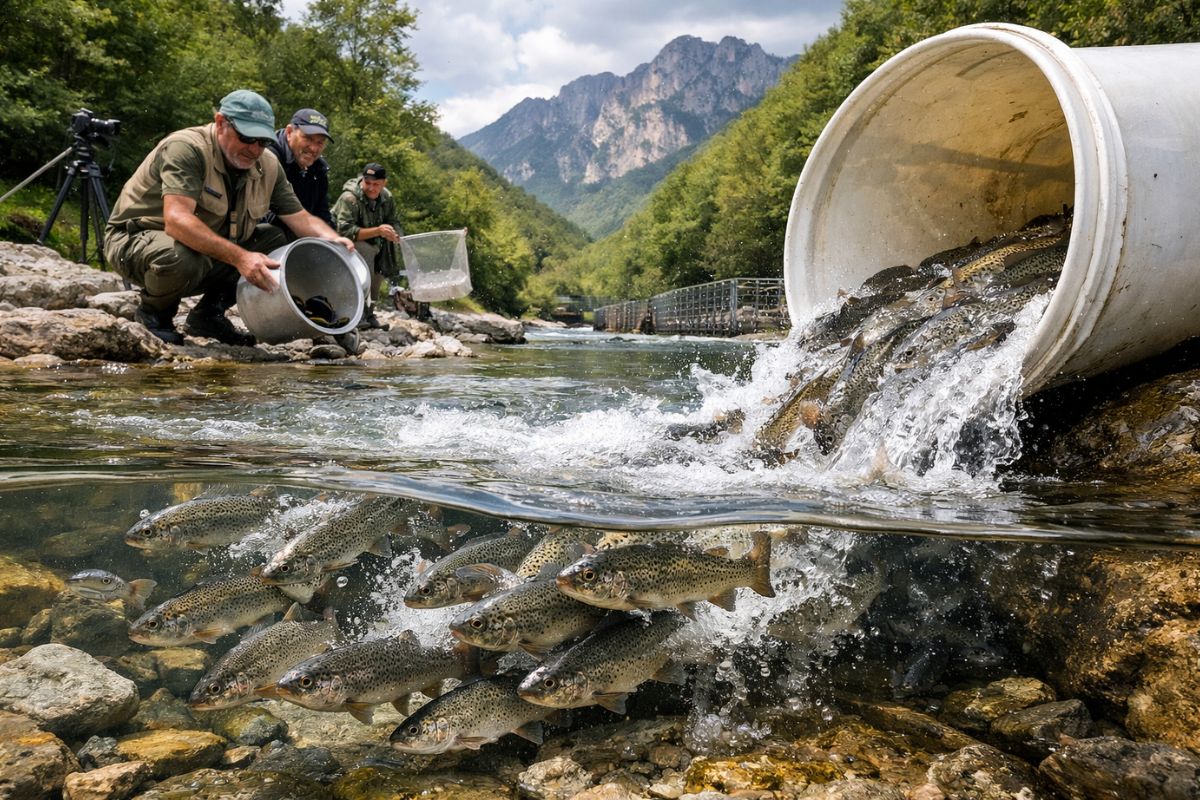
Mediterranean Trouts Return to Romito: Over 2,000 Juveniles Are Released in the Central Apennines to Restore the Liri, Block Invasives, and Accelerate European Renaturalization with Genetic Monitoring, Scientific Support.
In Italy, the release of Mediterranean trouts in the Romito stream, within the Zompo lo Schioppo Regional Reserve, aims to restore a tributary of the Liri. The hydroelectric dam isolates Atlantic invasives, while genetic tests, microchips, and new releases already scheduled expand recovery and strengthen the food chain of the rivers.
The trouts have once again been treated as a central piece of the recovery of a watercourse in the Central Apennines, Italy, following the release of about 2,000 juveniles of Mediterranean trout (Salmo ghigii) in the Romito stream, a tributary of the Liri river basin.
This initiative takes place within the Zompo lo Schioppo Regional Reserve, an area of 1,025 hectares, and was carried out with support from the Rewilding Apennines team and funding from Rewilding Europe, aiming for a direct goal: restore native trout populations and enhance the ecological health of the stream.
-
Something is happening around the Earth: Inside the huge explosion of fireballs in 2026

-
A hot air bubble coming from Argentina expands over Brazil, causing thermometers to exceed 38 degrees with a thermal sensation of 40 degrees in late March, affecting 6 states at once.

-
The radish leaf that almost everyone throws away has more polyphenols, flavonoids, and fiber than the consumed root, and a 2025 study showed that the leaf contains compounds that protect the intestine, combat inflammation, and may inhibit the growth of cancer cells.

-
A planet that seemed to defy the laws of physics has intrigued scientists for decades, until the James Webb revealed what is really affecting Saturn’s rotation.


What Happened in the Romito Stream and Why Trouts Became a Priority

The Romito, located in the Liri basin, recently received the release of approximately 2,000 juvenile Mediterranean trouts, a milestone for a native species whose presence is seen as an indicator of environmental quality.
The logic is simple and robust: when native trouts establish themselves, the river tends to be more alive, with better balance and greater vitality.
By boosting the presence of Mediterranean trouts, the project aims to benefit not only the fish but also a broad range of species associated with mountain streams, reinforcing ecological interactions that depend on cold water, adequate flow, and preserved habitat.
Why the Zompo lo Schioppo Reserve Became the Decisive Point of Release

The release of trouts took place within the Zompo lo Schioppo Regional Reserve, in the Central Apennines, an area known for the Zompo lo Schioppo waterfall, which gives its name to the reserve.
With 1,025 hectares, the territory creates a formal protection and environmental management scenario capable of sustaining ongoing actions of monitoring, removal of unwanted species, and tracking results.
Additionally, the Romito has been treated as an open-air laboratory to restore a living river, with decisions based on risks of genetic crossbreeding, river connectivity, and the capacity to keep native trouts isolated from invasive populations.
The Threat That Made Mediterranean Trouts Disappear from Italian Rivers
The decline of Mediterranean trouts is attributed to two factors considered decisive: habitat loss and the mass introduction of Atlantic trout, a non-native species, in almost all Italian rivers.
This process reduces the resilience of the native trout and creates risks of crossbreeding and competition.
That is precisely why the initiative in Romito places such emphasis on “genetically pure,” because the planned restoration depends on protecting local lineages and preventing Atlantic trouts from interfering with the newly released fish.
The Strategic Choice of Romito and the Unexpected Role of the Dam
The chosen section of the Romito is separated from the main course by a dam that generates hydroelectric power.
The structural impact is acknowledged, as dams harm the connectivity and natural functioning of river systems.
However, in this case, the same barrier creates a decisive operational advantage: the Atlantic trouts downstream cannot migrate upstream to reproduce with the newly released Mediterranean trouts.
At the same time, the setup allows for the Mediterranean trout to migrate downstream during flood periods.
Within this logic, the Liri gains even more relevance: it is presented as the only river in the Abruzzo region whose basin still contains populations of genetically pure Mediterranean trouts, elevating the strategic value of the area.
The Trout Restoration Plan in Multiple Steps, with Goals Until 2027
The restoration of trouts in Romito has been structured as a chain process, reflecting the phases of the fish’s life cycle and requiring gradual and verifiable interventions.
The first operation focused on selecting the best Mediterranean trouts for breeding.
To do this, tissue samples were collected from 80 fish captured in Romito, downstream of the dam, for genetic verification.
Subsequently, these fish received implanted microchips, creating individual traceability for management and monitoring.
Then, suitable adult trouts were selected, generating three batches of fertilized eggs, which evolved into fry in a local hatchery.
The first batch of fry has already been released into Romito, initiating the repopulation phase.
The proposed calendar includes more clear steps:
a second release of 500 trouts is scheduled for April this year and a third release is planned for 2026, consolidating the strategy for population reinforcement over time.
In summer, the operation reaches a critical point: all non-Mediterranean trouts upstream of the dam in Romito will be captured and removed, reducing the chance of crossbreeding in the protected stretch.
And in 2027, the team plans a genetic sampling in the same stretch, expecting to observe an increase in the proportion of Mediterranean trouts and a significant decrease in Atlantic trouts.
What Changes in the Ecosystem When Native Trouts Return to Dominate
The release seeks more than just replenishing a number of fish. The goal is to reinforce the food chain and “give new life to the ecosystem,” in the words of Angela Tavone, Communication Manager of Rewilding Apennines.
The ecological logic is that native trouts structure predator-prey relationships, influence the dynamics of aquatic invertebrates, connect energy from the stream to adjacent areas, and signal habitat quality.
By halting the advance of invasive species and recovering locally adapted trouts, the project repositions the Romito as a functional watercourse, within a broader context of healthy and wilder rivers.
Social Support Grew and Turned into an Event with Fishermen, Artists, and Locals
The release of trouts took place after a well-attended event held in February in the ecological restoration area.
The meeting brought together artists, environmentalists, fishermen, and local residents to celebrate species that shape the rivers of the Central Apennines.
Organized by the Rewilding Apennines team and Bruno D’Amicis, wildlife photographer and project council member, the event “About Trouts and Men” put native trouts at the center of public conversation.
The event took place at the Cantelmo Castle in Pettorano sul Gizio and featured lectures by trout specialist Stefano Esposito, who presented a millennium overview of human history and trouts, and Canadian ichthyologist and scientific illustrator Paul Vecsei, who showcased detailed drawings of fish species in Italian rivers.
The result, according to the context of the meeting, was to demonstrate that the health of rivers and the presence of native trouts matter directly to those living in the region.
Who Leads the Operation and Why the Initiative Became an Example of Partnership
The work is described as a collaborative effort that reinforces the role of natural reserves to connect private organizations, academics, and scientists.
The scientific leadership is attributed to Professor Amilcare D’Orsi, Scientific Director of the Zompo lo Schioppo Nature Reserve, and Professor Marco Seminara from the University of Sapienza in Rome.
In the most recent release, support involved the Department of Environmental Biology at the University of Sapienza in Rome, the Zootechnical Institute of Teramo, and the Abruzzo Regional Authority, forming a technical network that supports monitoring trouts, genetic verification stages, and field execution.
Roberto D’Amico, mayor of Morino, a village at the entrance of the reserve and responsible for its management, describes the Zompo lo Schioppo Reserve as a central point for fish conservation activities in the Liri Valley and places trout restoration as a pillar to enhance the natural heritage of the river and surrounding landscapes.
Why the Release of Trouts in the Liri Became a Symbol of the European Race for Natural Rivers
The restoration of Mediterranean trout in a tributary of the Liri is presented as an example of the growing movement of river renaturalization across Europe.
The movement’s logic involves actions such as dam removal, reconnection of rivers with floodplains, and reintroduction of key species, always aiming to revitalize watercourses and the fauna they support.
Within this framework, trouts serve as an indicator species and ecological engineering species because their presence and sustained reproduction indicate that the system has returned to offering conditions compatible with clean water, natural dynamics, and connected habitats.
As a consequence, the project associates restored rivers with benefits for people, including clean water, flood protection, and greater resilience against climate change.
Do you believe that releasing native trouts in rivers isolated by dams could be the most effective strategy to defeat invasive species without destroying the ecosystem?







-

-

-

-

-

-

57 pessoas reagiram a isso.