






 Portuguese
  Spanish


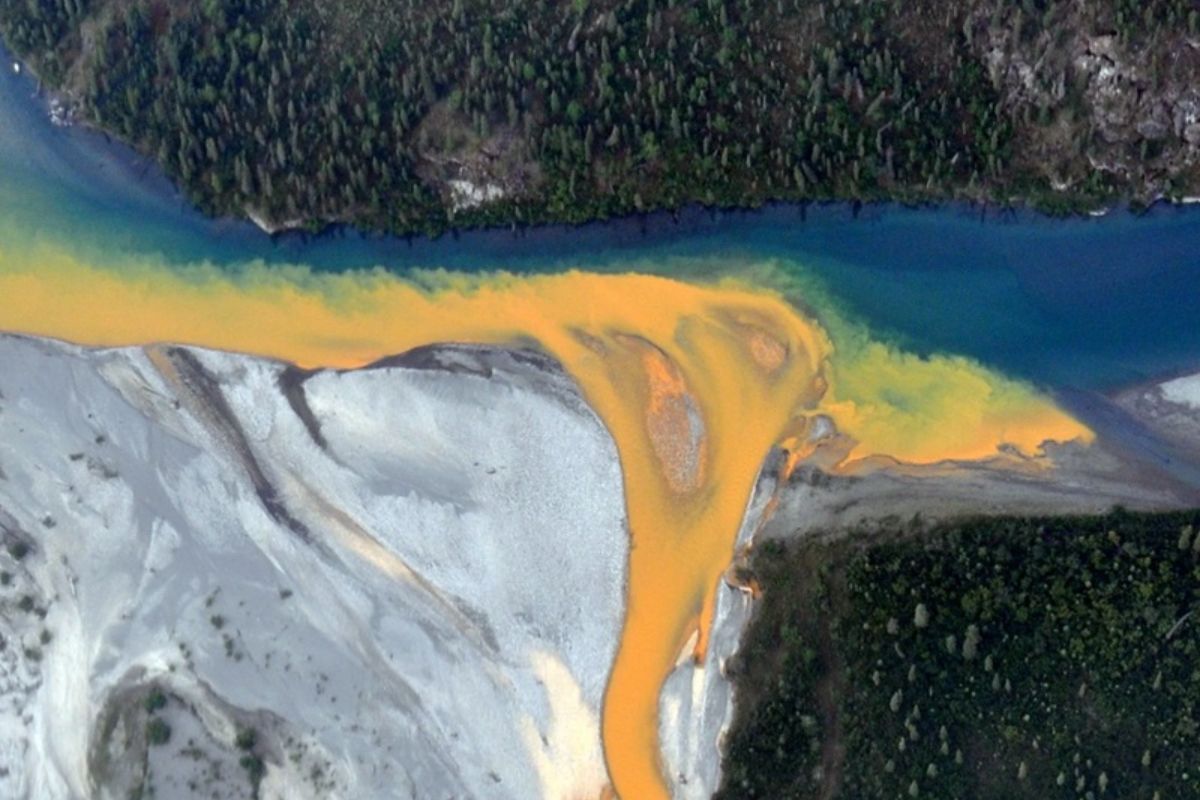


In Northern Alaska, More Than 70 Rivers Began to Show an Orange Hue Without Upstream Factories, and Academic Teams and the National Park Linked the Phenomenon to Permafrost Thawing, Which Releases Iron, Sulfides, and Metals, Acidifying Water and Unsettling Ecosystems Affecting Fish, Aquatic Insects, and Communities.
In Alaska, the idea of blue, clear glacial water has turned into a contrast: in remote stretches of the north, waterways began to flow with an intense orange coloration, without visible signs of industrial discharge and without obvious points of contamination along the banks. What seemed impossible in one of the planet’s most untouched environments started repeating in dozens of rivers.
The investigation gained momentum after observations made in 2018, when researchers returned to the area to continue ecological surveys and found drastic changes in the water and aquatic life. The pattern, previously treated as something local, appeared in over 70 rivers over the last decade, pointing to a broad process connected to what happens beneath the surface.
Orange Rivers in a Landscape Without an Obvious “Source”

In remote scenarios, the first suspicion tends to be a singular event: a landslide, an isolated discharge, a temporary alteration.
-
The large jar blender has a rival: Oster Ultra Power bets on 1,000 W, six stainless steel blades, and two portable cups with leak-proof lids.

-
Tesla injected an additional $250 million into the German factory, doubled the battery cell target, and opened its own production line for startups.

-
No more TV stuck on the wall: Samsung The Freestyle+, the new projector with over 400 lumens projects on walls, floors, and ceilings, bringing cinema to any corner of the house.
-
A Japanese governor single-handedly stalled the construction of the world’s fastest train for nine years, and only now has he agreed to allow a tunnel excavated at a depth of 1,400 meters.



However, in Northern Alaska, the orange coloration was not restricted to a single valley or a single summer. It appeared in different basins, repeated over the years, and in some locations, coincided with signs of a steep decline in aquatic biodiversity.
The detail that changed the course of the investigation was the absence of a typical “culprit.”
There were no factories, active mines, or visible channels discharging waste upstream. This shifted the question from “who discharged something into the river” to “what the territory itself is releasing when it thaws.” And, in this type of environment, what is stored in the soil can be as decisive as what is on the surface.
Permafrost Thaws and Subterranean Chemistry Comes Into Play
Much of Northern Alaska rests on permafrost, the soil that remains frozen for years on end and, in many places, for thousands of years.
When this geological “safe” begins to lose stability, water starts to circulate through layers that were previously isolated from the hydrological system. This new contact alters the composition of what reaches the streams, especially at the headwaters.
Initial research associated the phenomenon with permafrost thawing, releasing sulfide-rich minerals, iron, and other metals.
A component mentioned in this process is pyrite, which, when exposed to water and oxygen, undergoes chemical weathering, releasing substances that change water quality.
The orange color, in this context, is not “paint”: it is a sign of oxidized iron in particles.
Lower pH, Higher Turbidity, and Elevated Metals: What Does This Indicate in Practice
When the orange coloration appears, it often comes with a set of measurable changes.
A critical point is the drop in pH, meaning the water becomes more acidic than in comparable clear streams.
This acidification is relevant because it alters nutrient availability, the toxicity of some elements, and the survival capacity of sensitive organisms, especially in the early life stages.
Another recurring sign is increased turbidity, the “opacity” of water caused by suspended particles.
In this case, turbidity tends to rise due to iron and mineral particles, and analyses indicated elevated metals, including iron, aluminum, magnesium, zinc, nickel, and other trace elements.
Together, these factors turn the water into a different chemical environment, even if the river continues flowing in the same bed.
The Cascade Effect: From Aquatic Micro-Life to Fish and Predators
In cold rivers of Northern Alaska, life is highly specialized. Macroinvertebrates, microscopic algae, and microorganisms that live on submerged surfaces sustain the base of the food chain.
When the water becomes more acidic and loaded with metals and particles, this base can shrink rapidly, and the impact rises step by step: less food, less shelter, less effective oxygenation in microhabitats.
There is evidence of fish species loss in affected areas and severe declines in macroinvertebrates. Some fish may migrate to cleaner waters, but this doesn’t resolve the issue for the system as a whole: without the micro-life, fish fail to find the conditions to remain, grow, and reproduce.
What starts as water chemistry ends as ecological rearrangement, reflecting on animals that depend on these fish, such as bears and raptors.
Thermokarst and “Points” of Acidic Water: When the Soil Collapses
Permafrost thawing not only changes what goes into the river but also the shape of the landscape. In areas where soil ice melts, irregular and waterlogged terrain may emerge, associated with land collapse, known as thermokarst.
In these locations, zones form that function as sources of more acidic water, capable of affecting tundra and boreal vegetation even before this water reaches the streams.
These “points” of drainage do not behave like a single pipe that you can shut off. They can be spread over large areas, and water circulates through variable underground paths.
This explains why the phenomenon can appear in many different rivers without a single identifiable pollution source, and why the response tends to be more complex than classical solutions applied to localized problems.
When Change Descends the Basin: Drinking Water and Subsistence Fishing


Even when the change starts at the headwaters, it doesn’t stay confined there.
As the river flows through the basin, iron and metals can be transported to lower stretches, affecting water intake and areas where communities depend on the river for consumption and subsistence fishing.
In remote regions, distance becomes a risk multiplier: monitoring is difficult, intervening is costly, and the response window can be short when the water changes behavior.
The scenario also creates a perception challenge. The orange coloration is a strong visual alert, but not every problem is “painted” on the surface, and not all clear water is chemically stable. The real threat lies in the sum: acidity, particles, metals, and loss of aquatic life, with possible impacts on environmental health and cultural practices linked to river use.
What Can Be Done, and Why the Solution Is Not Simple in the Arctic
There are known techniques to treat acidic water and remove metals, such as adding lime to neutralize acidity, settling ponds to reduce particles, and reactive barriers to filter contaminants.
In contexts like acid mine drainage, these approaches can work because there is a more defined source and a viable location to install infrastructure.
In Northern Alaska, scale and dispersion change everything.
Acidity and iron would not come from a controllable point, but from extensive areas of thawing permafrost, making local remediation limited and, in some places, impractical.
Nevertheless, there is an immediate path that doesn’t rely on massive works: mapping where it occurs, comparing water chemistry over time, and anticipating where it may happen next, better protecting aquatic life and supply.
Alaska has become an open-air laboratory of how subterranean changes can dramatically surface without smokestacks, without pipes, and without an easy-to-point-out “villain.”
The orange water is a visible sign of a chemical transformation linked to permafrost thawing, with potential consequences for fish, food chains, landscapes, and those who rely on the water and what it supports.
I want to hear from you in a direct and personal way: if a river near you changed color from one year to the next, what would be the first thing you would suspect and why?
And, thinking about Alaska, do you think the priority should be to invest more in constant monitoring or try local interventions even in remote areas? What, in your view, would be a “fair” response for those who depend on these rivers to live?




Bull shit story, no creeks or rivers named to pin data. Everyone’s afraid of permafrost thaw, article posted on 2/26 about observing iron rich and “metals” into the northern rivers. It February there are no river to observe in Alaska -40F is normal, the ice on lakes is 4-6ft thick rivers are virtually sealed.
Im horrified.
They need to monitor and try to correct this issue before its to late to save the water ways and all that depends on it, human, **** and vegetation life. I see Alaskan fish sold in stores every where and I WONT be purchasing any until this is addressed or resolved. God help the researchers.
The problem is an overall warming climate, which is more extreme in the Arctic. There are no local “corrections” to be made. The only fix is to reduce global CO2. Something our president thinks is all a hoax.
The rivers where this is being observed are far from the more southern river systems sustaining Alaska’s wild salmon, which are typically harvested at sea. There is no reason to stop buying wild Alaska salmon. Your purchase of wild Alaskan salmon helps support the groups working to keep Alaska’s salmon healthy and abundant.
You CAN oppose the Pebble mine, which would have massive impact on the wild salmon of Bristol Bay.