





 Portuguese
  English
  Spanish
  5 min of reading
  2 comments


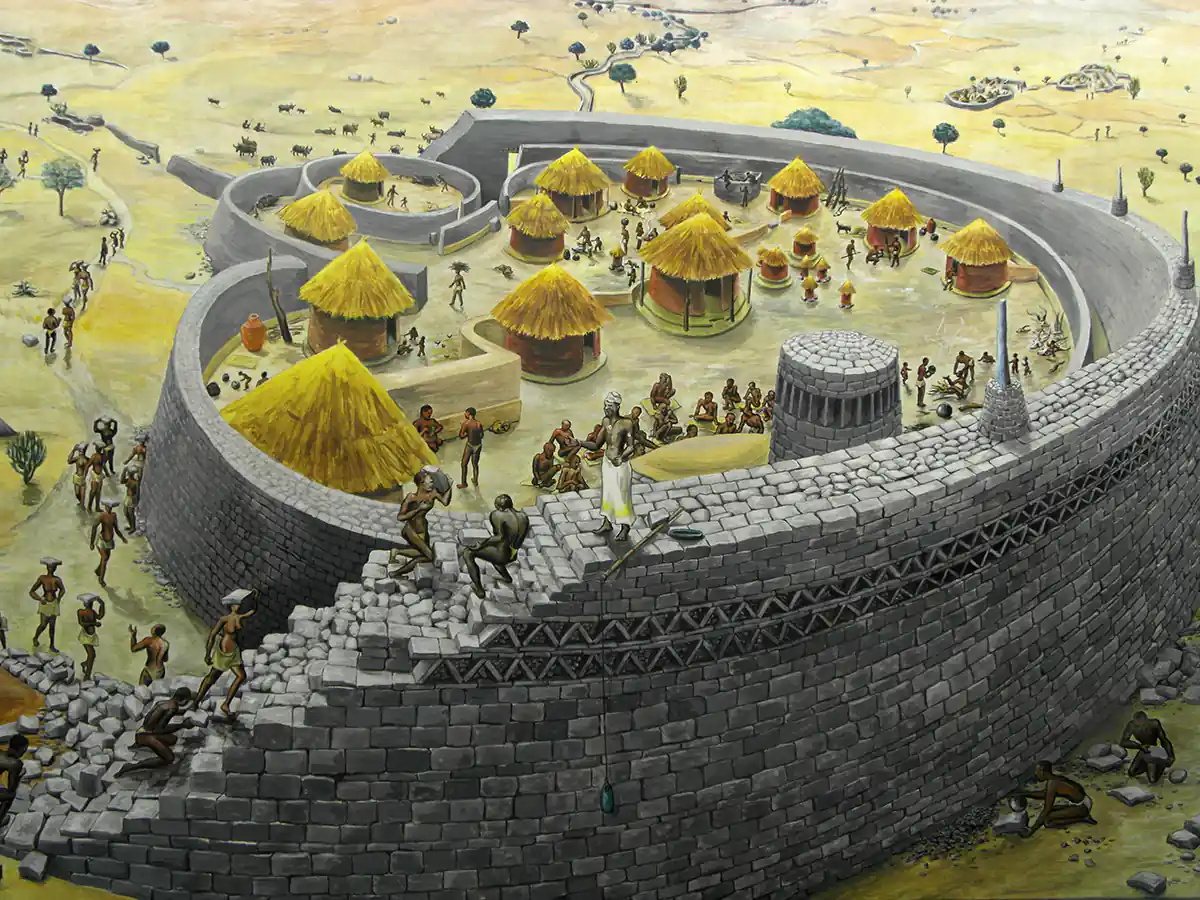


Great Zimbabwe Features Stone Walls with Blocks Weighing Up to 15 Tons Fitted Without Mortar and Remains the Largest Urban Complex of Ancient Africa.
In present-day Zimbabwe, in southern Africa, there is an archaeological complex that dismantles many preconceived ideas about ancient engineering on the continent. The Great Zimbabwe is not just a set of ruins. It was, between the 11th and 15th centuries, the largest city built entirely of stone in sub-Saharan Africa, housing a sophisticated urban population connected to international trade routes and protected by some of the most impressive walls ever built without mortar in the world.
What intrigues people to this day is the construction method: thousands of granite blocks, some estimated to weigh up to 15 tons, carefully cut and fitted dry, only by the weight and perfect geometry of the pieces.
Stone on Stone, Without Cement, Without Steel, Without Concrete
Unlike anything seen in modern construction, the structures of Great Zimbabwe were erected without any type of mortar or binder. No lime, clay, plaster, or any element that “glues” the stones.
-
Neither the Pyramids nor the Great Wall of China, this gigantic construction in Spain is the human mark on planet Earth that intrigues the most when seen in images from space.
-
Surrounded by cliffs, mist, and chilling stories, the ancient Hotel del Salto has been reborn as a museum while still unable to shake off its reputation as a haunted place.

-
This star-shaped fortified construction, hidden near the border of Spain, may be the largest fortress on the planet.

-
Congonhas receives the monorail promised for the 2014 World Cup after more than a decade of delays and becomes the first airport in Brazil with integrated subway.



Stability comes exclusively from three factors:
- precise geometry of the blocks,
- micrometric fitting between the pieces,
- extremely efficient distribution of weight.
This method requires a very high level of technical mastery. A minimal error in cutting a stone could compromise the entire wall. Even so, the walls have withstood more than 600 years of abandonment, rain, thermal variations, and light seismic activity.
Walls Up to 10 Meters High and Hundreds of Meters Long
The Great Zimbabwe complex is divided into three main areas:
- the Hilltop Acropolis, on the rocky top,
- the Great Enclosure, the most monumental part,
- and the Valley Ruins, where the residential areas were located.
In the Great Enclosure, the walls reach a height of 10 meters and exceed 250 meters in elliptical length, all made of dry stone. The thickness in some sections easily exceeds 5 meters at the base, ensuring stability even without any internal reinforcement.
In terms of the volume of material moved, it is one of the largest stone masonry works in pre-modern Africa.
How Were These Giant Stones Moved?
There is no absolute consensus on the transportation method, but archaeologists are working with several hypotheses:
- quarrying in nearby pits,
- using wooden rollers,
- manual levers,
- large-scale human labor,
- inclined ramps for vertical positioning.
All this without large-scale draft animals and without any sophisticated lifting technology. The simple fact of lifting blocks weighing several tons to dozens of meters high using only human strength already places Great Zimbabwe among the greatest feats of manual engineering in the world.
A City Connected to Medieval Global Trade
During its peak, between the 13th and 15th centuries, Great Zimbabwe was not an isolated city. Archaeological excavations revealed:
- Chinese porcelain,
- glass beads from the Middle East,
- artifacts from India,
- metals worked with a high degree of sophistication.

This proves that the city was part of a vast network of international trade, connected to the Indian Ocean coast by land routes crossing the African continent. The gold extracted from the region was one of the main exported products.
In other words, it was a wealthy, organized urban center, deeply integrated into the medieval global economy.
Why Does No One “Exactly Know” How the City Was Built?
The difficulty in fully explaining the work arises from three main factors:
- Absence of local written records detailing construction methods.
- Partial destruction and natural degradation over the centuries.
- Colonial interference in the 19th century, which damaged sections and distorted historical interpretations.
For decades, there were attempts to attribute the construction to foreign peoples, such as Egyptians, Phoenicians, or even ancient Europeans. Today, however, there is scientific consensus: the city was built by the ancestors of the Shona people, an advanced African civilization in mining, metallurgy, and urbanism.
The mystery that remains is not “who built it,” but how a society without machines achieved such precision and scale using only manual tools.
A Urban Colossus Erected to Symbolize Power
Great Zimbabwe was not only functional. It was a monumental symbol of political, economic, and religious authority. The walls served more than a defensive function. They:
- defined sacred areas,
- separated social classes,
- organized urban space,
- visually reinforced the power of the ruling elite.
The very word “Zimbabwe” derives from “Dzimba-dza-mabwe,” which literally means “houses of stone”.
Abandonment, Silence, and Historical Erasure
By the 15th century, the city began to be gradually abandoned, possibly due to:
- depletion of natural resources,
- changes in trade routes,
- environmental pressures,
- political disputes.
Centuries later, during European colonization, the site suffered looting, dismantling, and biased interpretations that attempted to minimize its African origin. This historical erasure meant that, for a long time, Great Zimbabwe was little known outside the continent.
Today, the site is a UNESCO World Heritage Site, but it is still far less known than other ancient stone cities, such as Machu Picchu or Petra.
One of the Greatest Proves of Ancient African Engineering
When analyzing the body of work, the numbers and techniques speak for themselves:
- thousands of tons of stone moved,
- giant blocks fitted without mortar,
- walls up to 10 meters high,
- hundreds of meters of continuous length,
- geometric precision maintained for centuries.
All of this was done without concrete, without steel, without machines, without electricity. Only with empirical engineering, practical mathematics, and extremely advanced social organization.
A Monument That Still Challenges Modern Engineering
Even today, any engineer who observes Great Zimbabwe with a technical eye perceives that:
- the weight distribution system is exemplary,
- the natural drainage of the walls prevents collapses due to infiltration,
- the fitting of the stones reduces vibration and displacement over time,
- the durability surpasses that of many poorly designed modern structures.
That is why the city remains standing, even after centuries of abandonment, torrential rains, and severe thermal variations.
A Work That Changes the Way We View the History of Engineering
Great Zimbabwe leaves a very clear message: advanced engineering was not exclusive to Europe, Asia, or the Middle East. Africa also produced megastructures, monumental cities, and sophisticated technical solutions long before industrialization.
Blocks weighing up to 15 tons, fitted without mortar, forming the largest stone city of ancient Africa, are not just an archaeological curiosity. They are concrete proof that the human capacity to build on a large scale has always been distributed across all civilizations.







E a mansão da xuxa? Cadê a reportagem?
Pedras de 15 toneladas não precisam de argamassa!!!!!!!
Kkkkkkkkkkkkkkkkkkkkkkkkkkk