





 Portuguese
  English
  Spanish
  4 min of reading
  9 comments





Geological Phenomenon Underway in Eastern Africa Reveals Slow, Yet Continuous, Movement of Tectonic Plates, with Records of Rapid Fissures, Volcanic Activity, and Scientific Projections on the Possible Formation of a New Ocean Over Millions of Years.
Africa is undergoing a geological process of tectonic separation that, over millions of years, may alter the shape of the continent and lead to the formation of a new ocean.
The phenomenon occurs in the East African Rift System, an extensive zone of fractures in the Earth’s crust where the Somali Plate is gradually moving away from the Nubian Plate, according to studies cited by international scientific institutions and National Geographic.
This geological system traverses countries such as Ethiopia, Kenya, and Tanzania and concentrates faults, earthquakes, and areas of volcanic activity.
-
House without a door and without a window: a resident lives high in the mountains, says he enjoys the “free life,” mentions that the cat comes and goes hunting bats and rats, and that when it rains he wakes up with wet feet.
-
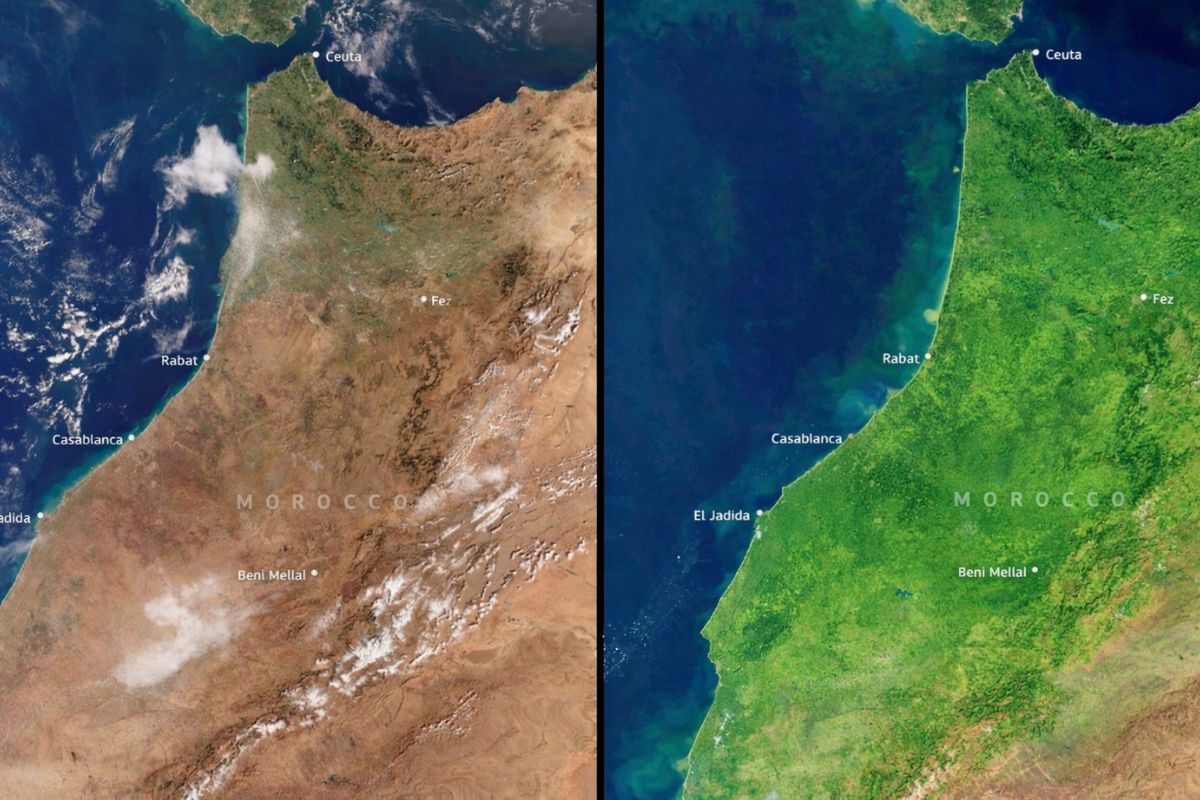
Satellite images show that Morocco became so green in 2026 that the country looks different from space: two months of heavy rains transformed arid land into dense vegetation for the first time in a decade.
-
Archaeologists were excavating the foundation of a historic house in Russia when they discovered a buried treasure with gold coins, left behind in the final days of the Russian Empire and now valued at over R$ 2.8 million.

-
The Mediterranean has become the target of the largest underwater archaeological mission ever coordinated by UNESCO: eight countries have joined forces to map shipwrecks and protect a historic corridor.

Researchers explain that this is a typical divergent boundary environment, in which the continental crust is gradually stretched and thinned, creating deep valleys and unstable structures over thousands of kilometers.
Although the process is slow on the human time scale, specific events help illustrate how the crust can deform rapidly in certain areas.
Experts emphasize, however, that these occurrences do not signify an immediate break of the continent, but rather localized episodes within a phenomenon that has been developing for tens of millions of years.
East African Rift: Origin and Dimension of the Geological System
The East African Rift is considered one of the largest active continental rift systems on the planet.
According to descriptions from the Geological Society of London, its extent reaches about 3,500 kilometers, from the region of the Red Sea to Southeast Africa, with two major main branches developing at distinct rates.
In this context, the Somali Plate, located to the east, has been slowly moving away from the Nubian Plate, which forms the majority of the African continent.
At the northern extreme, this movement connects to the divergence of the Arabian Plate, creating an area known as the Afar Triple Junction, frequently cited in studies on plate tectonics.
Research indicates that the thinning of the lithosphere in this region is associated both with the mechanical stretching of the crust and the rise of hot material from the mantle.
Still, scientists highlight that there are ongoing debates regarding the relative weight of each of these factors in the evolution of the rift.
Rate of Separation Between the African Plates
The idea that Africa is “splitting in half” is often simplified in popular content.
From a scientific perspective, what is observed is a gradual separation between tectonic plates and subplates, measured in millimeters or a few centimeters per year, depending on the segment being analyzed.
Recent studies indicate that in areas in the northern part of the system, especially near Afar, the opening rates can vary between about 16 and 20 millimeters per year.
In other parts of the rift, the rate is slower, which helps explain why the effects of the process are not uniform across the entire region.
According to geologists, this variation directly influences the local landscape, the distribution of earthquakes, and the presence of volcanism.
It is also one of the factors determining which areas may evolve more rapidly to advanced stages of rifting.
2005 Fissure in Ethiopia and What the Scientific Records Say
One of the most cited events in reports about the East African Rift occurred in 2005, in the Afar region of northern Ethiopia.
That year, a sequence of earthquakes and volcanic activity led to the opening of fissures on the surface, associated with magma intrusion into the crust, according to records from the Global Volcanism Program, linked to the Smithsonian Institution.
A National Geographic report describes that the fractures developed over the course of days, in a context of intense seismic and eruptive activity.
Experts explain that this type of episode represents a rapid release of accumulated tensions, something uncommon on the human scale, but compatible with active rifting environments.
On social media, the episode is often summarized as a “60-kilometer fissure opened in minutes.”
However, authoritative scientific and journalistic sources do not describe a continuous rupture of that length occurring instantaneously.
The available data point to a rapid process in geological terms, but distributed over successive events within a short time frame.
Formation of a New Ocean in Eastern Africa
The possibility of forming a new ocean is directly linked to the continuity of rifting and the progressive thinning of the crust.
According to the Geological Society of London, if the process advances, the valley could sink to the point that it allows sea water to enter, leading to the creation of a narrow ocean between the Nubian and Somali Plates.
Researchers emphasize that this scenario is not immediate and depends on millions of years of tectonic evolution.
Furthermore, the development does not occur uniformly along the entire extent of the rift.
Studies cited by National Geographic indicate that the northern sector, with a greater influence of volcanic processes, may show earlier signs of transition to an oceanic environment.
Geologist Lucia Perez Diaz, from Royal Holloway, University of London, states in interviews that regional differences are decisive for understanding how and where rifting may evolve more rapidly, without this representing a defined timeline for the opening of a new ocean.
With a process that combines continuous slowness and specific episodes of rapid deformation, what impacts could this tectonic movement bring, in the long term, to the populations and infrastructures located along the East African Rift?







Não acho nada demais. O planeta Terra sendo o planeta Terra.
Não acho nada de ****. O planeta Terra sendo o planeta Terra.
Como é fácil manipular as pessoas em um mundo globalizado.
Telescópios que acham planetas milhões de anos luz da terra, o telescópio james woebb consegue detectar tudo desse planeta, descobre galáxias do começo do universo, sendo que ele não consegue saber nem a composição do cometa A/31, não consegue saber a rota do asteroide e nem o tamanho dele previsto para cair aqui na terra ou na lua.
Aí agora vem os Cientistas dando um alarme que o Continente Africano vai ter um novo oceano que vai partir a África ao meio daqui a milhões de anos.
Sendo que não conseguem nem saber a previsão do tempo para amanhã.
Isso é uma palhaçada.
Quem dera que esse oceano viesse e rasgace a África ao meio, tem de acelerar porque já tem outros discutindo o colapso da civilização antes do ano de 2100.
Vou fazer uma previsão.
Daqui a 120 anos não restará nenhum ser vivo de nasceu no século XX,
A reportagem é muito bem escrita, mas o que a ciência diz, não condiz com nossas vidas.
Kkkkk boa mas quem viver verá ne amigo tudo e tão imprevisível e certeiro ao mesmo tempo mas são tempos conflitantes o tempo que vivemos hoje!
Somos manipulados a centenas de anos o grande engano da humanidade está chegando muitas coisas acontecendo ao mesmo tempo a humanidade vai estar apavorada com tantas catástrofes é só a biblia se cumprindo , 3iatlas é uma invenção eles vão usar isso pra enganar a todos fora oq já está sendo feito aqui no terra o juízo de Deus a justiça de Deus está chegando , se ele bater na porta irão abrir?